Miso Soup
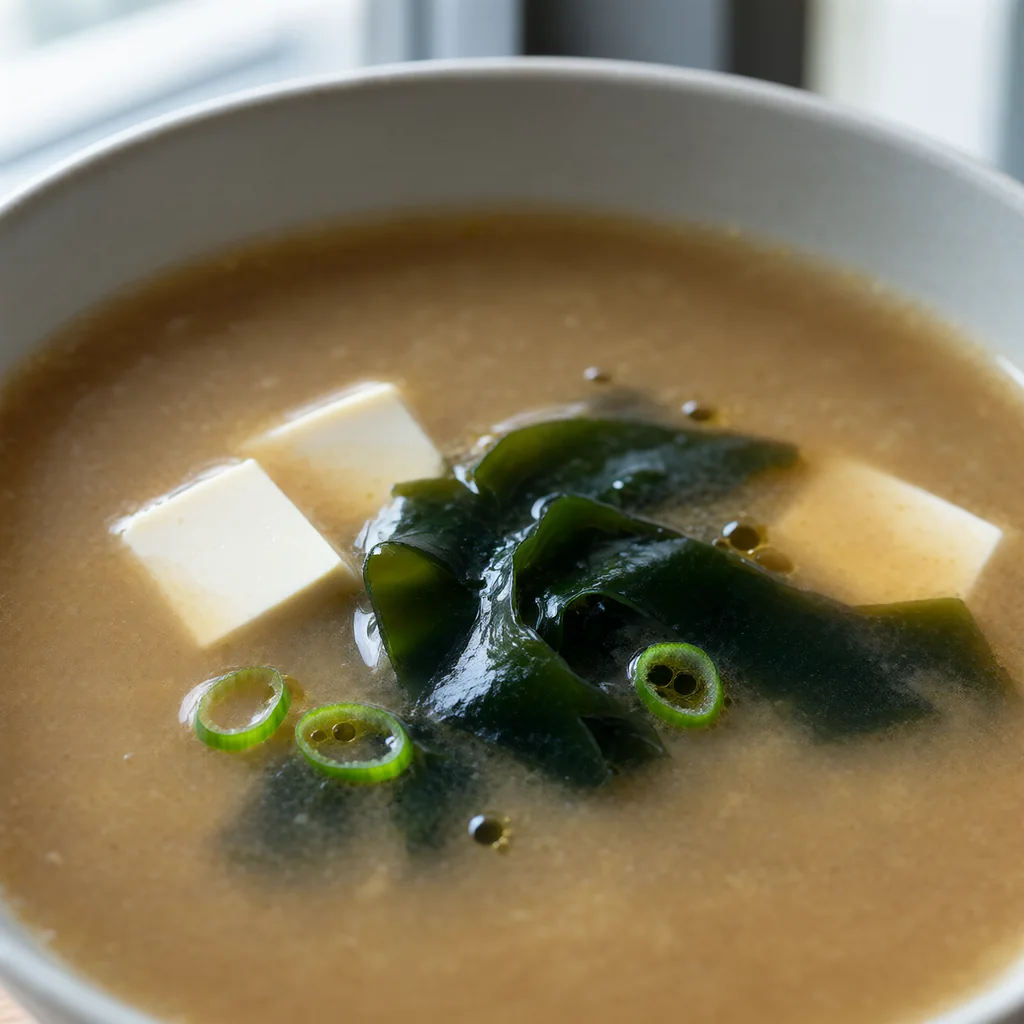
The common home version: dashi stock made from kombu and bonito flakes, with white miso, tofu, wakame and scallion. The broth is light, cloudy and salty, with a deep umami flavor.
- 4 servings
- 25 min in total
- Japanese
- Gluten-free
- Dairy-free
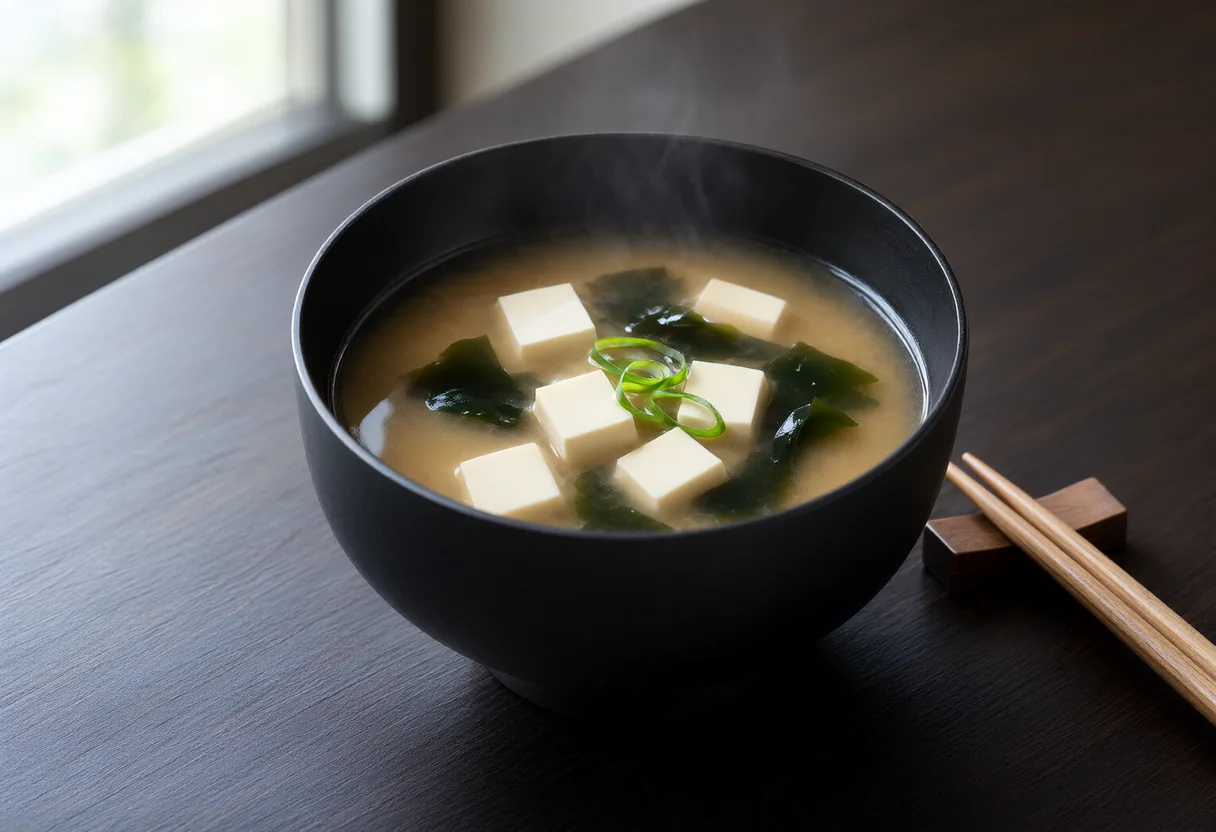
The common home version: dashi stock made from kombu and bonito flakes, with white miso, tofu, wakame and scallion. The broth is light, cloudy and salty, with a deep umami flavor.
Serves 4. Prep 10 min, cook 15 min.
Keeps 2 days in a covered container in the fridge. Reheat gently in a pan until steaming, without boiling, and stir before serving.
One portion is 205 g (a 4-serving recipe, 820 g cooked). By portion, per 100 g or for any weight: calories in Miso Soup.
| Nutrient | Per portion | Per 100 g | % DV |
|---|---|---|---|
| Energy and macronutrients | |||
| Energy | 70 kcal | 34.2 kcal | 4% |
| Protein | 5.7 g | 2.8 g | 11% |
| Carbohydrate | 6.2 g | 3 g | 2% |
| of which sugars | 1.6 g | 0.78 g | |
| Fiber | 1.3 g | 0.65 g | 5% |
| Fat | 3 g | 1.5 g | 4% |
| of which saturated | 0.47 g | 0.23 g | 2% |
| of which monounsaturated | 0.62 g | 0.3 g | |
| of which polyunsaturated | 1.6 g | 0.78 g | |
| Cholesterol | 0 mg | 0 mg | 0% |
| Minerals | |||
| Sodium | 762 mg | 372 mg | 33% |
| Potassium | 102 mg | 49.5 mg | 2% |
| Calcium | 152 mg | 74.2 mg | 12% |
| Iron | 2.6 mg | 1.3 mg | 14% |
| Magnesium | 24.2 mg | 11.8 mg | 6% |
| Phosphorus | 70.6 mg | 34.5 mg | 6% |
| Zinc | 0.85 mg | 0.41 mg | 8% |
| Copper | 0.18 mg | 0.09 mg | 20% |
| Manganese | 0.42 mg | 0.2 mg | 18% |
| Selenium | 4.8 µg | 2.3 µg | 9% |
| Vitamins | |||
| Vitamin A (RAE) | 3.4 µg | 1.7 µg | 0% |
| Vitamin C | 1 mg | 0.49 mg | 1% |
| Vitamin D | 0 µg | 0 µg | 0% |
| Vitamin E | 0.04 mg | 0.02 mg | 0% |
| Vitamin K | 17.1 µg | 8.4 µg | 14% |
| Thiamin (B1) | 0.05 mg | 0.03 mg | 4% |
| Riboflavin (B2) | 0.07 mg | 0.04 mg | 6% |
| Niacin (B3) | 0.29 mg | 0.14 mg | 2% |
| Pantothenic acid (B5) | 0.1 mg | 0.05 mg | 2% |
| Vitamin B6 | 0.06 mg | 0.03 mg | 4% |
| Folate (DFE) | 14.1 µg | 6.9 µg | 4% |
| Vitamin B12 | 0.02 µg | 0.01 µg | 1% |
| Choline | 25.6 mg | 12.5 mg | 5% |
Calculated from the weights in the ingredient list with USDA FoodData Central (SR Legacy) values; only what is eaten counts (drained oil, rinds and similar are left out). Vitamin losses in cooking are not modelled, and “≥” marks a value that is a lower bound because the table has no figure for some ingredients. % DV uses the FDA reference values for adults. Real dishes vary with ingredients and portion size.
Photograph a meal and Flog works out the nutrition for you, including the 25+ vitamins and minerals shown here. Free on iPhone, no account.