Ingredients
Serves 4. Prep 25 min, cook 75 min.
Broth
- 1100 ml (1100 g) water
- one 10 cm piece (8 g) dried kombu
- 1 large handful (15 g) bonito flakes (katsuobushi)
- 3 tbsp (50 g) light soy sauce
- 2 tbsp (36 g) mirin
- 3 tbsp (50 g) sake
- 3/4 tsp (4 g) salt
Simmered pieces
- 300 g, cut into 4 rounds 2 cm thick daikon radish, peeled
- 4 large (about 200 g peeled) eggs, hard-boiled and peeled
- 1 block (about 200 g), cut into 4 triangles konnyaku block
- 4 tubes (about 120 g) chikuwa (fish cake tubes)
- 200 g, cut into 4 pieces satsuma-age (fried fish cake)
- 1 block (about 150 g), cut into 4 triangles atsuage (thick fried tofu)
To serve
- 2 tsp (8 g) karashi (Japanese hot mustard)
Method
- Put the water and kombu in a 24 cm pot (4 liter). Leave for 30 minutes.
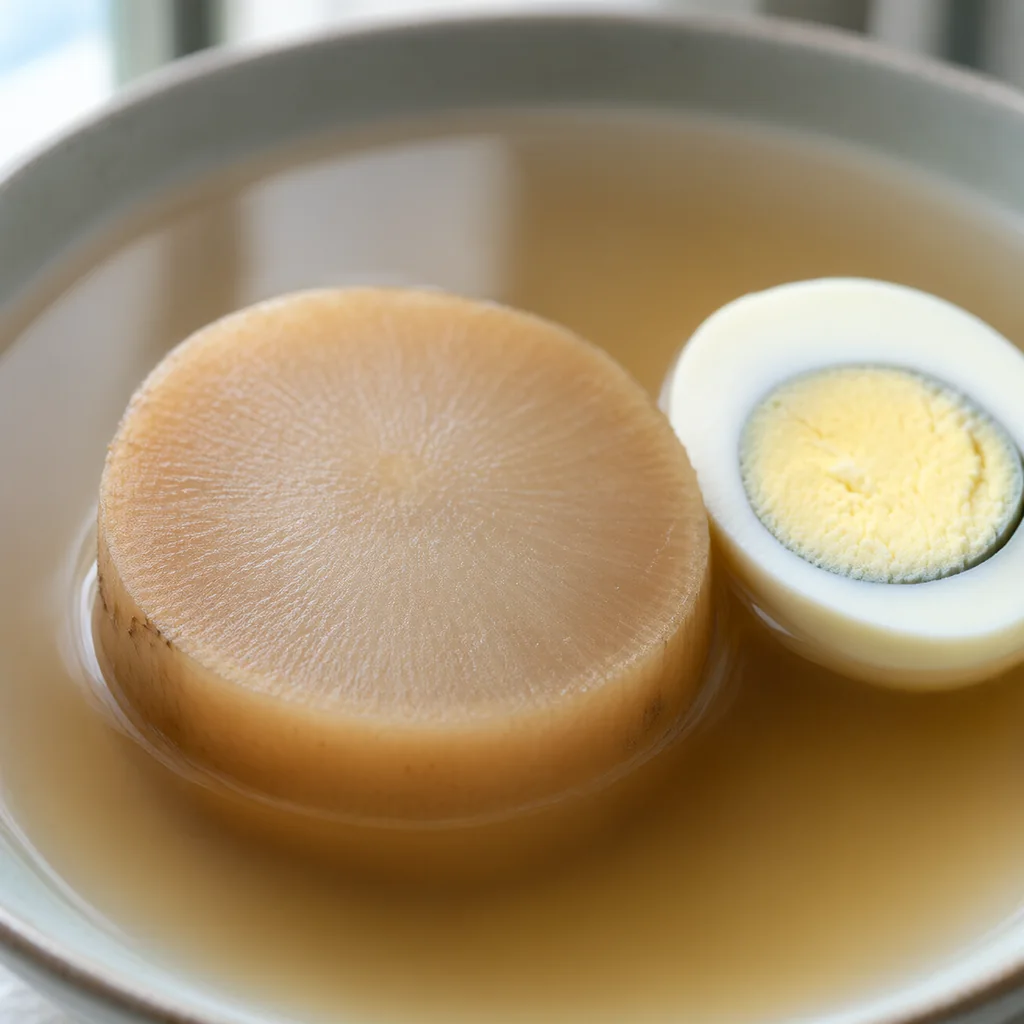
- Meanwhile, peel the daikon and cut it into 4 rounds 2 cm thick. Shave the sharp edges off each round and cut a shallow cross on one side. Cover with water in a small pan, bring to a simmer, and cook for 15 to 20 minutes, until a skewer slides in with little resistance. Drain.
- Boil the eggs in a separate pan of boiling water for 10 minutes. Cool in ice water and peel.
- Cut the konnyaku into 4 triangles and score the top lightly. Boil in water for 3 minutes, then drain. This removes its smell.
- Put the chikuwa, satsuma-age and atsuage in a colander and pour boiling water over them to wash off the surface oil. Cut each chikuwa in half on a diagonal. Cut the satsuma-age into 4 pieces.
- Heat the kombu pot over medium heat until small bubbles rise at the edge, about 8 minutes. Take out the kombu before the water boils. Add the bonito flakes, bring to a bare simmer, switch off the heat, and leave for 2 minutes. Strain the broth back into the pot.
- Add the soy sauce, mirin, sake and salt. Add the daikon, konnyaku and eggs and bring to a gentle simmer. Cook for 20 minutes with the lid ajar. The surface should only tremble.
- Add the chikuwa, satsuma-age and atsuage. Simmer for 20 more minutes.
- Turn off the heat, cover, and leave for 30 minutes so the pieces take up the broth. Reheat gently without boiling.
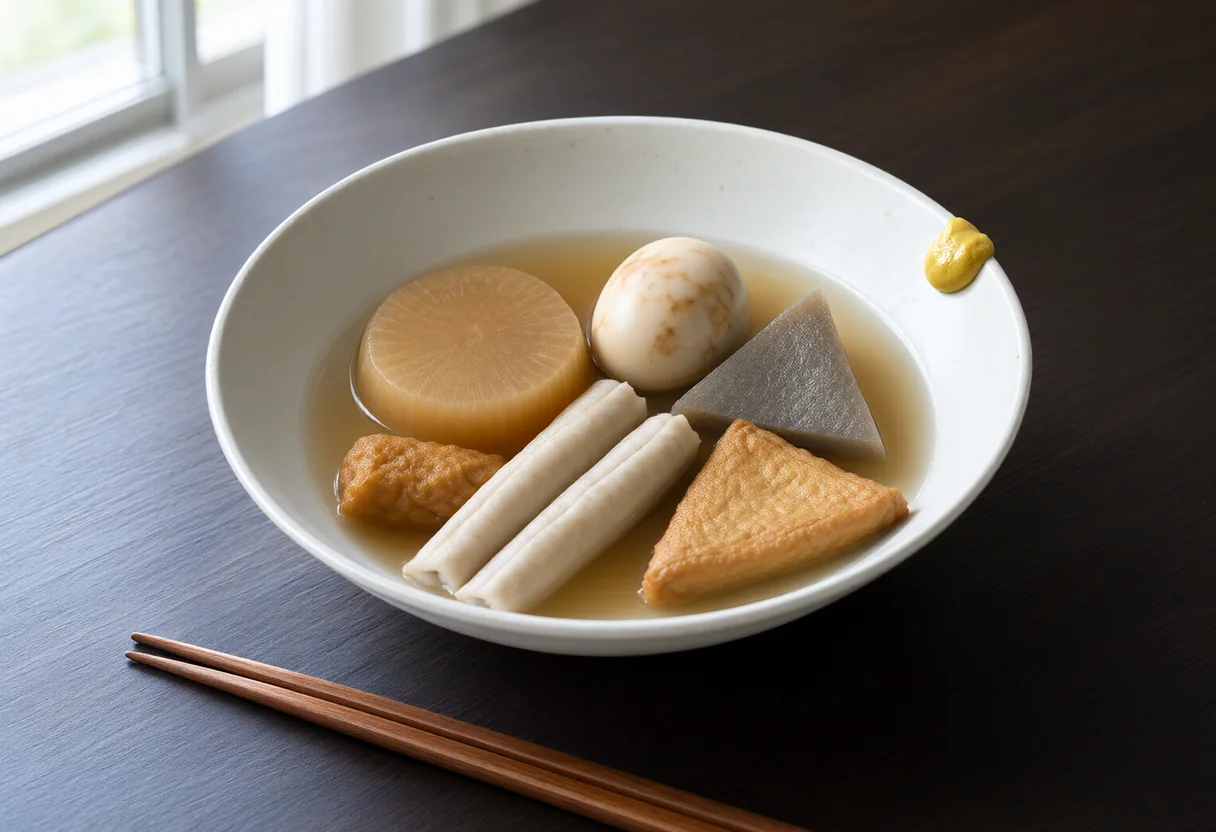
- Serve each person 1 piece of each kind (2 halves of chikuwa) in a deep bowl with about 80 g of broth. Put a little karashi on the rim.
Nutrition facts
One portion is 375 g (a 4-serving recipe, 1500 g cooked). By portion, per 100 g or for any weight: calories in Oden.
| Nutrient | Per portion | Per 100 g | % DV |
|---|
| Energy and macronutrients |
|---|
| Energy | 297 kcal | 79.2 kcal | 15% |
|---|
| Protein | 26.6 g | 7.1 g | 53% |
|---|
| Carbohydrate | 16.7 g | 4.5 g | 6% |
|---|
| of which sugars | 3.8 g | 1 g | |
|---|
| Fiber | 3 g | 0.81 g | 11% |
|---|
| Fat | 13.8 g | 3.7 g | 18% |
|---|
| of which saturated | 2.9 g | 0.78 g | 15% |
|---|
| of which monounsaturated | 3.9 g | 1 g | |
|---|
| of which polyunsaturated | 5.4 g | 1.4 g | |
|---|
| Cholesterol | 210 mg | 56.1 mg | 70% |
|---|
| Minerals |
|---|
| Sodium | 532 mg | 142 mg | 23% |
|---|
| Potassium | 513 mg | 137 mg | 11% |
|---|
| Calcium | 225 mg | 60 mg | 17% |
|---|
| Iron | 4 mg | 1.1 mg | 22% |
|---|
| Magnesium | 113 mg | 30 mg | 27% |
|---|
| Phosphorus | 448 mg | 119 mg | 36% |
|---|
| Zinc | 2 mg | 0.53 mg | 18% |
|---|
| Copper | 0.31 mg | 0.08 mg | 35% |
|---|
| Manganese | 0.85 mg | 0.23 mg | 37% |
|---|
| Selenium | 50.2 µg | 13.4 µg | 91% |
|---|
| Vitamins |
|---|
| Vitamin A (RAE) | 91 µg | 24.3 µg | 10% |
|---|
| Vitamin C | 16.5 mg | 4.4 mg | 18% |
|---|
| Vitamin D | 1.1 µg | 0.29 µg | 6% |
|---|
| Vitamin E | 1.5 mg | 0.39 mg | 10% |
|---|
| Vitamin K | 4.6 µg | 1.2 µg | 4% |
|---|
| Thiamin (B1) | 0.14 mg | 0.04 mg | 11% |
|---|
| Riboflavin (B2) | 0.33 mg | 0.09 mg | 25% |
|---|
| Niacin (B3) | 0.52 mg | 0.14 mg | 3% |
|---|
| Pantothenic acid (B5) | 1.1 mg | 0.29 mg | 22% |
|---|
| Vitamin B6 | 0.18 mg | 0.05 mg | 11% |
|---|
| Folate (DFE) | 97.9 µg | 26.1 µg | 24% |
|---|
| Vitamin B12 | 1.8 µg | 0.49 µg | 76% |
|---|
| Choline | 197 mg | 52.4 mg | 36% |
|---|
Calculated from the weights in the ingredient list with USDA FoodData Central (SR Legacy) values; only what is eaten counts (drained oil, rinds and similar are left out). Vitamin losses in cooking are not modelled, and “≥” marks a value that is a lower bound because the table has no figure for some ingredients. % DV uses the FDA reference values for adults. Real dishes vary with ingredients and portion size.