Ingredients
Serves 4. Prep 55 min, cook 20 min.
Filling (for 40 gyoza)
- 180 g ground pork (about 20% fat)
- 400 g (about 1/4 head), minced napa cabbage, minced
- 1 tsp (5 g) salt, for the cabbage
- 40 g (1 small bunch), minced garlic chives (or scallions), minced
- 2 cm piece (8 g), grated ginger, fresh
- 2 cloves (6 g), grated garlic
- 1 tbsp (17 g) soy sauce
- 2 tsp (10 g) sake
- 2 tsp (9 g) toasted sesame oil
- 1/2 tsp (1 g) white pepper, ground
Wrappers and frying
- 40 wrappers (about 240 g) gyoza wrappers, round, 8.5 cm
- 2 tbsp (27 g), 2 tsp per batch vegetable oil, for frying in 3 batches
Dipping sauce
- 2 tbsp (34 g) soy sauce
- 2 tbsp (30 g) rice vinegar
- 1 tsp (4 g) chili oil
Method
- Toss the minced cabbage with 5 g salt in a bowl and leave for 15 minutes. Squeeze it hard by the handful, or in a clean towel, until about 200 g of cabbage is left. Discard the liquid.
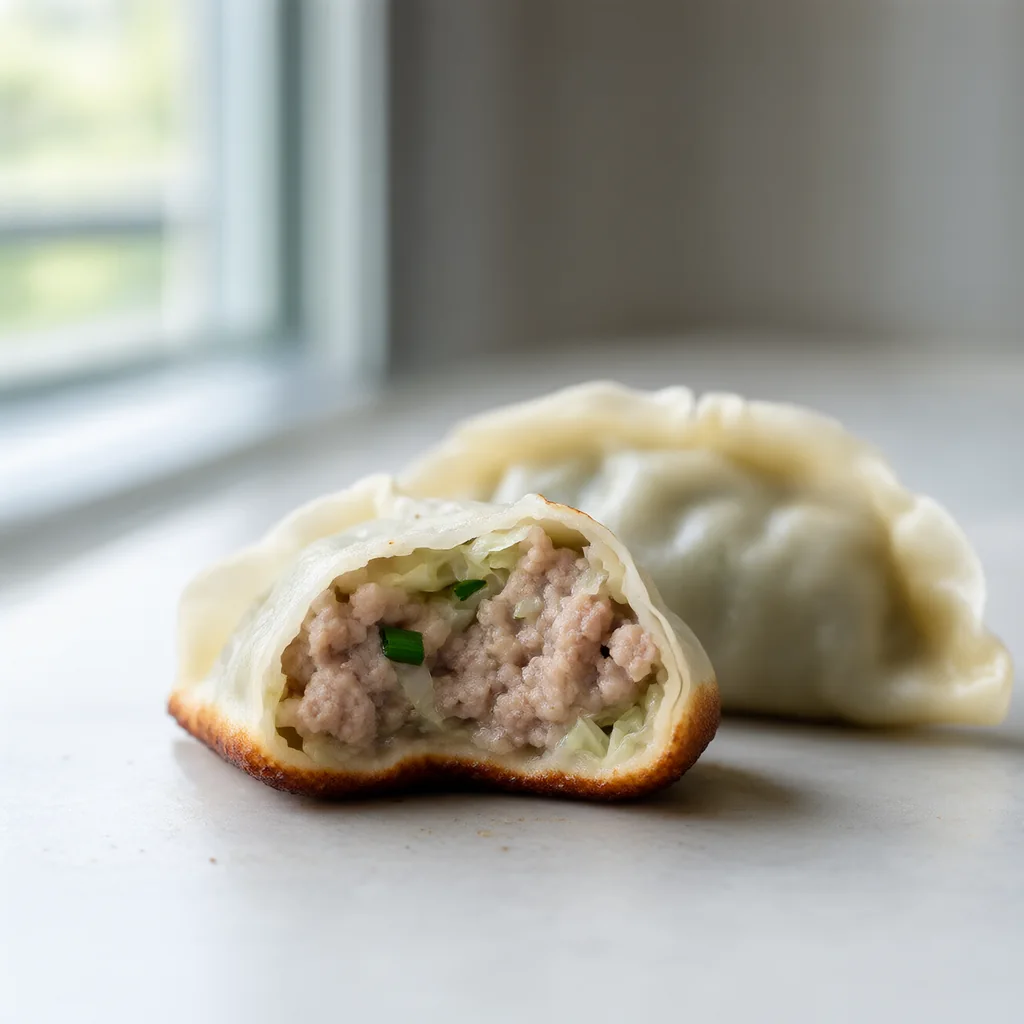
- In a large bowl, mix the pork, garlic chives, ginger, garlic, soy sauce, sake, sesame oil and pepper with your hand for 1 minute, in one direction, until the meat turns sticky. Mix in the cabbage. Chill the filling for 20 minutes.
- Put 1 level tablespoon of filling (about 12 g) in the middle of a wrapper. Wet half of the rim with a finger dipped in water. Fold the wrapper in half and pinch the center closed, then make 4 or 5 small pleats along the front edge, pressing each against the back edge. The base should be flat so the gyoza can stand. Set on a tray dusted with flour. Repeat to make 40.
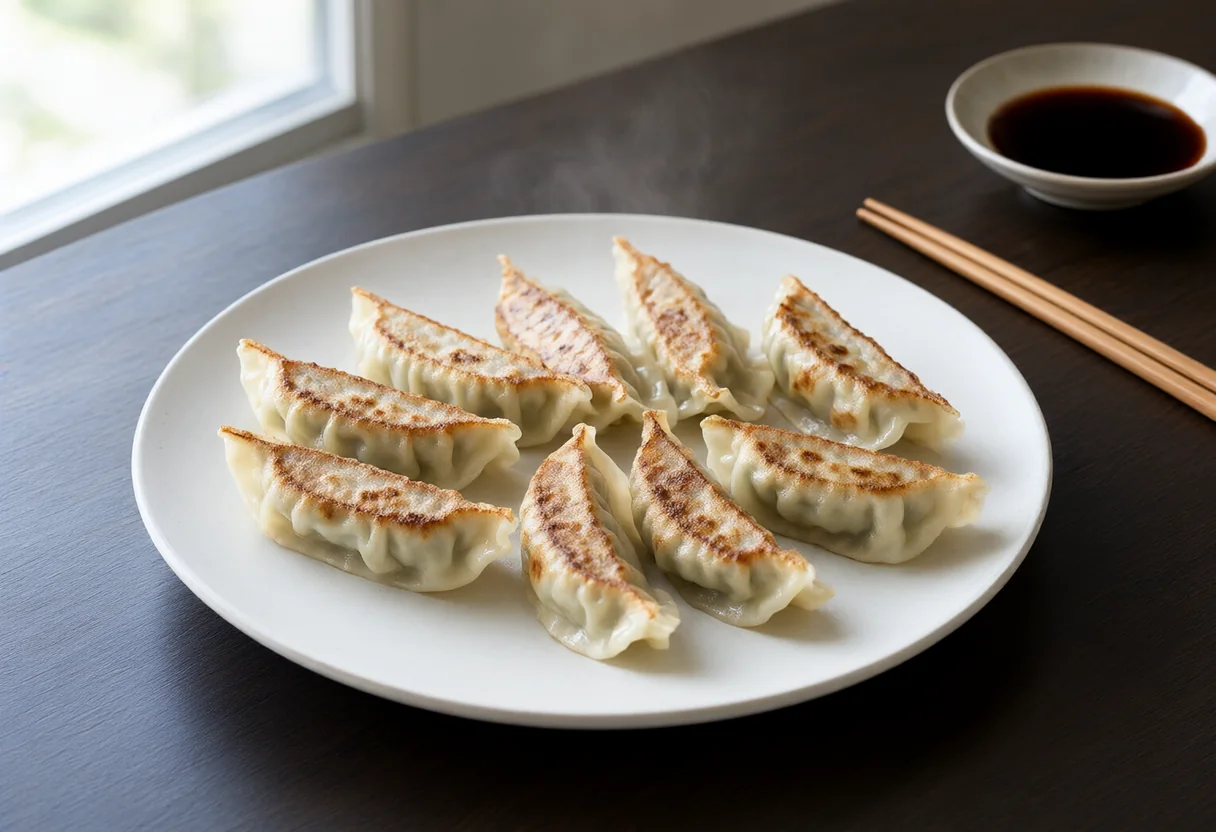
- Heat 2 teaspoons of the oil in a 28 cm nonstick skillet with a lid over medium-high heat. Add 13 or 14 gyoza, flat side down, close but not touching. Fry for 2 minutes, until the bottoms are golden.
- Pour in 70 ml of water and cover at once. Turn the heat to medium and steam for 4 minutes, until the wrappers look translucent and the filling is firm.
- Uncover and cook over medium heat for 1 to 2 minutes more, until the water has gone and the bottoms are crisp and deep golden. Slide onto a plate. Wipe the pan and repeat for 2 more batches.
- Mix the dipping sauce ingredients. Serve 10 gyoza per person, crisp side up, with the sauce in small dishes.
Nutrition facts
One portion is 196 g (a 4-serving recipe, 784 g cooked). By portion, per 100 g or for any weight: calories in Gyoza.
| Nutrient | Per portion | Per 100 g | % DV |
|---|
| Energy and macronutrients |
|---|
| Energy | 377 kcal | 193 kcal | 19% |
|---|
| Protein | 15.6 g | 8 g | 31% |
|---|
| Carbohydrate | 38.6 g | 19.7 g | 14% |
|---|
| of which sugars | ≥ 0.99 g | ≥ 0.51 g | |
|---|
| Fiber | 2.2 g | 1.1 g | 8% |
|---|
| Fat | 17.2 g | 8.8 g | 22% |
|---|
| of which saturated | 4.7 g | 2.4 g | 24% |
|---|
| of which monounsaturated | 6.3 g | 3.2 g | |
|---|
| of which polyunsaturated | 4.7 g | 2.4 g | |
|---|
| Cholesterol | 37.8 mg | 19.3 mg | 13% |
|---|
| Minerals |
|---|
| Sodium | 1,270 mg | 647 mg | 55% |
|---|
| Potassium | 398 mg | 203 mg | 8% |
|---|
| Calcium | 90.8 mg | 46.3 mg | 7% |
|---|
| Iron | 3 mg | 1.5 mg | 17% |
|---|
| Magnesium | 42.4 mg | 21.6 mg | 10% |
|---|
| Phosphorus | 173 mg | 88.1 mg | 14% |
|---|
| Zinc | 1.7 mg | 0.88 mg | 16% |
|---|
| Copper | 0.16 mg | 0.08 mg | 18% |
|---|
| Manganese | 0.69 mg | 0.35 mg | 30% |
|---|
| Selenium | 28.8 µg | 14.7 µg | 52% |
|---|
| Vitamins |
|---|
| Vitamin A (RAE) | 33.1 µg | 16.9 µg | 4% |
|---|
| Vitamin C | 20.2 mg | 10.3 mg | 22% |
|---|
| Vitamin D | ≥ 0 µg | ≥ 0 µg | 0% |
|---|
| Vitamin E | ≥ 0.47 mg | ≥ 0.24 mg | 3% |
|---|
| Vitamin K | ≥ 50.9 µg | ≥ 26 µg | 42% |
|---|
| Thiamin (B1) | 0.68 mg | 0.34 mg | 56% |
|---|
| Riboflavin (B2) | 0.39 mg | 0.2 mg | 30% |
|---|
| Niacin (B3) | 5.8 mg | 3 mg | 36% |
|---|
| Pantothenic acid (B5) | 0.45 mg | 0.23 mg | 9% |
|---|
| Vitamin B6 | 0.36 mg | 0.18 mg | 21% |
|---|
| Folate (DFE) | 135 µg | 68.7 µg | 34% |
|---|
| Vitamin B12 | 0.33 µg | 0.17 µg | 14% |
|---|
| Choline | ≥ 7.6 mg | ≥ 3.9 mg | 1% |
|---|
Calculated from the weights in the ingredient list with USDA FoodData Central (SR Legacy) values; only what is eaten counts (drained oil, rinds and similar are left out). Vitamin losses in cooking are not modelled, and “≥” marks a value that is a lower bound because the table has no figure for some ingredients. % DV uses the FDA reference values for adults. Real dishes vary with ingredients and portion size.