Ingredients
Serves 2. Prep 15 min, cook 20 min.
Gnocchi
- 500 g (one standard package) potato gnocchi, packaged
Salmon
- 180 g, cut into 3 cm cubes salmon fillet, skinless, cut into 3 cm cubes
- 2 tsp (10 g) olive oil
- 1/3 tsp (2 g) salt
Sauce
- 3 cloves (about 10 g), minced garlic, minced
- 100 ml (100 g) heavy cream
- 1 tbsp (15 g) lemon juice
- 150 ml (150 g) gnocchi cooking water, reserved
- 100 g frozen peas
- 80 g (2 big handfuls) baby spinach
- 20 g (about 1/4 cup) Parmesan, finely grated
- 1/3 tsp (2 g) salt
To serve
- 1/4 tsp (1 g) black pepper, ground
- 2 tbsp (5 g) fresh dill, chopped
Method
- Bring a large pot of water to a boil and salt it well, 1 tablespoon of salt per 2 liters. Pat the salmon cubes dry and sprinkle them with 2 g (1/3 tsp) of salt.
- Heat the oil in a 28 cm skillet over medium-high heat for 1 minute. Add the salmon and sear for 1 minute on each of 2 sides, until the outside turns opaque and light golden. The center will still be raw. Move the salmon to a plate.
- Lower the heat to medium. Add the garlic to the same skillet and stir for 30 seconds, until fragrant but not browned.
- Pour in the cream, lemon juice and peas. Simmer gently for 3 minutes, until the cream thickens slightly.
- Meanwhile, drop the gnocchi into the boiling water. Cook until they float, 2 to 3 minutes, then 30 seconds more. Lift them out with a slotted spoon. Keep 150 ml of the cooking water.
- Add the spinach to the skillet and stir for 1 minute, until wilted. Add the gnocchi, 100 ml of the reserved water, the Parmesan and the other 2 g (1/3 tsp) of salt. Toss gently for 1 minute.
- Slide the salmon back in with any juices. Fold gently for 1 to 2 minutes, adding up to 50 ml more water if the sauce is tight, until the salmon flakes easily and is just cooked through.
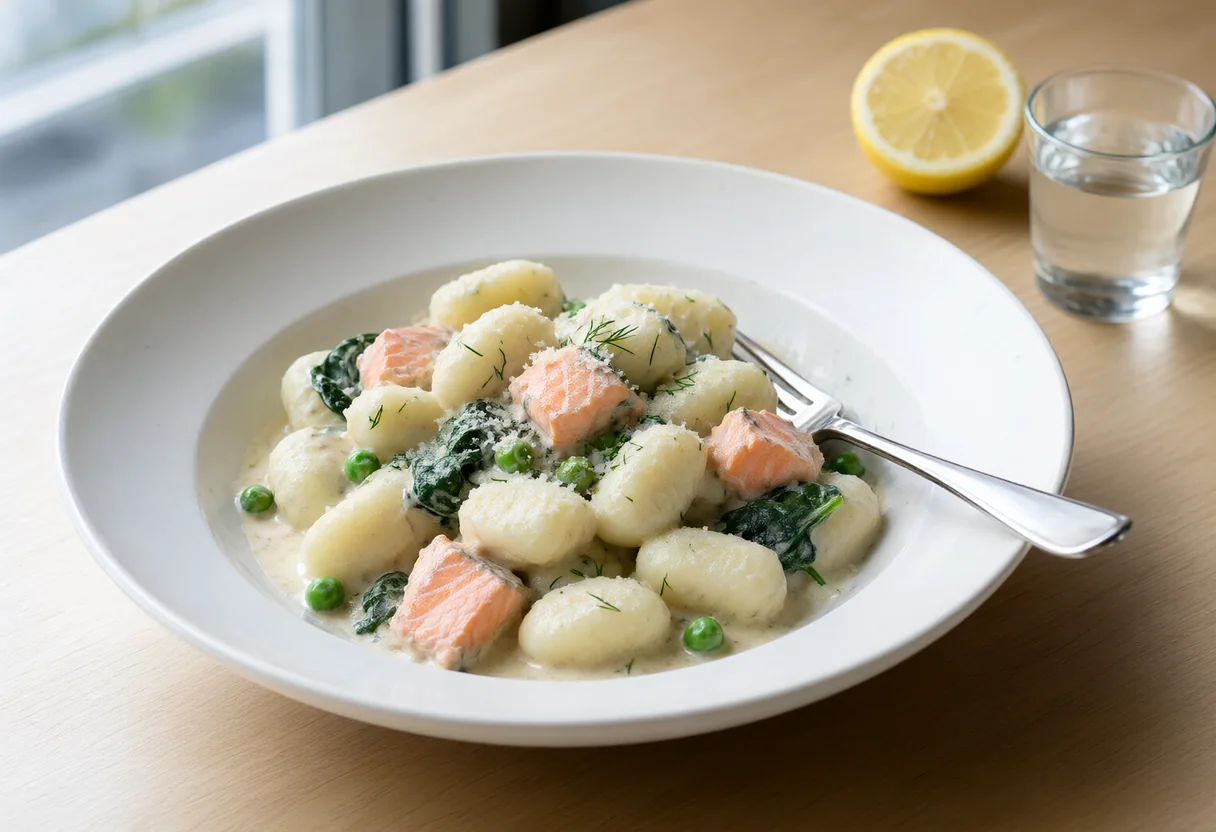
- Serve at once, with the pepper and dill.
Nutrition facts
One portion is 510 g (a 2-serving recipe, 1020 g cooked). By portion, per 100 g or for any weight: calories in Salmon Gnocchi.
| Nutrient | Per portion | Per 100 g | % DV |
|---|
| Energy and macronutrients |
|---|
| Energy | 830 kcal | 163 kcal | 42% |
|---|
| Protein | 39.8 g | 7.8 g | 80% |
|---|
| Carbohydrate | 76.1 g | 14.9 g | 28% |
|---|
| of which sugars | ≥ 4.4 g | ≥ 0.86 g | |
|---|
| Fiber | ≥ 3.4 g | ≥ 0.67 g | 12% |
|---|
| Fat | 41 g | 8 g | 53% |
|---|
| of which saturated | 16.9 g | 3.3 g | 85% |
|---|
| of which monounsaturated | 12.7 g | 2.5 g | |
|---|
| of which polyunsaturated | 6.2 g | 1.2 g | |
|---|
| Cholesterol | 197 mg | 38.6 mg | 66% |
|---|
| Minerals |
|---|
| Sodium | 1,130 mg | 221 mg | 49% |
|---|
| Potassium | 805 mg | 158 mg | 17% |
|---|
| Calcium | 212 mg | 41.5 mg | 16% |
|---|
| Iron | 5.4 mg | 1.1 mg | 30% |
|---|
| Magnesium | 126 mg | 24.6 mg | 30% |
|---|
| Phosphorus | 536 mg | 105 mg | 43% |
|---|
| Zinc | 3 mg | 0.58 mg | 27% |
|---|
| Copper | 0.43 mg | 0.08 mg | 48% |
|---|
| Manganese | 1.3 mg | 0.25 mg | 56% |
|---|
| Selenium | ≥ 28.6 µg | ≥ 5.6 µg | 52% |
|---|
| Vitamins |
|---|
| Vitamin A (RAE) | 548 µg | 107 µg | 61% |
|---|
| Vitamin C | 30.6 mg | 6 mg | 34% |
|---|
| Vitamin D | ≥ 10.8 µg | ≥ 2.1 µg | 54% |
|---|
| Vitamin E | ≥ 5.3 mg | ≥ 1 mg | 35% |
|---|
| Vitamin K | ≥ 213 µg | ≥ 41.8 µg | 178% |
|---|
| Thiamin (B1) | 0.9 mg | 0.18 mg | 75% |
|---|
| Riboflavin (B2) | 0.79 mg | 0.15 mg | 60% |
|---|
| Niacin (B3) | 11.6 mg | 2.3 mg | 72% |
|---|
| Pantothenic acid (B5) | 2.5 mg | 0.49 mg | 50% |
|---|
| Vitamin B6 | 0.87 mg | 0.17 mg | 51% |
|---|
| Folate (DFE) | 396 µg | 77.6 µg | 99% |
|---|
| Vitamin B12 | 3.5 µg | 0.68 µg | 145% |
|---|
| Choline | ≥ 103 mg | ≥ 20.3 mg | 19% |
|---|
Calculated from the weights in the ingredient list with USDA FoodData Central (SR Legacy) values; only what is eaten counts (drained oil, rinds and similar are left out). Vitamin losses in cooking are not modelled, and “≥” marks a value that is a lower bound because the table has no figure for some ingredients. % DV uses the FDA reference values for adults. Real dishes vary with ingredients and portion size.