Ingredients
Serves 4. Prep 15 min, cook 0 min.
Salad
- 2 balls (about 170 g each) burrata
- 700 g, cut in wedges and halves ripe tomatoes, mixed sizes
- 80 g (about 4 cups) arugula
Dressing
- 3 tbsp (40 g) extra virgin olive oil
- 1 tbsp (15 g) balsamic vinegar
- about 16 leaves (8 g) fresh basil leaves
- 3/4 tsp (4 g) flaky sea salt
- 1/2 tsp (1 g) black pepper, ground
Method
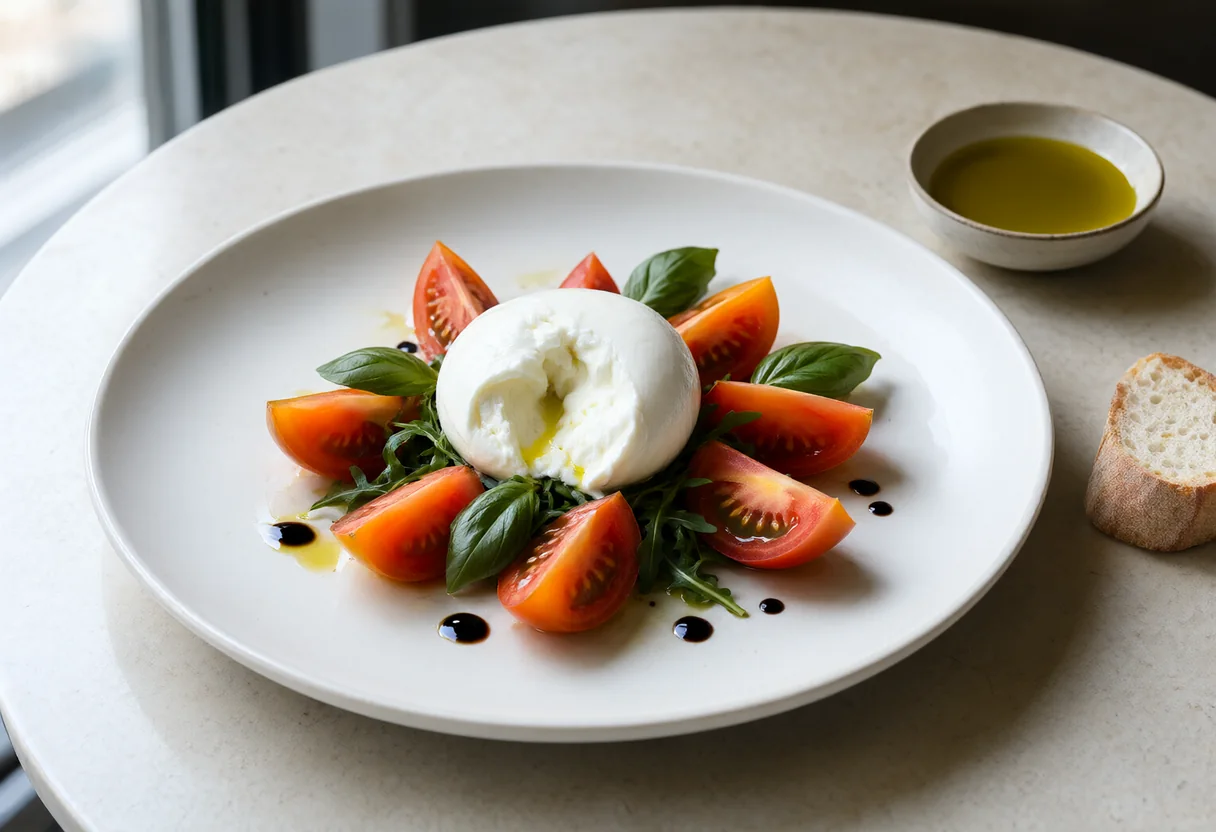
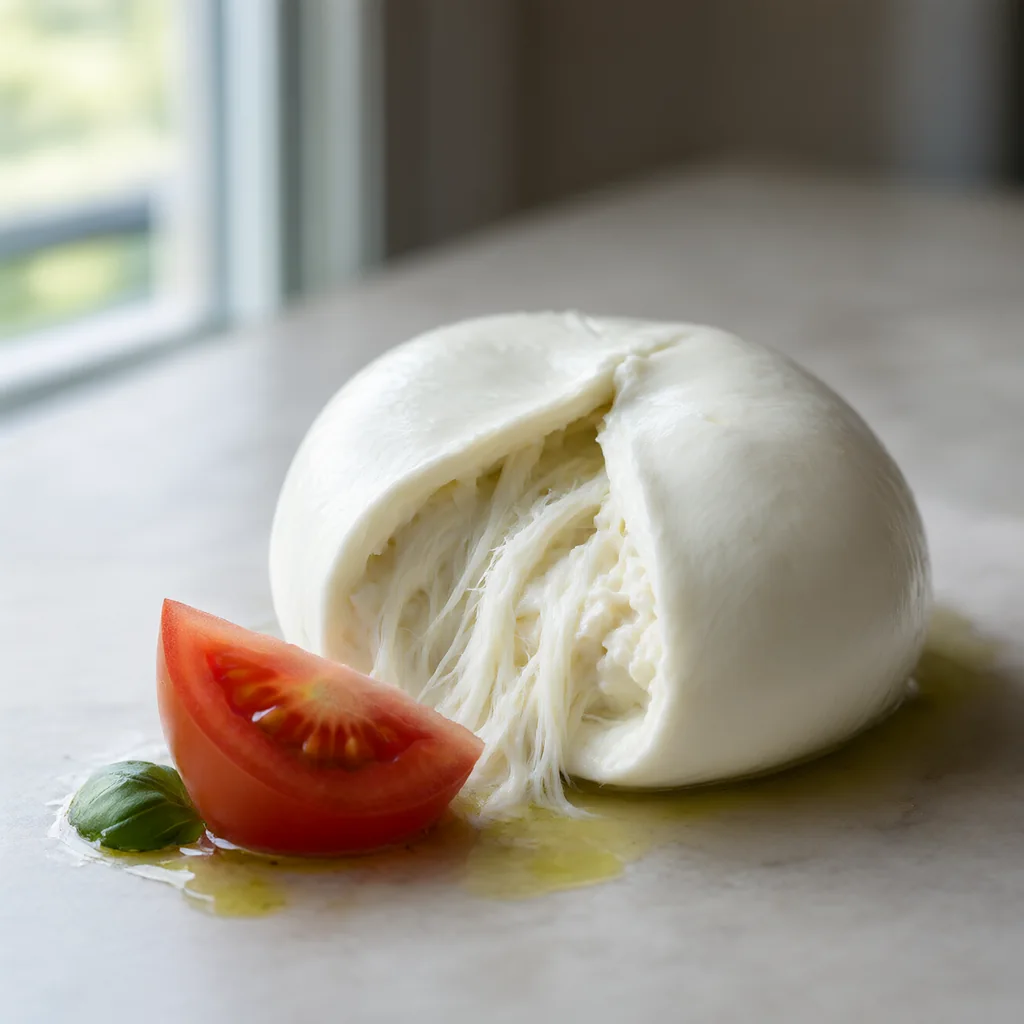
- Take the burrata out of the fridge 30 minutes before serving. Leave it in its liquid until you use it.
- Cut larger tomatoes into wedges about 3 cm thick and halve the small ones. Put them in a bowl, add the salt and mix. Leave for 10 minutes so they release their juices.
- Spread the arugula on a large platter. Spoon the tomatoes and all their juice over it.
- Lift the burrata from its liquid and set it on the tomatoes. Tear each ball open with your fingers so the creamy center spills out.
- Drizzle with the olive oil and the balsamic vinegar. Tear the basil over the top and finish with the pepper. Serve at once, with bread to soak up the juices.
Nutrition facts
One portion is 300 g (a 4-serving recipe, 1200 g cooked). By portion, per 100 g or for any weight: calories in Burrata Salad.
| Nutrient | Per portion | Per 100 g | % DV |
|---|
| Energy and macronutrients |
|---|
| Energy | 383 kcal | 128 kcal | 19% |
|---|
| Protein | 21 g | 7 g | 42% |
|---|
| Carbohydrate | 10.4 g | 3.5 g | 4% |
|---|
| of which sugars | 5.6 g | 1.9 g | |
|---|
| Fiber | 2.5 g | 0.84 g | 9% |
|---|
| Fat | 29.3 g | 9.8 g | 38% |
|---|
| of which saturated | 13.3 g | 4.4 g | 66% |
|---|
| of which monounsaturated | 13 g | 4.3 g | |
|---|
| of which polyunsaturated | 1.9 g | 0.64 g | |
|---|
| Cholesterol | 67.2 mg | 22.4 mg | 22% |
|---|
| Minerals |
|---|
| Sodium | 816 mg | 272 mg | 35% |
|---|
| Potassium | 567 mg | 189 mg | 12% |
|---|
| Calcium | 485 mg | 162 mg | 37% |
|---|
| Iron | 1.3 mg | 0.44 mg | 7% |
|---|
| Magnesium | 47.8 mg | 15.9 mg | 11% |
|---|
| Phosphorus | 356 mg | 119 mg | 28% |
|---|
| Zinc | 2.9 mg | 0.97 mg | 26% |
|---|
| Copper | 0.14 mg | 0.05 mg | 16% |
|---|
| Manganese | 0.35 mg | 0.12 mg | 15% |
|---|
| Selenium | 14.5 µg | 4.8 µg | 26% |
|---|
| Vitamins |
|---|
| Vitamin A (RAE) | 255 µg | 84.9 µg | 28% |
|---|
| Vitamin C | 27.3 mg | 9.1 mg | 30% |
|---|
| Vitamin D | 0.34 µg | 0.11 µg | 2% |
|---|
| Vitamin E | 2.6 mg | 0.88 mg | 18% |
|---|
| Vitamin K | 52.2 µg | 17.4 µg | 44% |
|---|
| Thiamin (B1) | 0.1 mg | 0.03 mg | 8% |
|---|
| Riboflavin (B2) | 0.29 mg | 0.1 mg | 23% |
|---|
| Niacin (B3) | 1.2 mg | 0.4 mg | 8% |
|---|
| Pantothenic acid (B5) | 0.37 mg | 0.12 mg | 7% |
|---|
| Vitamin B6 | 0.19 mg | 0.06 mg | 11% |
|---|
| Folate (DFE) | 53 µg | 17.7 µg | 13% |
|---|
| Vitamin B12 | 1.9 µg | 0.65 µg | 81% |
|---|
| Choline | 28.2 mg | 9.4 mg | 5% |
|---|
Calculated from the weights in the ingredient list with USDA FoodData Central (SR Legacy) values; only what is eaten counts (drained oil, rinds and similar are left out). Vitamin losses in cooking are not modelled, and “≥” marks a value that is a lower bound because the table has no figure for some ingredients. % DV uses the FDA reference values for adults. Real dishes vary with ingredients and portion size.