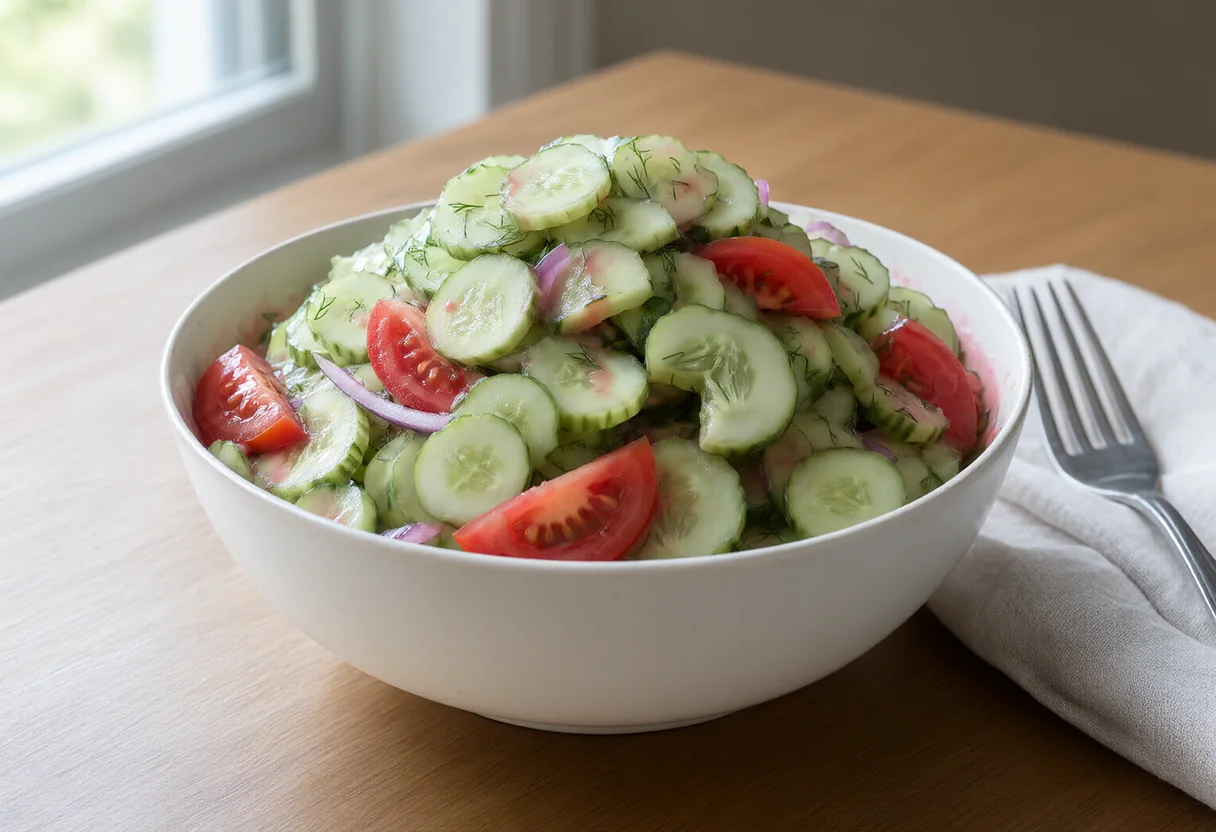
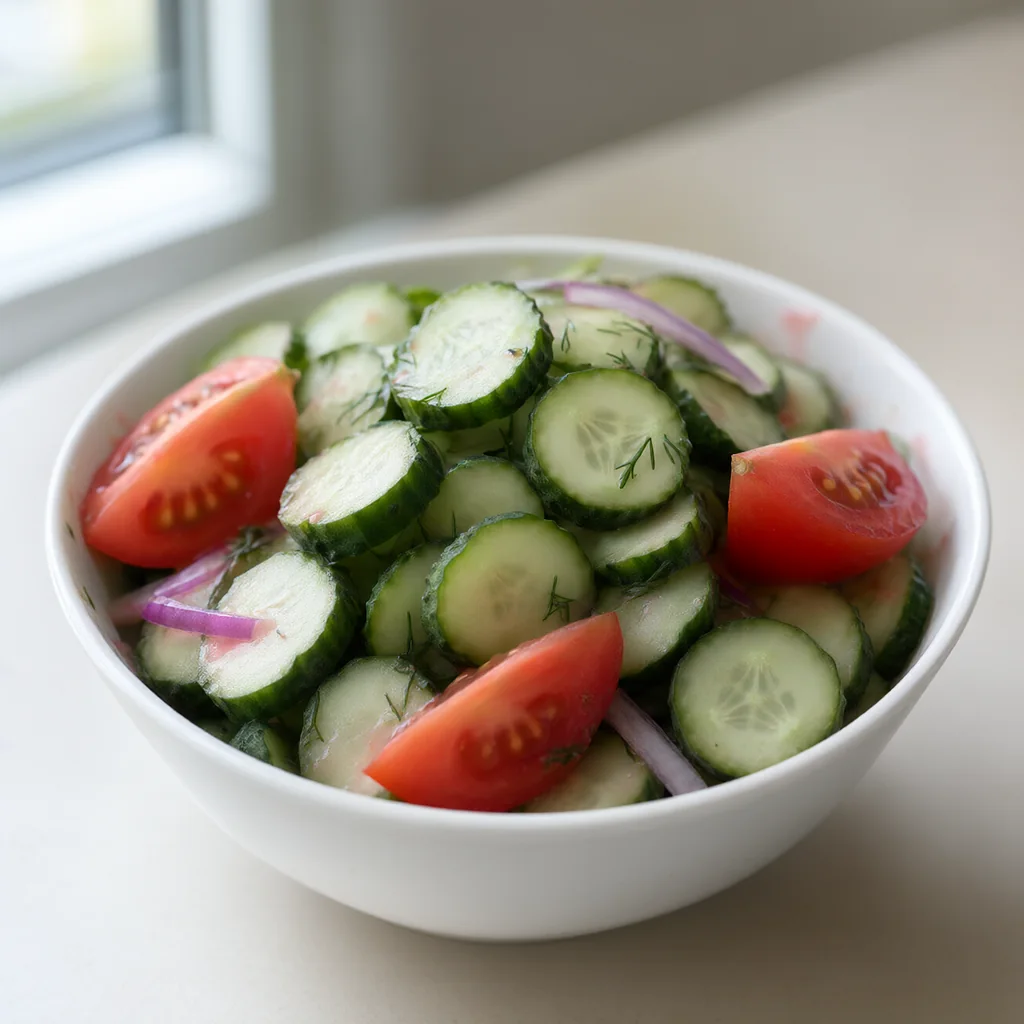
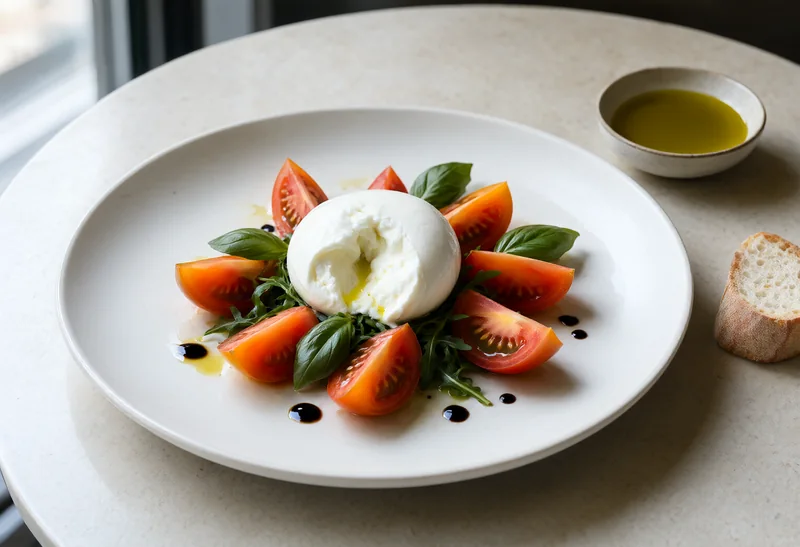
Ingredients
Serves 4. Prep 15 min, cook 0 min.
- 520 g (2 medium), peeled and cut into 5 mm half-moons cucumbers, peeled
- 500 g (3 large), cut into wedges ripe tomatoes
- 30 g (1/4 small), sliced thin red onion
- 5 g (a small handful), chopped fresh dill
- 1 tsp (4 g) sunflower or olive oil
- 2 tsp (10 g) red wine vinegar
- 1 tsp (5 g) salt
- 1/4 tsp (1 g) black pepper, ground
Method
- Peel the cucumbers. Cut them in half lengthwise, then into 5 mm half-moons.
- Cut the tomatoes in half through the stem, cut out the core, and cut each half into 3 or 4 wedges.
- Slice the red onion as thin as you can. If it is sharp, soak it in cold water for 5 minutes and drain.
- Put the cucumber, tomato and onion in a wide bowl. Add the salt, pepper, vinegar and oil.
- Toss gently with two spoons, so the tomato wedges do not break up. Add the dill and toss once more.
- Leave the salad for 10 minutes so the salt draws out the juices, then taste and add more salt or vinegar if needed. Serve with the juices from the bowl.
Nutrition facts
One portion is 270 g (a 4-serving recipe, 1080 g cooked). By portion, per 100 g or for any weight: calories in Cucumber and Tomato Salad.
| Nutrient | Per portion | Per 100 g | % DV |
|---|
| Energy and macronutrients |
|---|
| Energy | 49 kcal | 18.1 kcal | 2% |
|---|
| Protein | 2 g | 0.75 g | 4% |
|---|
| Carbohydrate | 8.6 g | 3.2 g | 3% |
|---|
| of which sugars | 5.4 g | 2 g | |
|---|
| Fiber | 2.6 g | 0.97 g | 9% |
|---|
| Fat | 1.5 g | 0.55 g | 2% |
|---|
| of which saturated | 0.25 g | 0.09 g | 1% |
|---|
| of which monounsaturated | 0.26 g | 0.1 g | |
|---|
| of which polyunsaturated | 0.79 g | 0.29 g | |
|---|
| Cholesterol | 0 mg | 0 mg | 0% |
|---|
| Minerals |
|---|
| Sodium | 495 mg | 183 mg | 22% |
|---|
| Potassium | 498 mg | 184 mg | 11% |
|---|
| Calcium | 36.6 mg | 13.5 mg | 3% |
|---|
| Iron | 0.76 mg | 0.28 mg | 4% |
|---|
| Magnesium | 31.3 mg | 11.6 mg | 7% |
|---|
| Phosphorus | 60.9 mg | 22.6 mg | 5% |
|---|
| Zinc | 0.46 mg | 0.17 mg | 4% |
|---|
| Copper | 0.17 mg | 0.06 mg | 19% |
|---|
| Manganese | 0.3 mg | 0.11 mg | 13% |
|---|
| Selenium | 0.18 µg | 0.07 µg | 0% |
|---|
| Vitamins |
|---|
| Vitamin A (RAE) | 62.6 µg | 23.2 µg | 7% |
|---|
| Vitamin C | 22.9 mg | 8.5 mg | 25% |
|---|
| Vitamin D | 0 µg | 0 µg | 0% |
|---|
| Vitamin E | 1.1 mg | 0.42 mg | 8% |
|---|
| Vitamin K | 19.7 µg | 7.3 µg | 16% |
|---|
| Thiamin (B1) | 0.09 mg | 0.03 mg | 8% |
|---|
| Riboflavin (B2) | 0.06 mg | 0.02 mg | 5% |
|---|
| Niacin (B3) | 0.82 mg | 0.3 mg | 5% |
|---|
| Pantothenic acid (B5) | 0.44 mg | 0.16 mg | 9% |
|---|
| Vitamin B6 | 0.18 mg | 0.07 mg | 10% |
|---|
| Folate (DFE) | 40.3 µg | 14.9 µg | 10% |
|---|
| Vitamin B12 | 0 µg | 0 µg | 0% |
|---|
| Choline | 16.3 mg | 6 mg | 3% |
|---|
Calculated from the weights in the ingredient list with USDA FoodData Central (SR Legacy) values; only what is eaten counts (drained oil, rinds and similar are left out). Vitamin losses in cooking are not modelled, and “≥” marks a value that is a lower bound because the table has no figure for some ingredients. % DV uses the FDA reference values for adults. Real dishes vary with ingredients and portion size.
People who log cucumber and tomato salad in Flog average about 16.7 kcal per 100 g, against 18.1 kcal per 100 g here.