Ingredients
Serves 8. Prep 50 min, cook 55 min.
Filling
- 70 g (about 6 tbsp), rinsed and drained medium-grain rice, rinsed
- 1 medium (about 100 g), finely chopped onion, finely chopped
- 1 small (about 60 g), seeded and finely chopped ripe tomato, finely chopped
- 1 small bunch (20 g), leaves finely chopped fresh flat-leaf parsley, finely chopped
- 2 tbsp (6 g), finely chopped fresh mint, finely chopped
- 1 1/2 tbsp (22 g) extra-virgin olive oil
- 2 tsp (10 g) lemon juice
- 3/4 tsp (4 g) salt
- 1/2 tsp (1 g) ground allspice
- 1/4 tsp (1 g) black pepper, ground
Leaves
- 35 leaves (about 80 g), rinsed and drained brined grape leaves, jarred, rinsed
Simmering
- 25 ml (23 g) extra-virgin olive oil
- 1 tbsp (15 g) lemon juice
- 250 ml (250 g) water, hot
Method
- Rinse the leaves in a bowl of hot water, soak them for 5 minutes, then drain and rinse again. Brine is very salty. Pick out 32 intact leaves for rolling and 3 for lining the pot. Trim off the tough stems with scissors.
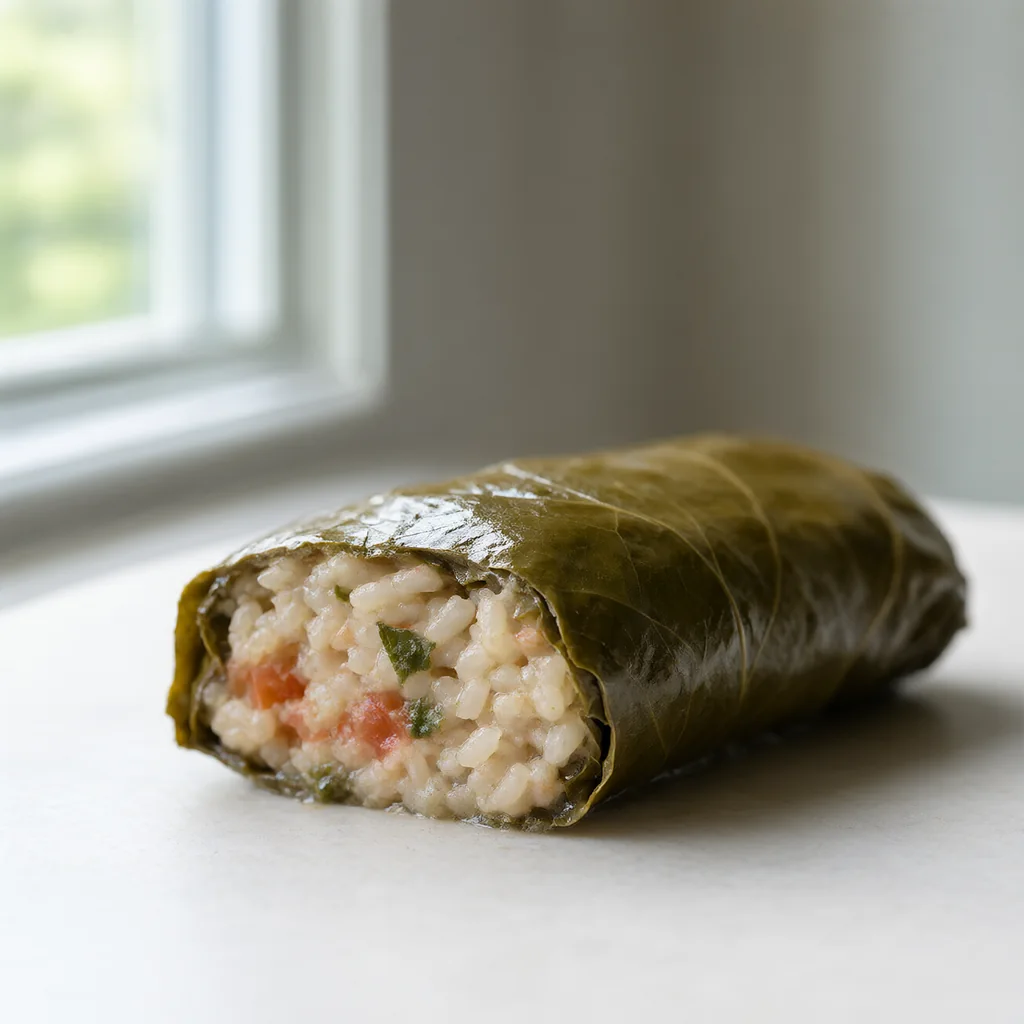
- Mix the rice, onion, tomato, parsley, mint, the 22 g (1 1/2 tbsp) of oil, the 10 g (2 tsp) of lemon juice, the salt, allspice and pepper in a bowl. Let it stand 10 minutes.
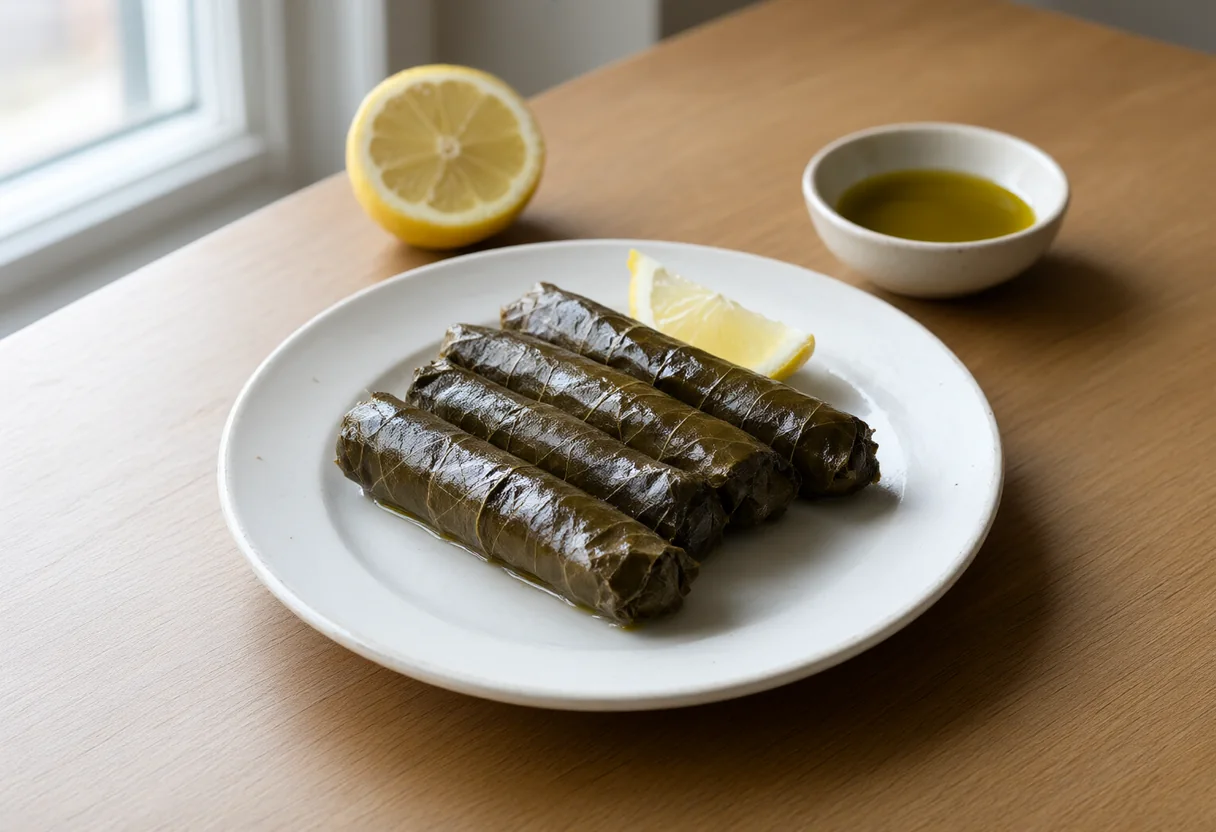
- Lay one leaf shiny side down on a board, stem end toward you. Put a heaping teaspoon of filling (about 9 g) near the stem end. Fold in the two sides, then roll up snugly toward the tip into a thin cylinder about 5 cm long. Do not stuff too full, since the rice swells. Repeat with the remaining leaves.
- Line the bottom of a 22 to 24 cm heavy pot with the 3 spare leaves. Pack the rolls seam side down in tight rows, in 2 layers.
- Pour the 25 ml (23 g) of oil, the 15 g (1 tbsp) of lemon juice and the hot water over the rolls. Lay a small heatproof plate upside down on top to hold them in place.
- Bring to a gentle simmer, cover and cook over low heat for 45 minutes, until the rice is soft and the leaves are tender. Taste one roll; if the rice is still firm, add 50 ml hot water and cook 10 minutes more.
- Turn off the heat and leave the pot covered for 20 minutes. Lift out the rolls and serve cold or at room temperature, with lemon wedges. Discard the pot leaves and leftover liquid.
Nutrition facts
One portion is 62.5 g (a 8-serving recipe, 500 g cooked). By portion, per 100 g or for any weight: calories in Stuffed Grape Leaves.
| Nutrient | Per portion | Per 100 g | % DV |
|---|
| Energy and macronutrients |
|---|
| Energy | 89.8 kcal | 144 kcal | 4% |
|---|
| Protein | 1.3 g | 2.1 g | 3% |
|---|
| Carbohydrate | 10.1 g | 16.1 g | 4% |
|---|
| of which sugars | ≥ 0.83 g | ≥ 1.3 g | |
|---|
| Fiber | 1.5 g | 2.5 g | 5% |
|---|
| Fat | 5.2 g | 8.3 g | 7% |
|---|
| of which saturated | 0.73 g | 1.2 g | 4% |
|---|
| of which monounsaturated | 3.6 g | 5.8 g | |
|---|
| of which polyunsaturated | 0.64 g | 1 g | |
|---|
| Cholesterol | 0 mg | 0 mg | 0% |
|---|
| Minerals |
|---|
| Sodium | 458 mg | 733 mg | 20% |
|---|
| Potassium | 69.8 mg | 112 mg | 1% |
|---|
| Calcium | 38.1 mg | 61 mg | 3% |
|---|
| Iron | 1 mg | 1.6 mg | 6% |
|---|
| Magnesium | 8.9 mg | 14.3 mg | 2% |
|---|
| Phosphorus | 20.5 mg | 32.7 mg | 2% |
|---|
| Zinc | 0.21 mg | 0.34 mg | 2% |
|---|
| Copper | 0.2 mg | 0.32 mg | 22% |
|---|
| Manganese | 0.18 mg | 0.29 mg | 8% |
|---|
| Selenium | 1.5 µg | 2.4 µg | 3% |
|---|
| Vitamins |
|---|
| Vitamin A (RAE) | 39.3 µg | 62.8 µg | 4% |
|---|
| Vitamin C | 7.7 mg | 12.3 mg | 9% |
|---|
| Vitamin D | 0 µg | 0 µg | 0% |
|---|
| Vitamin E | 0.94 mg | 1.5 mg | 6% |
|---|
| Vitamin K | 53.7 µg | 85.9 µg | 45% |
|---|
| Thiamin (B1) | 0.07 mg | 0.11 mg | 6% |
|---|
| Riboflavin (B2) | 0.05 mg | 0.07 mg | 4% |
|---|
| Niacin (B3) | 0.96 mg | 1.5 mg | 6% |
|---|
| Pantothenic acid (B5) | 0.55 mg | 0.88 mg | 11% |
|---|
| Vitamin B6 | 0.05 mg | 0.08 mg | 3% |
|---|
| Folate (DFE) | 49.7 µg | 79.5 µg | 12% |
|---|
| Vitamin B12 | 0 µg | 0 µg | 0% |
|---|
| Choline | ≥ 1.8 mg | ≥ 2.8 mg | 0% |
|---|
Calculated from the weights in the ingredient list with USDA FoodData Central (SR Legacy) values; only what is eaten counts (drained oil, rinds and similar are left out). Vitamin losses in cooking are not modelled, and “≥” marks a value that is a lower bound because the table has no figure for some ingredients. % DV uses the FDA reference values for adults. Real dishes vary with ingredients and portion size.