Ingredients
Serves 2. Prep 25 min, cook 14 min.
Sushi rice
- 150 g short-grain (sushi) rice
- 180 ml (180 g) water
- 1 tbsp (15 g) rice vinegar
- 1 tsp (5 g) sugar
- 1/4 tsp (1.5 g) salt
Salmon
- 200 g, cut into 2 cm cubes salmon fillet, sushi-grade, skinless
- 2 tbsp (36 g) soy sauce
- 2 tsp (10 g) toasted sesame oil
- 2 tsp (10 g) rice vinegar
- 1 tsp (5 g) fresh ginger, finely grated
Toppings
- 1 small (about 100 g), sliced avocado, ripe, peeled and pitted
- 1/3 cucumber (about 80 g), sliced into thin half-moons cucumber
- 60 g edamame, shelled, cooked
- 1 small (about 40 g), shredded carrot, peeled
- 2 (about 10 g), sliced thin scallions
- 2 tsp (6 g) sesame seeds, toasted
Method
- Rinse the rice in a bowl of cold water, swirling and changing the water 4 or 5 times, until it runs almost clear. Drain well.
- Put the rice and the 180 ml of water in a medium saucepan with a tight lid. Bring to a boil over high heat. Cover, reduce to the lowest heat and cook for 12 minutes without lifting the lid. Remove from the heat and leave covered for 10 minutes.
- Warm 15 g of rice vinegar with the sugar and 1.5 g of salt for 15 seconds in a microwave, or in a small pan, until the sugar dissolves. Tip the rice into a wide bowl, pour the vinegar over and fold it in with cutting strokes of a spatula. Let it cool to room temperature, about 15 minutes.
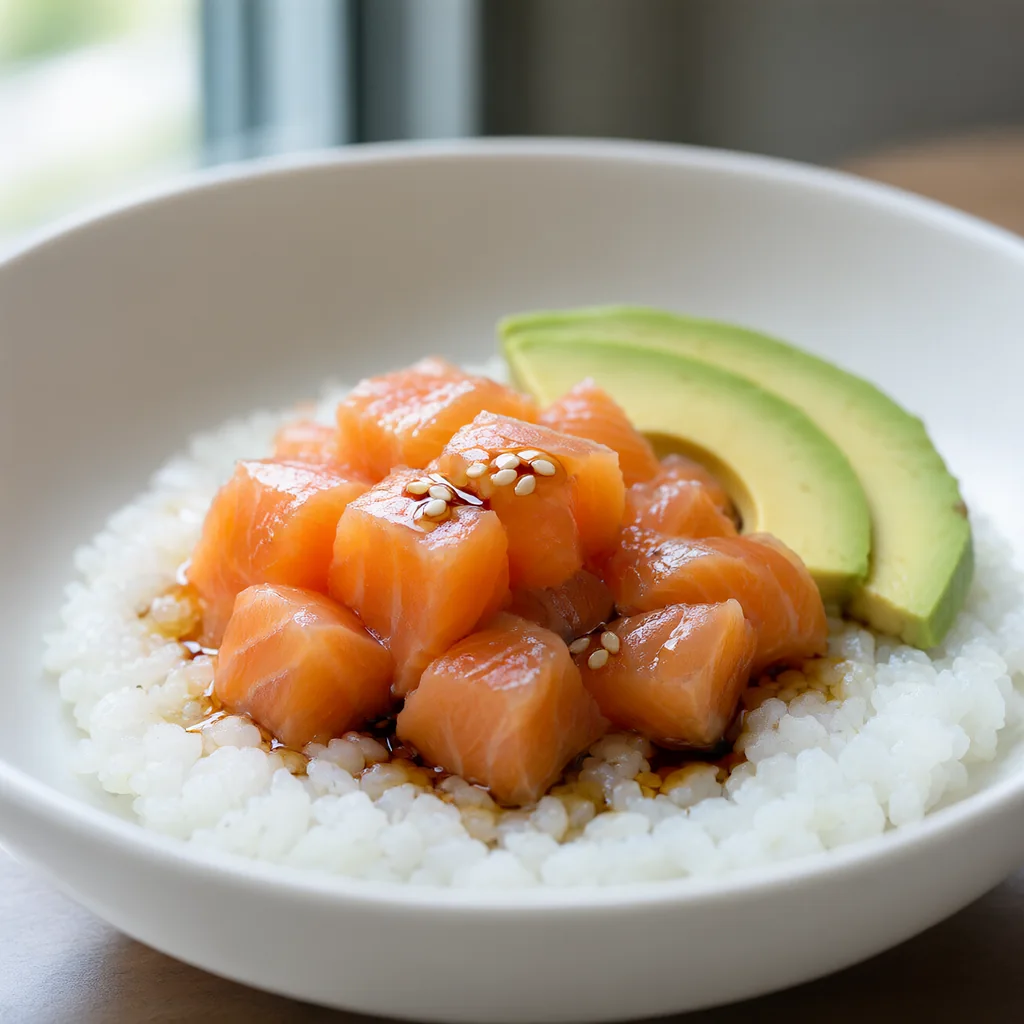
- Whisk the soy sauce, sesame oil, 10 g of rice vinegar and the ginger in a bowl. Pat the salmon dry, cut it into 2 cm cubes and fold it into the sauce. Cover and refrigerate for 10 minutes, no longer.
- Slice the avocado and cucumber, shred the carrot and slice the scallions.
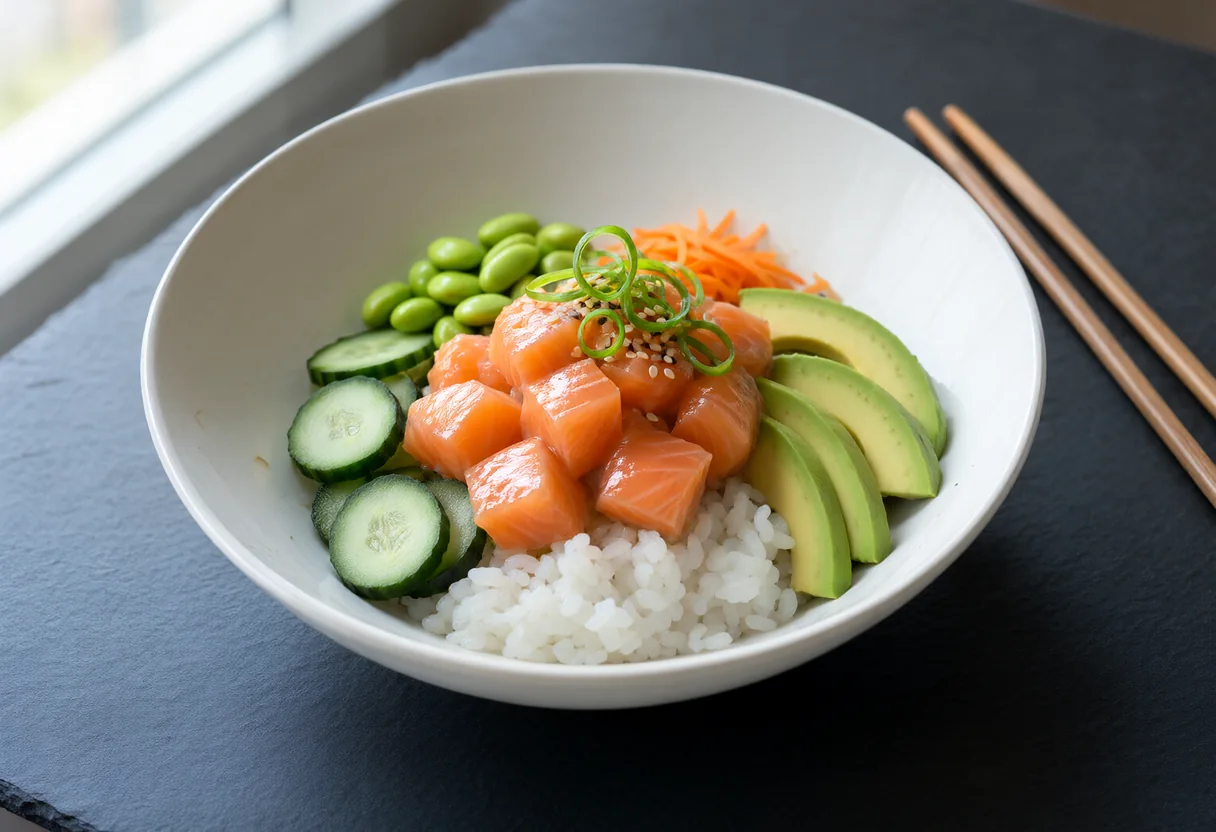
- Divide the rice between 2 wide bowls. Spoon the salmon and its sauce on one side, then arrange the avocado, cucumber, edamame and carrot around it. Sprinkle with the scallions and sesame seeds and serve right away.
Nutrition facts
One portion is 440 g (a 2-serving recipe, 880 g cooked). By portion, per 100 g or for any weight: calories in Salmon Poke Bowl.
| Nutrient | Per portion | Per 100 g | % DV |
|---|
| Energy and macronutrients |
|---|
| Energy | 700 kcal | 159 kcal | 35% |
|---|
| Protein | 32.6 g | 7.4 g | 65% |
|---|
| Carbohydrate | 75.4 g | 17.1 g | 27% |
|---|
| of which sugars | ≥ 4.7 g | ≥ 1.1 g | |
|---|
| Fiber | 6.1 g | 1.4 g | 22% |
|---|
| Fat | 29.7 g | 6.8 g | 38% |
|---|
| of which saturated | 5.4 g | 1.2 g | 27% |
|---|
| of which monounsaturated | 11.7 g | 2.7 g | |
|---|
| of which polyunsaturated | 8.6 g | 2 g | |
|---|
| Cholesterol | 55 mg | 12.5 mg | 18% |
|---|
| Minerals |
|---|
| Sodium | 1,370 mg | 311 mg | 59% |
|---|
| Potassium | 1,070 mg | 244 mg | 23% |
|---|
| Calcium | 117 mg | 26.6 mg | 9% |
|---|
| Iron | 3 mg | 0.67 mg | 16% |
|---|
| Magnesium | 112 mg | 25.4 mg | 27% |
|---|
| Phosphorus | 454 mg | 103 mg | 36% |
|---|
| Zinc | 2.3 mg | 0.53 mg | 21% |
|---|
| Copper | 0.46 mg | 0.1 mg | 51% |
|---|
| Manganese | 1.4 mg | 0.31 mg | 60% |
|---|
| Selenium | 26 µg | 5.9 µg | 47% |
|---|
| Vitamins |
|---|
| Vitamin A (RAE) | 235 µg | 53.5 µg | 26% |
|---|
| Vitamin C | 17.4 mg | 4 mg | 19% |
|---|
| Vitamin D | 11 µg | 2.5 µg | 55% |
|---|
| Vitamin E | ≥ 4.8 mg | ≥ 1.1 mg | 32% |
|---|
| Vitamin K | ≥ 31.2 µg | ≥ 7.1 µg | 26% |
|---|
| Thiamin (B1) | 0.43 mg | 0.1 mg | 36% |
|---|
| Riboflavin (B2) | 0.37 mg | 0.08 mg | 28% |
|---|
| Niacin (B3) | 11.9 mg | 2.7 mg | 75% |
|---|
| Pantothenic acid (B5) | 3.5 mg | 0.79 mg | 69% |
|---|
| Vitamin B6 | 1 mg | 0.23 mg | 60% |
|---|
| Folate (DFE) | 120 µg | 27.2 µg | 30% |
|---|
| Vitamin B12 | 3.2 µg | 0.73 µg | 135% |
|---|
| Choline | ≥ 94.1 mg | ≥ 21.4 mg | 17% |
|---|
Calculated from the weights in the ingredient list with USDA FoodData Central (SR Legacy) values; only what is eaten counts (drained oil, rinds and similar are left out). Vitamin losses in cooking are not modelled, and “≥” marks a value that is a lower bound because the table has no figure for some ingredients. % DV uses the FDA reference values for adults. Real dishes vary with ingredients and portion size.
People who log salmon poke bowl in Flog average about 146 kcal per 100 g, against 159 kcal per 100 g here.