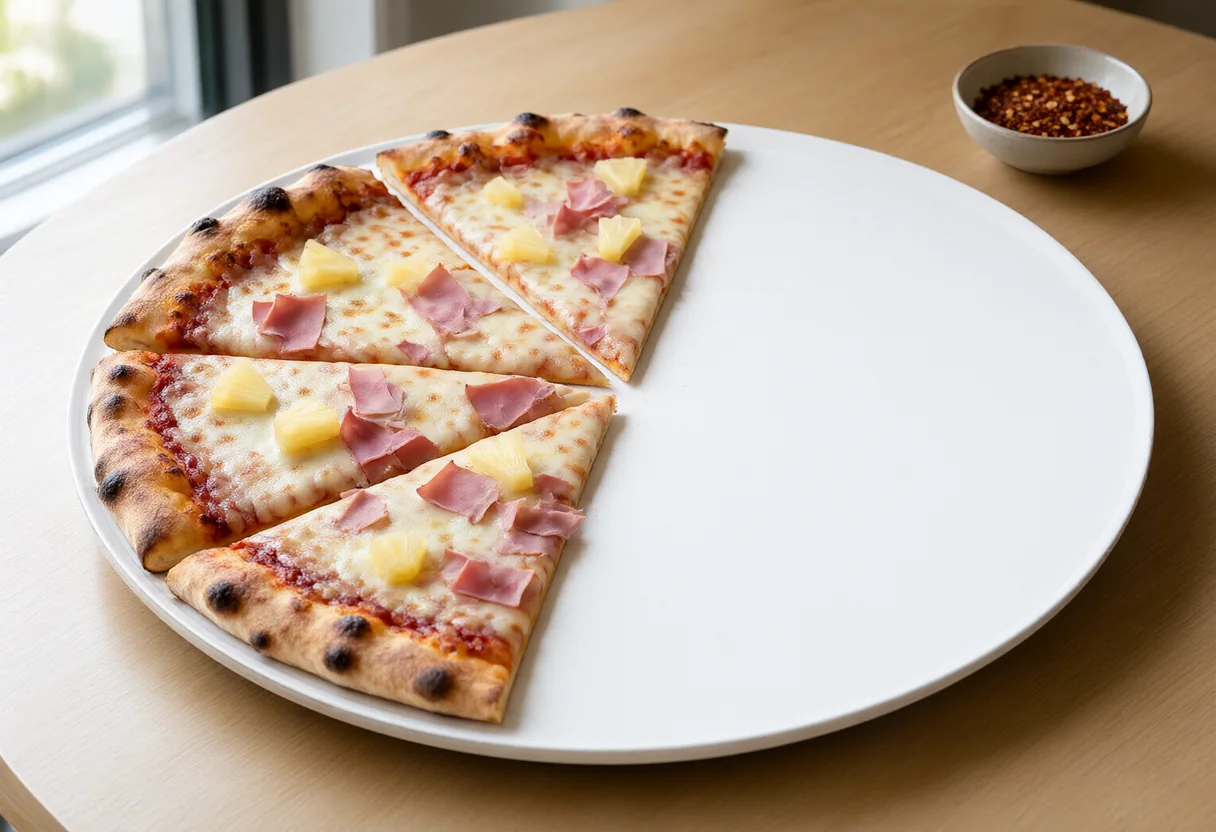
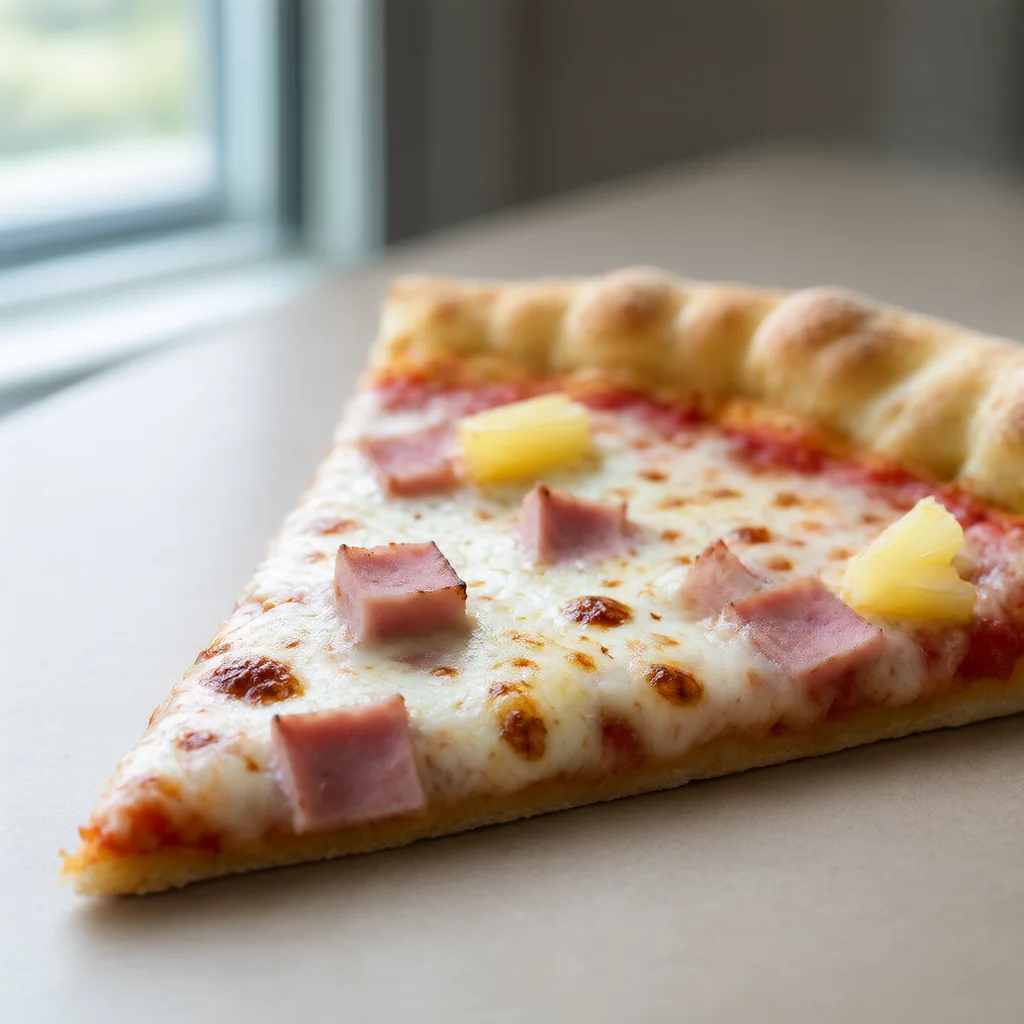
Ingredients
Serves 4. Prep 30 min, cook 24 min.
Dough (makes two 30 cm pizzas)
- 400 g (about 3 1/4 cups) bread flour
- 260 ml (260 g) water, lukewarm
- 1 1/4 tsp (4 g) instant yeast
- 1 1/2 tsp (8 g) salt
- 2 tsp (9 g) olive oil
Sauce
- 200 g (about 3/4 cup) canned crushed tomatoes
- 1 tsp (1 g) dried oregano
- 1/4 tsp (1 g) salt
Toppings
- 280 g, coarsely shredded (about 2 3/4 cups) low-moisture mozzarella
- 160 g, diced into 1.5 cm cubes cooked ham, thick-sliced
- 200 g drained, cut into 1.5 cm pieces pineapple chunks, canned in juice, drained
- 1 tbsp (14 g) olive oil, for the crust edge
Method
- Mix the flour and yeast in a large bowl. Add the lukewarm water, 9 g oil and the salt. Stir until no dry flour is left.
- Knead on a lightly floured counter for 8 to 10 minutes, until smooth and elastic and the dough springs back when poked.
- Put the dough in an oiled bowl, cover, and leave at room temperature (about 22°C / 72°F) for 1 1/2 to 2 hours, until doubled.
- Forty-five minutes before baking, set a baking steel, a pizza stone or an upside-down heavy baking sheet on a rack in the upper third of the oven. Heat the oven to its highest setting, 250 to 260°C (480 to 500°F).
- Tip the pineapple into a sieve, press out the juice, then spread it on paper towels and pat dry. Dice the ham. Stir the crushed tomatoes with the oregano and 1 g salt.
- Cut the dough in half (about 340 g each) and roll into balls. Rest 10 minutes, covered. Press and stretch one ball on a sheet of floured parchment into a round about 30 cm wide, leaving the outer 2 cm slightly thicker.
- Spread 100 g of the sauce over the dough, leaving a 1.5 cm rim. Scatter 140 g mozzarella, then half the ham (80 g) and half the pineapple (100 g). Brush 7 g of oil on the rim.
- Slide the parchment and pizza onto the hot steel or sheet with a pizza peel or the back of a baking sheet. Bake 8 to 10 minutes, until the crust is golden with dark blisters and the cheese bubbles with brown spots. The parchment will darken; this is normal.
- Cut into 8 slices. Shape, top and bake the second pizza the same way. Serve 4 slices per person.
Nutrition facts
One portion is 345 g (a 4-serving recipe, 1380 g cooked). By portion, per 100 g or for any weight: calories in Hawaiian Pizza.
| Nutrient | Per portion | Per 100 g | % DV |
|---|
| Energy and macronutrients |
|---|
| Energy | 750 kcal | 217 kcal | 37% |
|---|
| Protein | 35.2 g | 10.2 g | 70% |
|---|
| Carbohydrate | 87.7 g | 25.4 g | 32% |
|---|
| of which sugars | 10.8 g | 3.1 g | |
|---|
| Fiber | 4.9 g | 1.4 g | 17% |
|---|
| Fat | 28.5 g | 8.2 g | 36% |
|---|
| of which saturated | 12.2 g | 3.5 g | 61% |
|---|
| of which monounsaturated | 11.1 g | 3.2 g | |
|---|
| of which polyunsaturated | 2.3 g | 0.66 g | |
|---|
| Cholesterol | 85.1 mg | 24.7 mg | 28% |
|---|
| Minerals |
|---|
| Sodium | 1,790 mg | 520 mg | 78% |
|---|
| Potassium | 489 mg | 142 mg | 10% |
|---|
| Calcium | 459 mg | 133 mg | 35% |
|---|
| Iron | 5.9 mg | 1.7 mg | 33% |
|---|
| Magnesium | 67.9 mg | 19.7 mg | 16% |
|---|
| Phosphorus | 473 mg | 137 mg | 38% |
|---|
| Zinc | 3.4 mg | 0.98 mg | 31% |
|---|
| Copper | 0.39 mg | 0.11 mg | 43% |
|---|
| Manganese | 1.1 mg | 0.33 mg | 49% |
|---|
| Selenium | 59.8 µg | 17.3 µg | 109% |
|---|
| Vitamins |
|---|
| Vitamin A (RAE) | 145 µg | 42.1 µg | 16% |
|---|
| Vitamin C | 10.9 mg | 3.2 mg | 12% |
|---|
| Vitamin D | 0.63 µg | 0.18 µg | 3% |
|---|
| Vitamin E | 2.1 mg | 0.6 mg | 14% |
|---|
| Vitamin K | 10.1 µg | 2.9 µg | 8% |
|---|
| Thiamin (B1) | 1.3 mg | 0.37 mg | 106% |
|---|
| Riboflavin (B2) | 0.85 mg | 0.25 mg | 65% |
|---|
| Niacin (B3) | 9.9 mg | 2.9 mg | 62% |
|---|
| Pantothenic acid (B5) | 0.94 mg | 0.27 mg | 19% |
|---|
| Vitamin B6 | 0.34 mg | 0.1 mg | 20% |
|---|
| Folate (DFE) | 329 µg | 95.5 µg | 82% |
|---|
| Vitamin B12 | 0.68 µg | 0.2 µg | 28% |
|---|
| Choline | 63.3 mg | 18.3 mg | 12% |
|---|
Calculated from the weights in the ingredient list with USDA FoodData Central (SR Legacy) values; only what is eaten counts (drained oil, rinds and similar are left out). Vitamin losses in cooking are not modelled, and “≥” marks a value that is a lower bound because the table has no figure for some ingredients. % DV uses the FDA reference values for adults. Real dishes vary with ingredients and portion size.