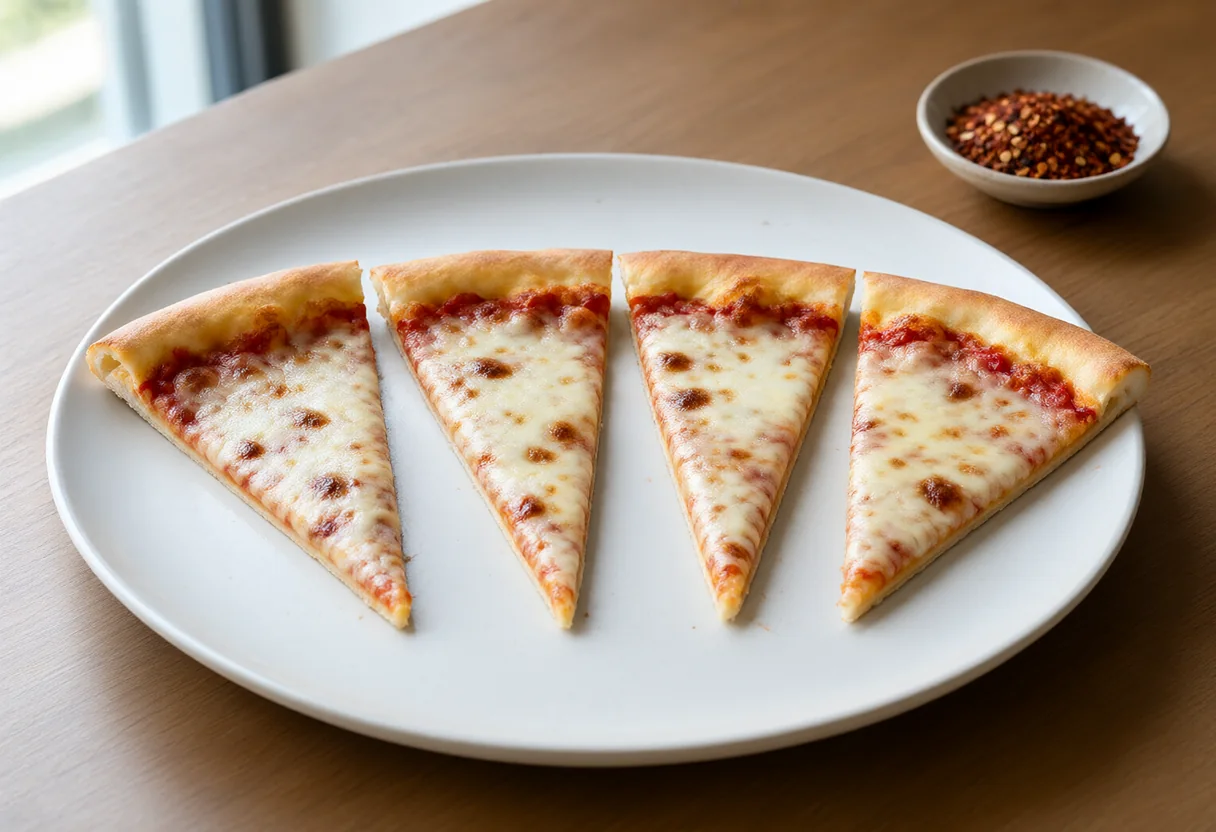
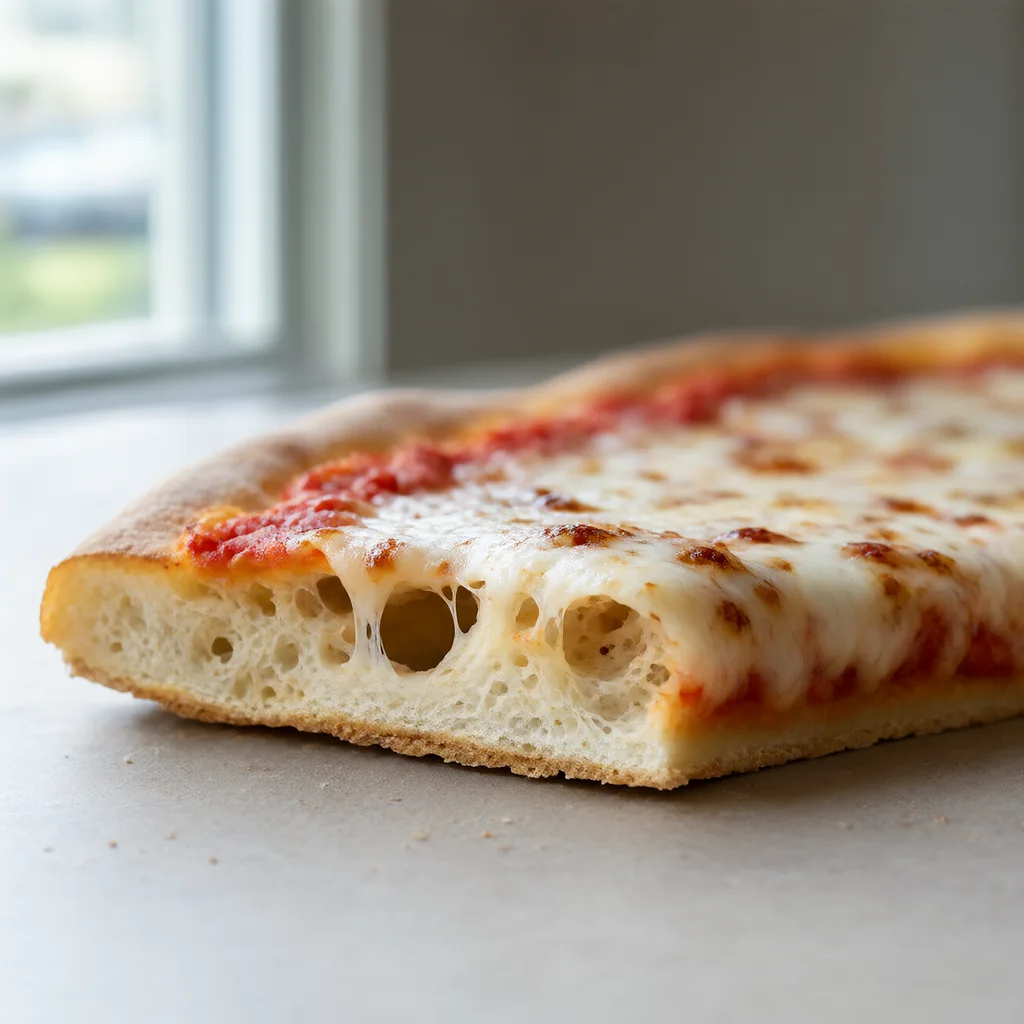
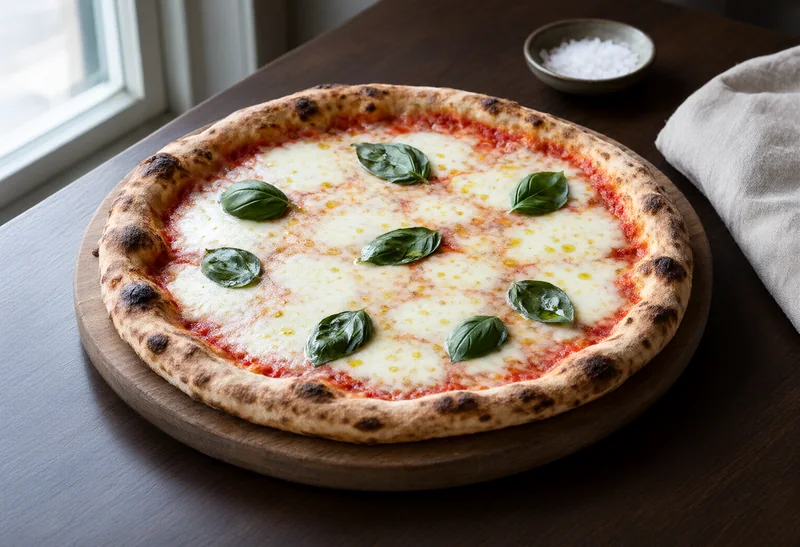
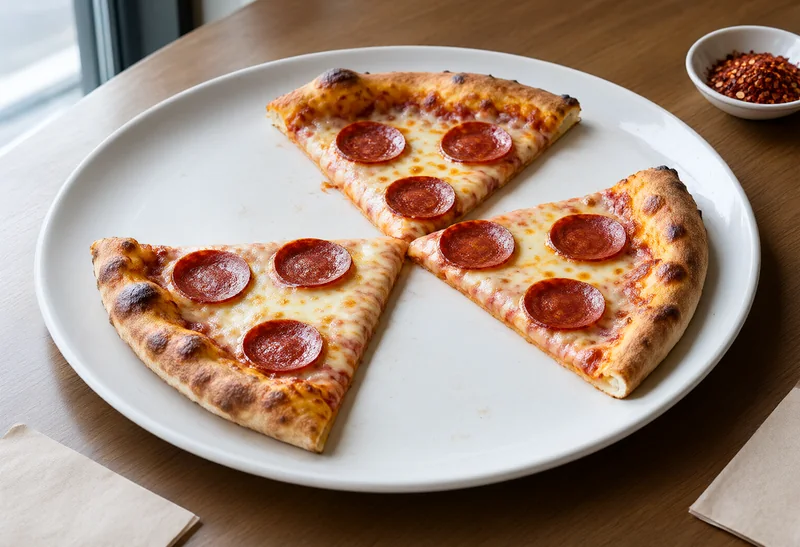
Ingredients
Serves 4. Prep 30 min, cook 20 min.
Dough (makes two 30 cm pizzas)
- 450 g (about 3 1/2 cups) bread flour or all-purpose flour
- 290 ml (290 g) water, warm (about 35 C / 95 F)
- 1 tsp (3 g) instant yeast
- 1 1/2 tsp (9 g) salt
- 1 tbsp (14 g) olive oil
- about 2 tbsp (15 g) flour, for dusting the counter and hands
Sauce
- 200 g (about 3/4 cup) canned crushed tomatoes
- 2 tsp (8 g) olive oil
- 1 clove (4 g) garlic, 1 clove, minced
- 1/2 tsp (1 g) dried oregano
- 1/3 tsp (2 g) salt
Topping
- 300 g (about 3 cups shredded) low-moisture mozzarella, block, shredded
Method
- Stir the yeast into the warm water and leave for 5 minutes. In a large bowl, mix the flour and salt. Add the yeast water and the oil and stir until no dry flour remains.
- Knead on a lightly floured counter for 8 to 10 minutes, until smooth and springy. It should spring back slowly when pressed. Put it in an oiled bowl, cover with plastic wrap and leave in a warm spot for 1 hour, until doubled.
- While the dough rises, stir together the crushed tomatoes, oil, garlic, oregano and salt. Do not cook the sauce. Shred the mozzarella.
- Put a baking steel, a pizza stone or an upside-down heavy baking sheet on the rack in the upper third of the oven. Heat the oven to 250 C (480 F) for at least 45 minutes.
- Divide the dough in half and shape each piece into a ball. Cover and rest for 15 minutes.
- Cut two sheets of parchment paper about 35 cm square. Stretch one ball on a sheet with floured fingertips, working outward from the center and leaving the edge slightly thicker, until it is about 30 cm across. Reshape any thin or torn spots by pinching them together.
- Spread half of the sauce (about 107 g) over the dough, leaving a 2 cm border. Scatter half of the cheese (150 g) evenly over the sauce.
- Trim the paper close to the dough. Lift the pizza, paper and all, on a pizza peel or a rimless baking sheet and slide it onto the hot steel or sheet. Bake for 10 to 12 minutes, until the edge is deep golden and the cheese is bubbling with brown spots.
- Slide the pizza onto a board and let it rest for 2 minutes, then cut into 8 slices. Shape and top the second pizza while the first bakes, and bake it the same way.
Nutrition facts
One portion is 295 g (a 4-serving recipe, 1180 g cooked). By portion, per 100 g or for any weight: calories in Cheese Pizza.
| Nutrient | Per portion | Per 100 g | % DV |
|---|
| Energy and macronutrients |
|---|
| Energy | 701 kcal | 238 kcal | 35% |
|---|
| Protein | 32.6 g | 11.1 g | 65% |
|---|
| Carbohydrate | 91.1 g | 30.9 g | 33% |
|---|
| of which sugars | 4 g | 1.4 g | |
|---|
| Fiber | 4 g | 1.4 g | 14% |
|---|
| Fat | 22.4 g | 7.6 g | 29% |
|---|
| of which saturated | 9.5 g | 3.2 g | 48% |
|---|
| of which monounsaturated | 8.5 g | 2.9 g | |
|---|
| of which polyunsaturated | 2.2 g | 0.76 g | |
|---|
| Cholesterol | 48 mg | 16.3 mg | 16% |
|---|
| Minerals |
|---|
| Sodium | 1,660 mg | 564 mg | 72% |
|---|
| Potassium | 416 mg | 141 mg | 9% |
|---|
| Calcium | 566 mg | 192 mg | 44% |
|---|
| Iron | 6 mg | 2 mg | 33% |
|---|
| Magnesium | 60.8 mg | 20.6 mg | 14% |
|---|
| Phosphorus | 544 mg | 184 mg | 44% |
|---|
| Zinc | 3.9 mg | 1.3 mg | 35% |
|---|
| Copper | 0.34 mg | 0.12 mg | 38% |
|---|
| Manganese | 1.1 mg | 0.36 mg | 46% |
|---|
| Selenium | 66.4 µg | 22.5 µg | 121% |
|---|
| Vitamins |
|---|
| Vitamin A (RAE) | 176 µg | 59.6 µg | 20% |
|---|
| Vitamin C | 4.9 mg | 1.7 mg | 5% |
|---|
| Vitamin D | 0.3 µg | 0.1 µg | 2% |
|---|
| Vitamin E | 2.3 mg | 0.78 mg | 15% |
|---|
| Vitamin K | 8.8 µg | 3 µg | 7% |
|---|
| Thiamin (B1) | 1.1 mg | 0.36 mg | 89% |
|---|
| Riboflavin (B2) | 0.91 mg | 0.31 mg | 70% |
|---|
| Niacin (B3) | 9.6 mg | 3.3 mg | 60% |
|---|
| Pantothenic acid (B5) | 1.1 mg | 0.36 mg | 21% |
|---|
| Vitamin B6 | 0.22 mg | 0.07 mg | 13% |
|---|
| Folate (DFE) | 373 µg | 126 µg | 93% |
|---|
| Vitamin B12 | 1.3 µg | 0.43 µg | 53% |
|---|
| Choline | 29.5 mg | 10 mg | 5% |
|---|
Calculated from the weights in the ingredient list with USDA FoodData Central (SR Legacy) values; only what is eaten counts (drained oil, rinds and similar are left out). Vitamin losses in cooking are not modelled, and “≥” marks a value that is a lower bound because the table has no figure for some ingredients. % DV uses the FDA reference values for adults. Real dishes vary with ingredients and portion size.
People who log cheese pizza in Flog average about 265 kcal per 100 g, against 238 kcal per 100 g here.