Ingredients
Serves 6. Prep 50 min, cook 30 min.
Dough
- 360 g all-purpose flour
- 170 g (a scant 3/4 cup) whole milk, warm (about 38 C)
- 1 large (about 50 g) egg
- 40 g (3 tbsp) butter, melted and cooled
- 2 tsp (10 g) sugar
- scant 1 tsp (5 g) salt
- 2 tsp (6 g) instant dry yeast
Filling
- 360 g, cut into 12 pieces about 6 by 3 cm cod or other firm white fish fillet, skinless and boneless
- 1 medium (about 100 g), finely chopped onion
- 20 g (1 1/2 tbsp) butter
- 8 g (2 tbsp) fresh dill, chopped
- 2/3 tsp (4 g) salt
- 1/2 tsp (1 g) black pepper, ground
Glaze
- 1 yolk (about 18 g) egg yolk
- 2 tsp (10 g) whole milk
Method
- Stir the warm milk, sugar and yeast together in a large bowl. Whisk in the egg, the melted butter and the 5 g of salt. Add the flour and stir to a shaggy dough.
- Knead on a lightly floured counter for 8 to 10 minutes, until smooth and soft. Put the dough back in the bowl, cover with plastic wrap, and leave in a warm place for 60 minutes, until doubled.
- While the dough rises, melt the 20 g of butter in a 20 cm skillet over medium heat. Cook the chopped onion for 8 minutes, stirring, until soft and pale gold. Cool completely.
- Pat the fish dry. Cut it into 12 pieces about 6 by 3 cm. Toss the pieces with the dill, the 4 g of salt and the pepper, and keep them in the fridge.
- Heat the oven to 200 C (400 F). Line two baking sheets with parchment.
- Punch down the dough and cut it into 12 equal pieces (about 53 g each). Keep the ones you are not using covered. Roll each piece into an oval about 12 by 8 cm.
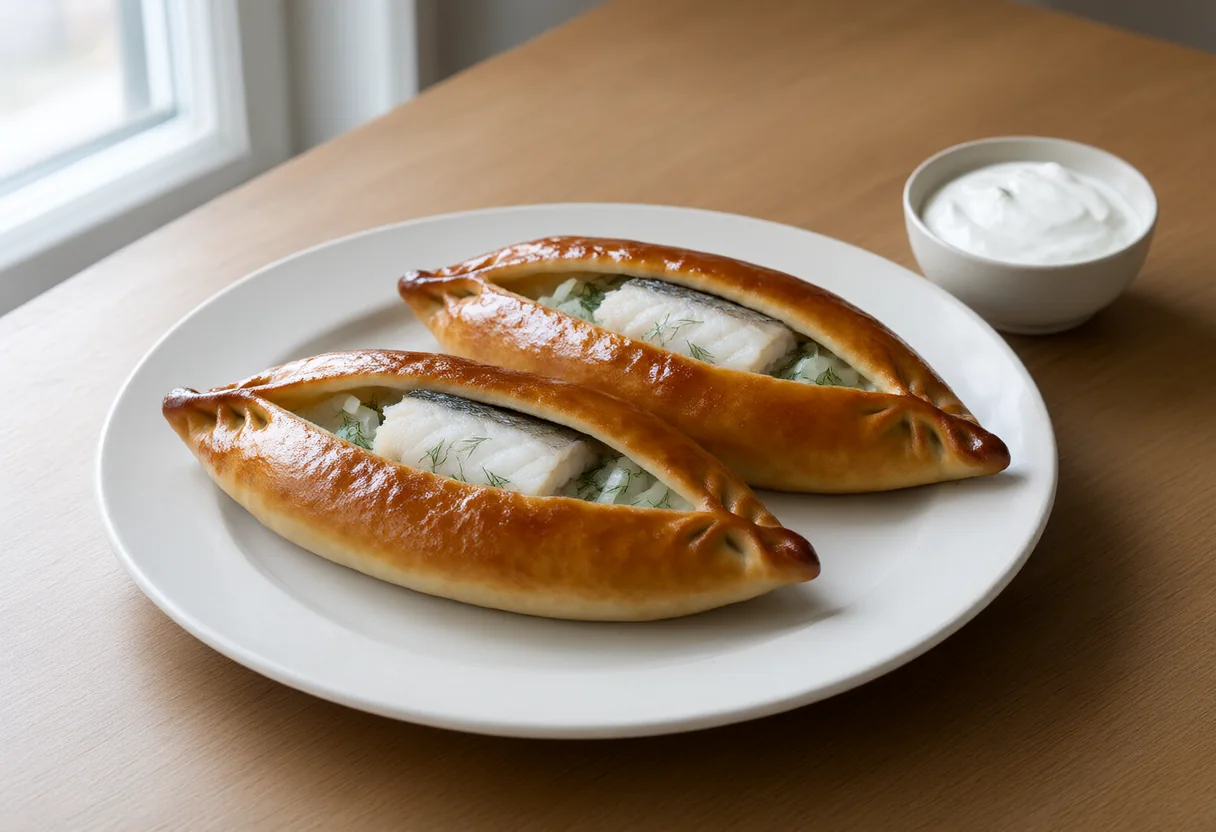
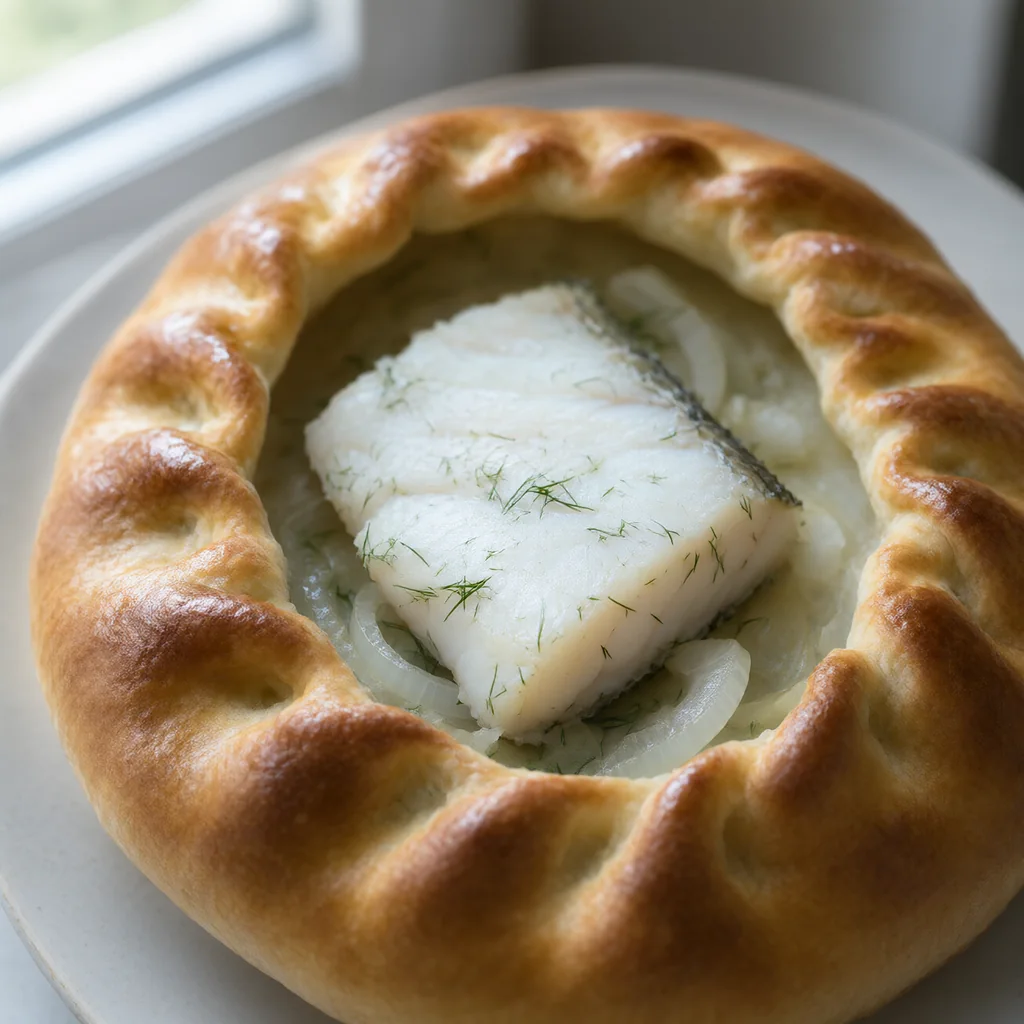
- Spoon about 1 tsp of onion down the middle of an oval and lay a piece of fish on top, lengthwise. Lift the two long edges up around the filling and pinch the two ends shut, so that you get a boat with the fish showing in an open middle about 6 by 2 cm.
- Set the pies on the sheets, 6 per sheet and 3 cm apart. Cover loosely with a clean towel and let them puff for 20 minutes.
- Whisk the yolk and the 10 g of milk. Brush only the exposed dough with it, not the fish.
- Bake for 20 to 22 minutes, swapping the sheets after 10 minutes, until the dough is golden and the fish is opaque and flakes easily. Cool for 5 minutes and serve warm, 2 pies per person.
Nutrition facts
One portion is 165 g (a 6-serving recipe, 990 g cooked). By portion, per 100 g or for any weight: calories in Fish Rasstegai.
| Nutrient | Per portion | Per 100 g | % DV |
|---|
| Energy and macronutrients |
|---|
| Energy | 397 kcal | 240 kcal | 20% |
|---|
| Protein | 20.1 g | 12.2 g | 40% |
|---|
| Carbohydrate | 51.2 g | 31.1 g | 19% |
|---|
| of which sugars | 4.1 g | 2.5 g | |
|---|
| Fiber | 2.2 g | 1.4 g | 8% |
|---|
| Fat | 11.8 g | 7.1 g | 15% |
|---|
| of which saturated | 6.4 g | 3.9 g | 32% |
|---|
| of which monounsaturated | 3.2 g | 1.9 g | |
|---|
| of which polyunsaturated | 1 g | 0.63 g | |
|---|
| Cholesterol | 114 mg | 69 mg | 38% |
|---|
| Minerals |
|---|
| Sodium | 707 mg | 429 mg | 31% |
|---|
| Potassium | 415 mg | 251 mg | 9% |
|---|
| Calcium | 71.5 mg | 43.3 mg | 5% |
|---|
| Iron | 3.4 mg | 2.1 mg | 19% |
|---|
| Magnesium | 40 mg | 24.2 mg | 10% |
|---|
| Phosphorus | 255 mg | 154 mg | 20% |
|---|
| Zinc | 1.1 mg | 0.67 mg | 10% |
|---|
| Copper | 0.14 mg | 0.08 mg | 15% |
|---|
| Manganese | 0.49 mg | 0.3 mg | 21% |
|---|
| Selenium | 45.8 µg | 27.8 µg | 83% |
|---|
| Vitamins |
|---|
| Vitamin A (RAE) | 119 µg | 72.3 µg | 13% |
|---|
| Vitamin C | 3 mg | 1.8 mg | 3% |
|---|
| Vitamin D | 1.3 µg | 0.76 µg | 6% |
|---|
| Vitamin E | 0.84 mg | 0.51 mg | 6% |
|---|
| Vitamin K | 1.4 µg | 0.86 µg | 1% |
|---|
| Thiamin (B1) | 0.66 mg | 0.4 mg | 55% |
|---|
| Riboflavin (B2) | 0.49 mg | 0.3 mg | 38% |
|---|
| Niacin (B3) | 5.3 mg | 3.2 mg | 33% |
|---|
| Pantothenic acid (B5) | 0.86 mg | 0.52 mg | 17% |
|---|
| Vitamin B6 | 0.25 mg | 0.15 mg | 15% |
|---|
| Folate (DFE) | 217 µg | 132 µg | 54% |
|---|
| Vitamin B12 | 0.83 µg | 0.5 µg | 35% |
|---|
| Choline | 102 mg | 61.8 mg | 19% |
|---|
Calculated from the weights in the ingredient list with USDA FoodData Central (SR Legacy) values; only what is eaten counts (drained oil, rinds and similar are left out). Vitamin losses in cooking are not modelled, and “≥” marks a value that is a lower bound because the table has no figure for some ingredients. % DV uses the FDA reference values for adults. Real dishes vary with ingredients and portion size.