Ingredients
Serves 4. Prep 40 min, cook 20 min.
Dough
- 195 g (1 1/2 cups) all-purpose flour
- 100 ml (100 g), at 35-40°C warm water
- 2 tsp (10 g) sunflower or vegetable oil
- 1/2 tsp (3 g) salt
Filling
- 240 g ground beef, 80% lean
- 1 small (about 80 g), grated with its juice onion, grated
- 50 ml (50 g) cold water
- 1 tsp (5 g) salt
- 1/2 tsp (1 g) black pepper, ground
Frying
- 300 ml (276 g) sunflower or vegetable oil, for frying
Method
- Dissolve the salt in the warm water and stir in the 10 g of oil. Add the flour and mix, then knead on the counter for 5 minutes into a smooth, stiff dough. Cover with a bowl and rest for 30 minutes.
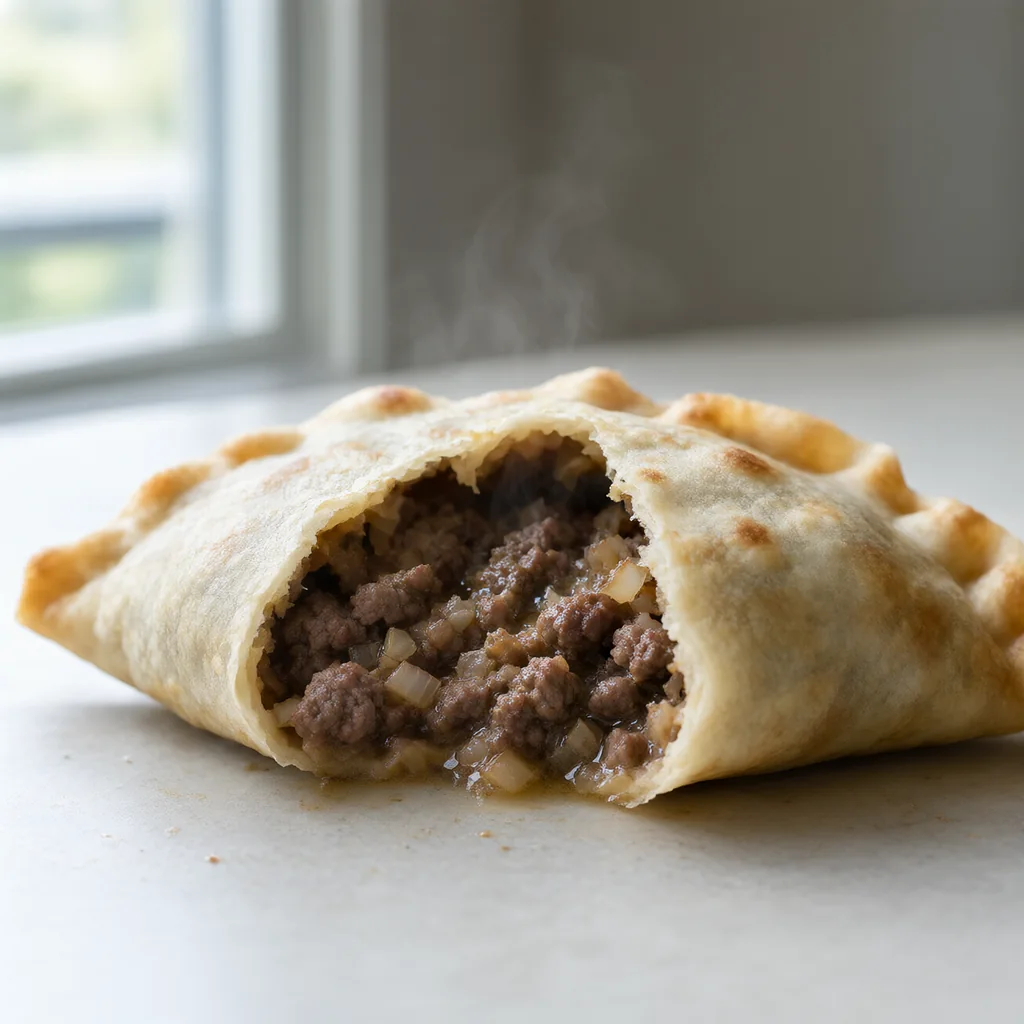
- Grate the onion on the large holes of a box grater and keep the juice. Mix it with the beef, cold water, 5 g salt and pepper. Stir hard for 1 minute until the mixture is sticky, loose and wet. Chill until needed.
- Cut the dough into 4 equal pieces (about 77 g each). Roll each into a round 22 cm across and about 2 mm thick, dusting lightly with flour.
- Spread a quarter of the filling (about 94 g) over half of each round, leaving a 1.5 cm border. Fold the empty half over the filling.
- Press out the air around the filling and press the edge firmly shut. Crimp with a fork, then check that no gaps remain.
- Heat the 300 ml of frying oil in a 26 cm skillet over medium-high heat until a scrap of dough sizzles at once, about 175°C (350°F).
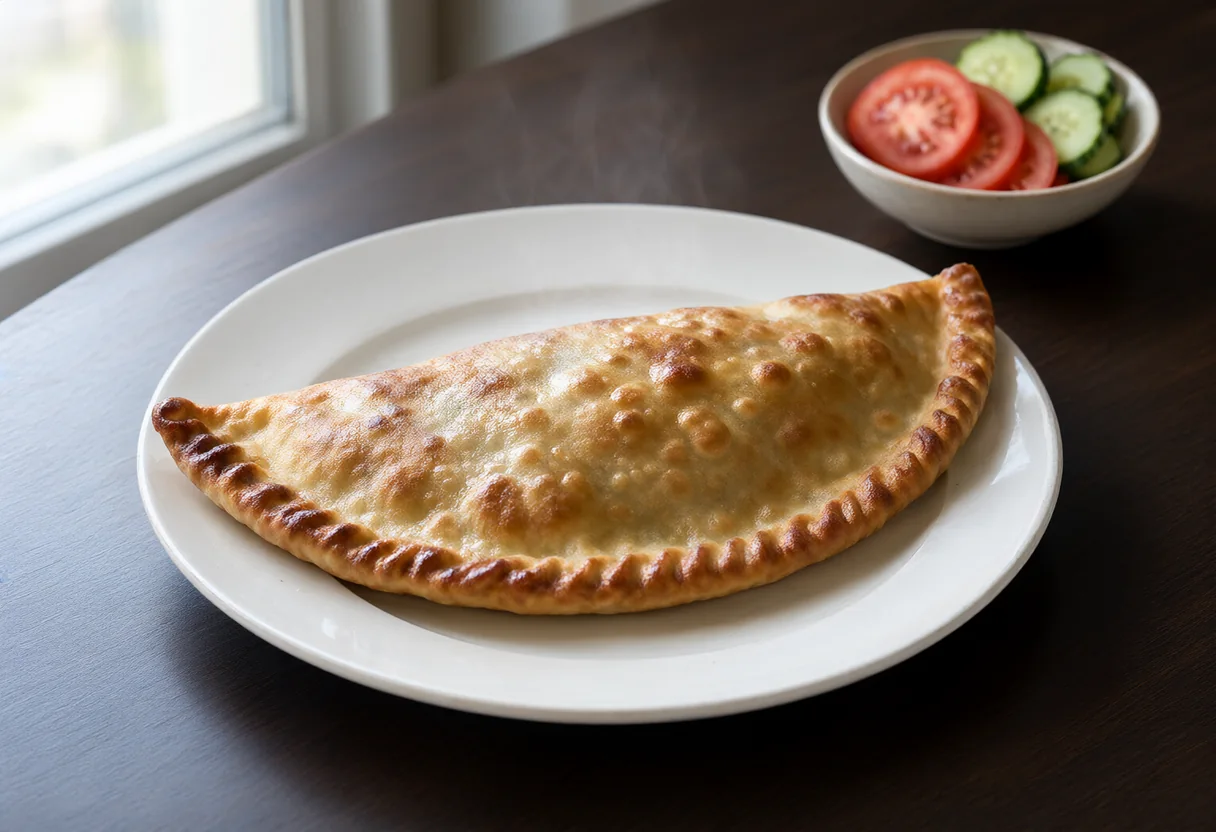
- Fry the cheburek one at a time for 2 to 3 minutes per side, until deep golden with blisters across the surface. Turn down the heat if it browns in under 2 minutes, so the meat has time to cook through.
- Lift out and drain on a wire rack or paper towels for 2 minutes. Serve hot.
Nutrition facts
One portion is 150 g (a 4-serving recipe, 600 g cooked). By portion, per 100 g or for any weight: calories in Cheburek.
| Nutrient | Per portion | Per 100 g | % DV |
|---|
| Energy and macronutrients |
|---|
| Energy | 458 kcal | 305 kcal | 23% |
|---|
| Protein | 15.6 g | 10.4 g | 31% |
|---|
| Carbohydrate | 39.2 g | 26.2 g | 14% |
|---|
| of which sugars | 0.98 g | 0.65 g | |
|---|
| Fiber | 1.7 g | 1.1 g | 6% |
|---|
| Fat | 26 g | 17.3 g | 33% |
|---|
| of which saturated | 6 g | 4 g | 30% |
|---|
| of which monounsaturated | 8 g | 5.3 g | |
|---|
| of which polyunsaturated | 9.4 g | 6.3 g | |
|---|
| Cholesterol | 42.6 mg | 28.4 mg | 14% |
|---|
| Minerals |
|---|
| Sodium | 818 mg | 545 mg | 36% |
|---|
| Potassium | 247 mg | 165 mg | 5% |
|---|
| Calcium | 25.4 mg | 16.9 mg | 2% |
|---|
| Iron | 3.5 mg | 2.3 mg | 19% |
|---|
| Magnesium | 23.7 mg | 15.8 mg | 6% |
|---|
| Phosphorus | 154 mg | 102 mg | 12% |
|---|
| Zinc | 2.9 mg | 1.9 mg | 26% |
|---|
| Copper | 0.12 mg | 0.08 mg | 14% |
|---|
| Manganese | 0.4 mg | 0.27 mg | 17% |
|---|
| Selenium | 25.6 µg | 17.1 µg | 47% |
|---|
| Vitamins |
|---|
| Vitamin A (RAE) | 2.5 µg | 1.6 µg | 0% |
|---|
| Vitamin C | 1.5 mg | 0.99 mg | 2% |
|---|
| Vitamin D | 0.06 µg | 0.04 µg | 0% |
|---|
| Vitamin E | 5.7 mg | 3.8 mg | 38% |
|---|
| Vitamin K | 2.4 µg | 1.6 µg | 2% |
|---|
| Thiamin (B1) | 0.42 mg | 0.28 mg | 35% |
|---|
| Riboflavin (B2) | 0.34 mg | 0.23 mg | 26% |
|---|
| Niacin (B3) | 5.4 mg | 3.6 mg | 34% |
|---|
| Pantothenic acid (B5) | 0.54 mg | 0.36 mg | 11% |
|---|
| Vitamin B6 | 0.24 mg | 0.16 mg | 14% |
|---|
| Folate (DFE) | 150 µg | 99.9 µg | 37% |
|---|
| Vitamin B12 | 1.3 µg | 0.86 µg | 54% |
|---|
| Choline | 40.2 mg | 26.8 mg | 7% |
|---|
Calculated from the weights in the ingredient list with USDA FoodData Central (SR Legacy) values; only what is eaten counts (drained oil, rinds and similar are left out). Vitamin losses in cooking are not modelled, and “≥” marks a value that is a lower bound because the table has no figure for some ingredients. % DV uses the FDA reference values for adults. Real dishes vary with ingredients and portion size.
People who log cheburek in Flog average about 290 kcal per 100 g, against 305 kcal per 100 g here.