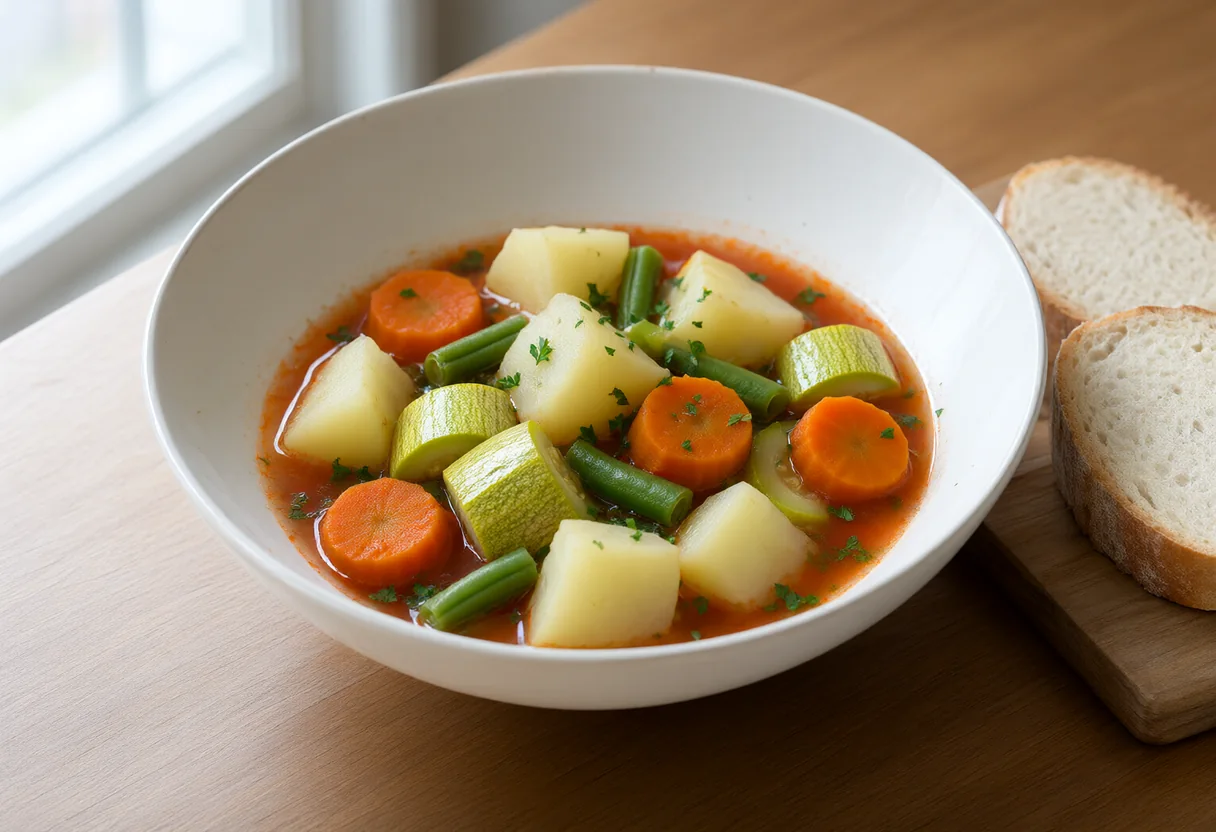
Ingredients
Serves 4. Prep 20 min, cook 50 min.
Base
- 1 1/2 tbsp (20 g) olive oil
- 1 large (about 150 g), diced into 1 cm pieces onion
- 3 medium (about 200 g), sliced into 1 cm rounds carrots
- 2 stalks (about 80 g), sliced 5 mm thick celery
- 3 cloves (about 10 g), minced garlic
- 1 tbsp (20 g) tomato paste
Stew
- 2 medium (about 250 g), cut into 2 cm cubes potatoes, peeled
- 1 can (400 g) canned diced tomatoes with their juice
- 450 ml (450 g) water
- 1 tsp (6 g) salt
- 1/2 tsp (1 g) black pepper, ground
- 1/2 tsp (1 g) dried thyme
- 1 leaf bay leaf
Added later
- 1 medium (about 200 g), cut into 2 cm pieces zucchini
- 100 g, cut into 3 cm pieces green beans, trimmed
To finish
- 1/4 cup (10 g) fresh parsley, chopped
Method
- Prepare the vegetables: dice the onion, slice the carrots and celery, mince the garlic, cube the potatoes, cut the zucchini and green beans. Keep the zucchini and green beans in a separate bowl.
- Heat the oil in a 5-liter (26 cm) heavy pot over medium heat for 1 minute. Add the onion, carrots and celery with the salt. Cook for 8 to 10 minutes, stirring often, until the onion is soft and translucent. Do not let it brown.
- Add the garlic and tomato paste and stir for 1 minute, until the paste darkens slightly and smells sweet.
- Add the potatoes, canned tomatoes with their juice, water, pepper, thyme and bay leaf. Stir and bring to a boil over high heat.
- Turn the heat down to low so the stew bubbles gently. Cover with the lid slightly open and cook for 15 minutes.
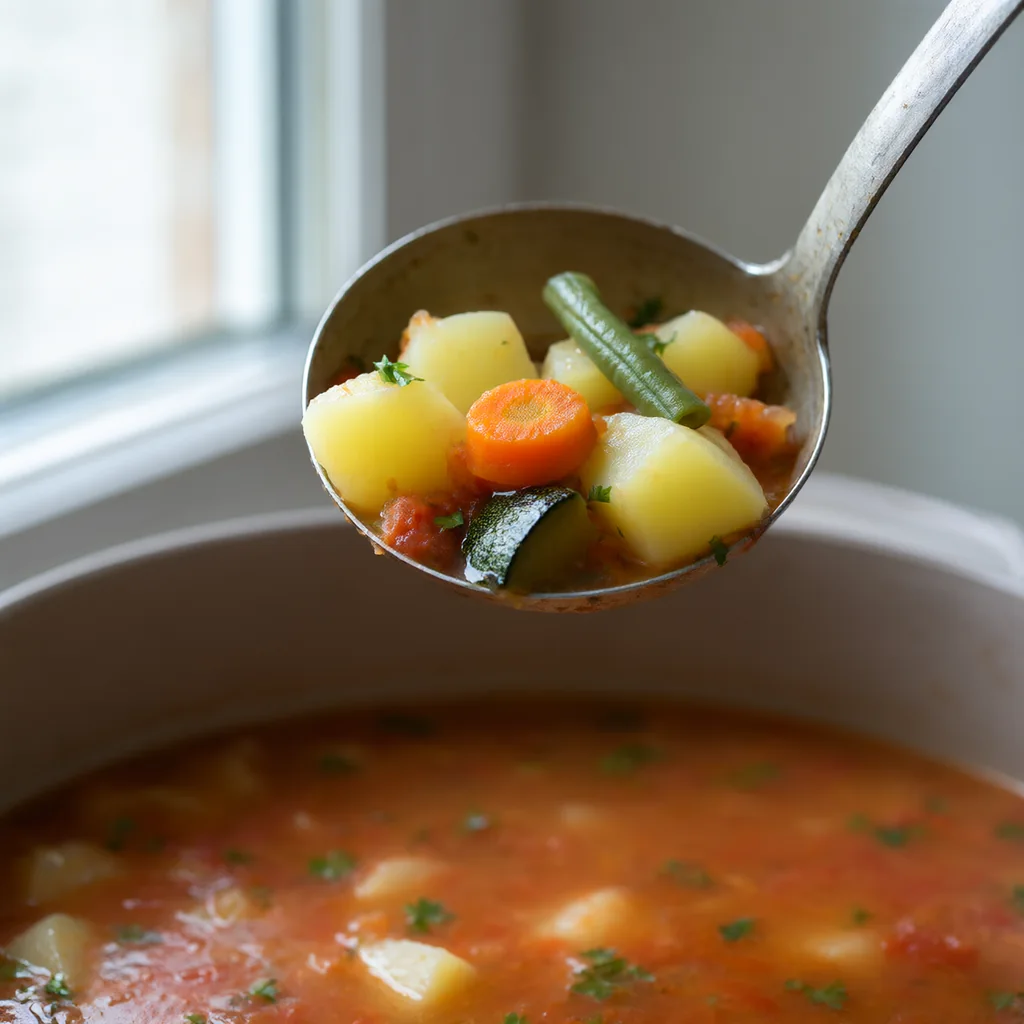
- Add the zucchini and green beans. Return to a gentle simmer and cook partly covered for another 15 minutes, until a knife slides easily into the potatoes and carrots and the green beans are tender.
- Take the lid off and simmer for 5 more minutes, until the broth is a little thicker. Take out the bay leaf, stir in the parsley and taste for salt. Serve hot in deep bowls.
Nutrition facts
One portion is 410 g (a 4-serving recipe, 1640 g cooked). By portion, per 100 g or for any weight: calories in Vegetable Stew.
| Nutrient | Per portion | Per 100 g | % DV |
|---|
| Energy and macronutrients |
|---|
| Energy | 168 kcal | 41 kcal | 8% |
|---|
| Protein | 4.4 g | 1.1 g | 9% |
|---|
| Carbohydrate | 27.7 g | 6.8 g | 10% |
|---|
| of which sugars | 10.2 g | 2.5 g | |
|---|
| Fiber | 7.4 g | 1.8 g | 27% |
|---|
| Fat | 5.8 g | 1.4 g | 7% |
|---|
| of which saturated | 0.86 g | 0.21 g | 4% |
|---|
| of which monounsaturated | 3.7 g | 0.91 g | |
|---|
| of which polyunsaturated | 0.82 g | 0.2 g | |
|---|
| Cholesterol | 0 mg | 0 mg | 0% |
|---|
| Minerals |
|---|
| Sodium | 773 mg | 189 mg | 34% |
|---|
| Potassium | 975 mg | 238 mg | 21% |
|---|
| Calcium | 108 mg | 26.4 mg | 8% |
|---|
| Iron | 2.3 mg | 0.57 mg | 13% |
|---|
| Magnesium | 56.4 mg | 13.8 mg | 13% |
|---|
| Phosphorus | 128 mg | 31.2 mg | 10% |
|---|
| Zinc | 0.85 mg | 0.21 mg | 8% |
|---|
| Copper | 0.26 mg | 0.06 mg | 29% |
|---|
| Manganese | 0.56 mg | 0.14 mg | 24% |
|---|
| Selenium | 2.1 µg | 0.51 µg | 4% |
|---|
| Vitamins |
|---|
| Vitamin A (RAE) | 471 µg | 115 µg | 52% |
|---|
| Vitamin C | 42 mg | 10.2 mg | 47% |
|---|
| Vitamin D | 0 µg | 0 µg | 0% |
|---|
| Vitamin E | 2.1 mg | 0.52 mg | 14% |
|---|
| Vitamin K | 78.4 µg | 19.1 µg | 65% |
|---|
| Thiamin (B1) | 0.73 mg | 0.18 mg | 61% |
|---|
| Riboflavin (B2) | 0.21 mg | 0.05 mg | 16% |
|---|
| Niacin (B3) | 2.6 mg | 0.64 mg | 16% |
|---|
| Pantothenic acid (B5) | 0.72 mg | 0.17 mg | 14% |
|---|
| Vitamin B6 | 0.53 mg | 0.13 mg | 31% |
|---|
| Folate (DFE) | 68.5 µg | 16.7 µg | 17% |
|---|
| Vitamin B12 | 0 µg | 0 µg | 0% |
|---|
| Choline | 32.7 mg | 8 mg | 6% |
|---|
Calculated from the weights in the ingredient list with USDA FoodData Central (SR Legacy) values; only what is eaten counts (drained oil, rinds and similar are left out). Vitamin losses in cooking are not modelled, and “≥” marks a value that is a lower bound because the table has no figure for some ingredients. % DV uses the FDA reference values for adults. Real dishes vary with ingredients and portion size.