Ingredients
Serves 4. Prep 20 min, cook 3 h 10 min.
Ragù
- 2 tsp (10 g) olive oil
- 1 medium (about 100 g) onion, finely chopped
- 1 medium (about 60 g) carrot, finely chopped
- 1 large stalk (about 50 g) celery, finely chopped
- 20 g pancetta, finely diced
- 130 g ground beef, about 15% fat
- 60 g ground pork
- 80 ml (80 g) whole milk
- 80 ml (80 g) dry white wine
- 4 tsp (20 g) tomato paste
- 250 g tomato passata (strained tomatoes)
- 60 ml (60 g), as needed water, hot, added during simmering
- 3/4 tsp (4 g) fine salt
- a few grinds (1 g) black pepper, freshly ground
Pasta
- 400 g dried spaghetti
- about 520 g (boil in 4 L of water with 40 g salt) water absorbed by the spaghetti while boiling
To serve
- 32 g (8 g per plate) Parmesan, finely grated
Method
- Heat the oil in a heavy pot about 24 cm wide and 3 L deep over medium heat. Add the pancetta and cook for 3 minutes, stirring, until the fat runs and it starts to color.
- Add the onion, carrot and celery. Cook for 12 minutes over medium-low heat, stirring often, until soft and golden but not brown.
- Raise the heat to medium-high. Add the beef and pork and the salt and pepper. Break the meat up with a wooden spoon and cook for 10 to 12 minutes, until all the liquid has gone and the meat is browned and starting to stick to the pot.
- Pour in the milk. Simmer for 5 minutes, stirring, until it has been absorbed.
- Pour in the wine. Simmer for 4 minutes until it has almost gone.
- Stir in the tomato paste, then the passata (strained tomatoes). Bring to a bare simmer and turn the heat down to the lowest setting. The surface should barely bubble.
- Cook with the lid ajar for 2 1/2 hours, stirring every 15 minutes and scraping the bottom. If it looks dry or starts to catch, add a splash of the hot water. Use all 60 ml over the cooking time. This leaves about 430 g of thick sauce.
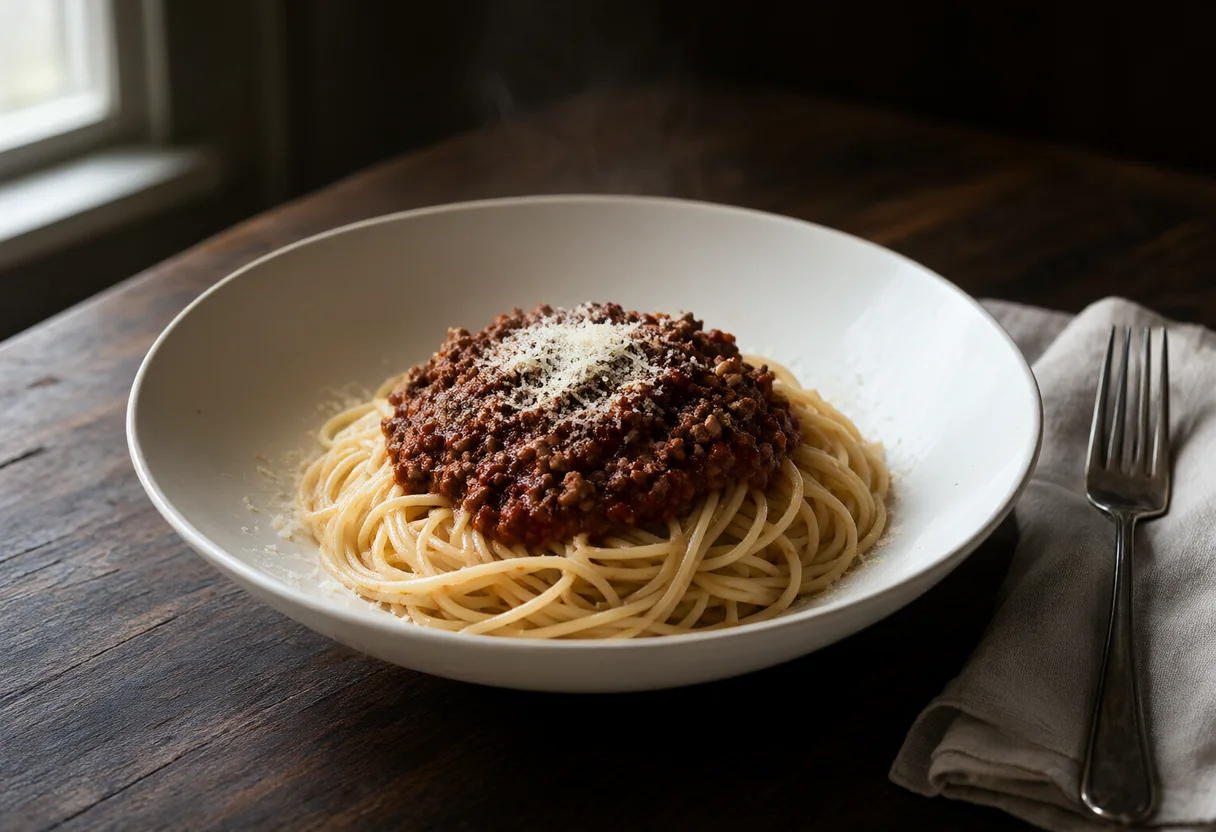
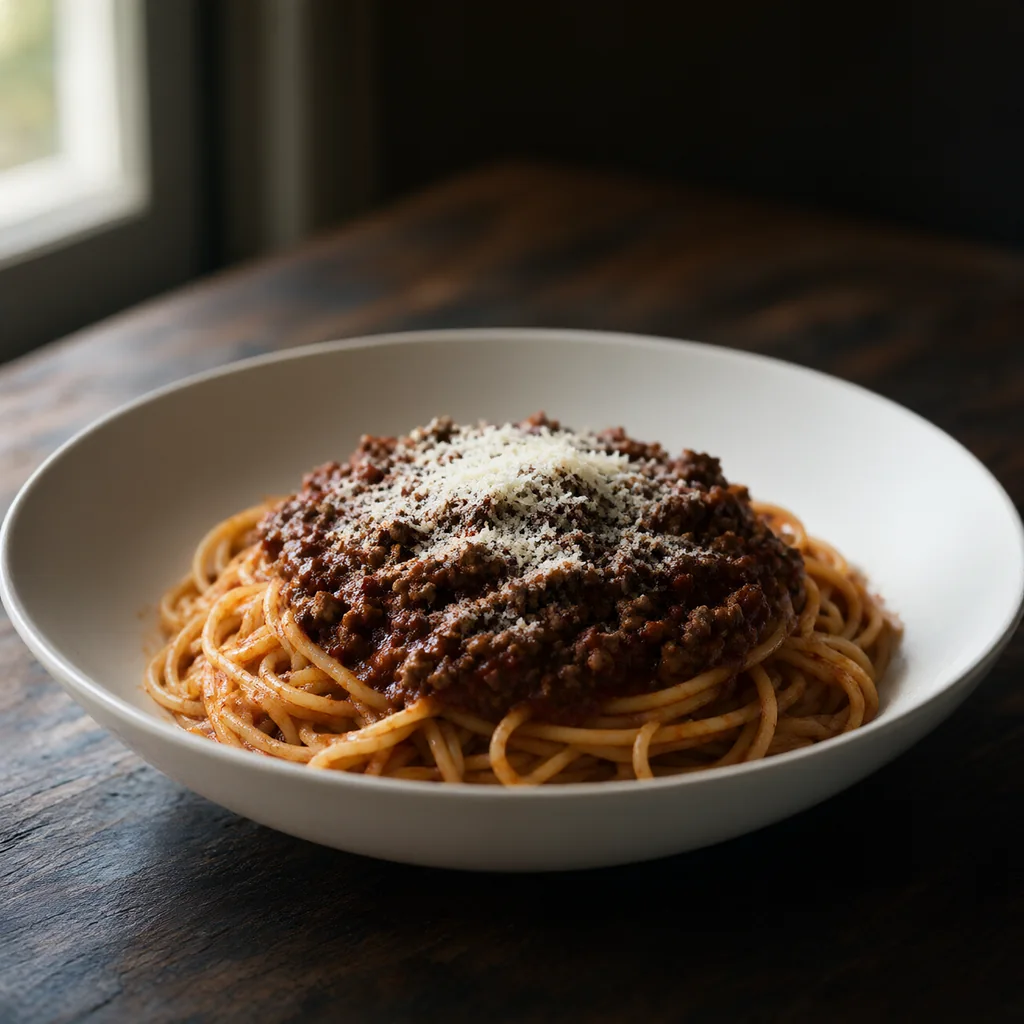
- Taste. Add salt if needed. The sauce should be thick, dark red and glossy, with a little fat on the surface, and no watery liquid on the spoon.
- When the sauce is nearly ready, bring 4 liters of water to a boil with 40 g salt. Cook the spaghetti for 1 minute less than the package time, usually 8 to 9 minutes. Keep a cup of the pasta water, then drain.
- Add the spaghetti to the sauce. Toss over low heat for 1 minute, adding a splash of pasta water if it is tight, until the sauce clings to every strand.
- Divide into 4 warm plates and top each with 8 g of Parmesan.
Nutrition facts
One portion is 345 g (a 4-serving recipe, 1380 g cooked). By portion, per 100 g or for any weight: calories in Spaghetti Bolognese.
| Nutrient | Per portion | Per 100 g | % DV |
|---|
| Energy and macronutrients |
|---|
| Energy | 613 kcal | 178 kcal | 31% |
|---|
| Protein | 27.5 g | 8 g | 55% |
|---|
| Carbohydrate | 85 g | 24.6 g | 31% |
|---|
| of which sugars | 8.7 g | 2.5 g | |
|---|
| Fiber | 5.5 g | 1.6 g | 19% |
|---|
| Fat | 16.1 g | 4.7 g | 21% |
|---|
| of which saturated | 5.5 g | 1.6 g | 27% |
|---|
| of which monounsaturated | 6.7 g | 1.9 g | |
|---|
| of which polyunsaturated | 1.8 g | 0.51 g | |
|---|
| Cholesterol | 43 mg | 12.5 mg | 14% |
|---|
| Minerals |
|---|
| Sodium | 893 mg | 259 mg | 39% |
|---|
| Potassium | 770 mg | 223 mg | 16% |
|---|
| Calcium | 180 mg | 52 mg | 14% |
|---|
| Iron | 5.2 mg | 1.5 mg | 29% |
|---|
| Magnesium | 88.5 mg | 25.6 mg | 21% |
|---|
| Phosphorus | 390 mg | 113 mg | 31% |
|---|
| Zinc | 3.8 mg | 1.1 mg | 35% |
|---|
| Copper | 0.46 mg | 0.13 mg | 51% |
|---|
| Manganese | 1.1 mg | 0.33 mg | 49% |
|---|
| Selenium | 77.3 µg | 22.4 µg | 140% |
|---|
| Vitamins |
|---|
| Vitamin A (RAE) | 173 µg | 50.2 µg | 19% |
|---|
| Vitamin C | 8.6 mg | 2.5 mg | 10% |
|---|
| Vitamin D | 0.41 µg | 0.12 µg | 2% |
|---|
| Vitamin E | 1.9 mg | 0.55 mg | 13% |
|---|
| Vitamin K | 10.8 µg | 3.1 µg | 9% |
|---|
| Thiamin (B1) | 1 mg | 0.3 mg | 85% |
|---|
| Riboflavin (B2) | 0.64 mg | 0.18 mg | 49% |
|---|
| Niacin (B3) | 10.9 mg | 3.2 mg | 68% |
|---|
| Pantothenic acid (B5) | 1.2 mg | 0.34 mg | 23% |
|---|
| Vitamin B6 | 0.51 mg | 0.15 mg | 30% |
|---|
| Folate (DFE) | 413 µg | 120 µg | 103% |
|---|
| Vitamin B12 | 1 µg | 0.3 µg | 43% |
|---|
| Choline | 63.3 mg | 18.4 mg | 12% |
|---|
Calculated from the weights in the ingredient list with USDA FoodData Central (SR Legacy) values; only what is eaten counts (drained oil, rinds and similar are left out). Vitamin losses in cooking are not modelled, and “≥” marks a value that is a lower bound because the table has no figure for some ingredients. % DV uses the FDA reference values for adults. Real dishes vary with ingredients and portion size.
People who log spaghetti bolognese in Flog average about 149 kcal per 100 g, against 178 kcal per 100 g here.