Ingredients
Serves 4. Prep 20 min, cook 65 min.
Chicken
- 1 whole (about 1.4 kg) whole chicken, with skin and bones
- 1 tbsp (14 g) unsalted butter, soft
- 1 1/2 tsp (8 g) salt
- 1/2 tsp (1 g) black pepper, ground
- 4 sprigs (3 g) fresh thyme sprigs
- 1/2 lemon (about 50 g) lemon half, left in the cavity
- 6 cloves (about 20 g), skins on garlic cloves, unpeeled
Vegetables
- 500 g, unpeeled, cut into 4 cm pieces Yukon Gold or other waxy potatoes
- 4 medium (about 250 g), cut into 4 cm chunks carrots
- 1 large (about 150 g), cut into 6 wedges onion
- 1 tbsp (14 g) vegetable oil
Pan juices
Method
- Take the chicken out of the fridge 30 minutes before roasting. Put a rack in the lower third of the oven and heat to 220 C (425 F). Pat the chicken completely dry with paper towels, inside and out. Dry skin is what makes it crisp.
- Mix the butter with 5 g of the salt, the pepper and the leaves of 2 thyme sprigs. Slide your fingers under the skin over the breast to loosen it, and push about half the butter under it. Rub the rest over the outside of the chicken.
- Put the lemon half, the garlic cloves and the other 2 thyme sprigs in the cavity. Tie the legs together with kitchen twine.
- Put the potatoes, carrots and onion in a roasting pan about 30 x 40 cm. Add the oil and the remaining 3 g of salt, and toss. Spread them out and set the chicken on top, breast side up, in the middle.
- Roast at 220 C for 20 minutes. Lower the oven to 190 C (375 F) and roast for 40 to 45 minutes more, stirring the vegetables around the chicken once halfway through. It is done when a thermometer in the thickest part of the thigh, not touching bone, reads 74 C (165 F) and the juices run clear.
- Move the chicken to a board, cover loosely with foil and rest it for 15 minutes. Lift the vegetables with a slotted spoon into an ovenproof dish and keep them in the turned-off oven.
- Tip the drippings from the pan into a jug and leave for 2 minutes. Spoon the clear fat off the top and discard it. Put the dark juices in a small saucepan with the water, scraping the browned bits from the roasting pan into it. Simmer for 5 minutes, until reduced by about a third.
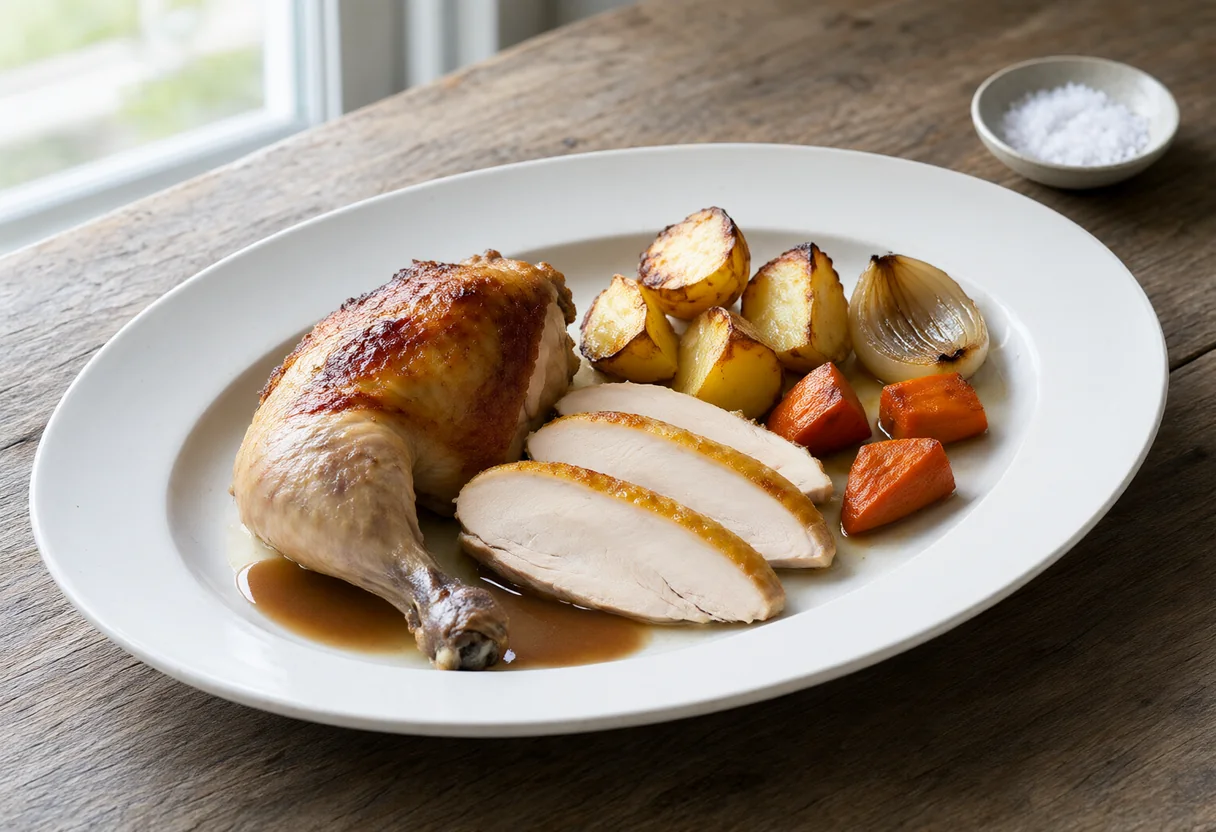
- Carve the chicken: cut off the legs and separate thighs from drumsticks, cut the breast meat off each side of the bone, and slice it. Serve a quarter of the meat (about 160 g) per person with the vegetables, the soft roasted garlic squeezed from its skins, and a spoonful of the juices.
Nutrition facts
One portion is 370 g (a 4-serving recipe, 1480 g cooked). By portion, per 100 g or for any weight: calories in Roast Chicken.
| Nutrient | Per portion | Per 100 g | % DV |
|---|
| Energy and macronutrients |
|---|
| Energy | 658 kcal | 178 kcal | 33% |
|---|
| Protein | 43.5 g | 11.8 g | 87% |
|---|
| Carbohydrate | 33.3 g | 9 g | 12% |
|---|
| of which sugars | 5.6 g | 1.5 g | |
|---|
| Fiber | 5.2 g | 1.4 g | 19% |
|---|
| Fat | 38.7 g | 10.5 g | 50% |
|---|
| of which saturated | 11.5 g | 3.1 g | 58% |
|---|
| of which monounsaturated | 14.9 g | 4 g | |
|---|
| of which polyunsaturated | 9.1 g | 2.5 g | |
|---|
| Cholesterol | 167 mg | 45.1 mg | 56% |
|---|
| Minerals |
|---|
| Sodium | 978 mg | 264 mg | 43% |
|---|
| Potassium | 1,220 mg | 328 mg | 26% |
|---|
| Calcium | 81.9 mg | 22.1 mg | 6% |
|---|
| Iron | 3.4 mg | 0.92 mg | 19% |
|---|
| Magnesium | 85.3 mg | 23.1 mg | 20% |
|---|
| Phosphorus | 426 mg | 115 mg | 34% |
|---|
| Zinc | 3.5 mg | 0.93 mg | 31% |
|---|
| Copper | 0.31 mg | 0.08 mg | 34% |
|---|
| Manganese | 0.5 mg | 0.13 mg | 22% |
|---|
| Selenium | 32.1 µg | 8.7 µg | 58% |
|---|
| Vitamins |
|---|
| Vitamin A (RAE) | 634 µg | 171 µg | 70% |
|---|
| Vitamin C | 36.8 mg | 10 mg | 41% |
|---|
| Vitamin D | 0.42 µg | 0.12 µg | 2% |
|---|
| Vitamin E | 1.4 mg | 0.39 mg | 10% |
|---|
| Vitamin K | 21.3 µg | 5.8 µg | 18% |
|---|
| Thiamin (B1) | 0.3 mg | 0.08 mg | 25% |
|---|
| Riboflavin (B2) | 0.35 mg | 0.09 mg | 27% |
|---|
| Niacin (B3) | 16.5 mg | 4.5 mg | 103% |
|---|
| Pantothenic acid (B5) | 2.6 mg | 0.69 mg | 51% |
|---|
| Vitamin B6 | 1.3 mg | 0.35 mg | 77% |
|---|
| Folate (DFE) | 51 µg | 13.8 µg | 13% |
|---|
| Vitamin B12 | 0.67 µg | 0.18 µg | 28% |
|---|
| Choline | 152 mg | 41 mg | 28% |
|---|
Calculated from the weights in the ingredient list with USDA FoodData Central (SR Legacy) values; only what is eaten counts (drained oil, rinds and similar are left out). Vitamin losses in cooking are not modelled, and “≥” marks a value that is a lower bound because the table has no figure for some ingredients. % DV uses the FDA reference values for adults. Real dishes vary with ingredients and portion size.
People who log roast chicken in Flog average about 151 kcal per 100 g, against 178 kcal per 100 g here.