Ingredients
Serves 4. Prep 75 min, cook 15 min.
Dough
- 300 g (about 2 1/2 cups) plain wheat flour
- 1 large (about 50 g) egg, large
- 125 g (125 ml) cold water
- 4 g (3/4 tsp) fine salt
Filling
- 200 g pork shoulder, boneless, ground
- 200 g beef chuck, ground
- 1 medium (about 110 g) onion, grated or finely minced
- 45 g (3 tbsp) ice-cold water
- 8 g (1 1/2 tsp) fine salt
- 2 g (1 tsp) black pepper, ground
To serve
- 40 g (3 tbsp) butter, unsalted
- 70 g (about 4 tbsp) sour cream
Method
- Mix the flour and 4 g salt in a large bowl. Make a well in the middle.
- Add the egg and cold water. Stir with a fork, then knead on the counter for 8 minutes, until the dough is smooth and firm. It should not stick to your hands.
- Cover the dough with an upturned bowl or wrap it in plastic wrap. Rest it for 30 minutes at room temperature.
- Meanwhile, mix the pork, beef, onion, 8 g salt and pepper in a bowl. Add the ice-cold water a spoon at a time, mixing with your hand until the filling is sticky and loose. Fry a small ball of it in a pan, taste, and adjust the salt.
- Cut the dough in 4 pieces. Keep the rest covered. Roll one piece on a floured counter to 2 mm thick.
- Cut circles with a 6 cm cutter or a small glass. Re-roll the scraps once.
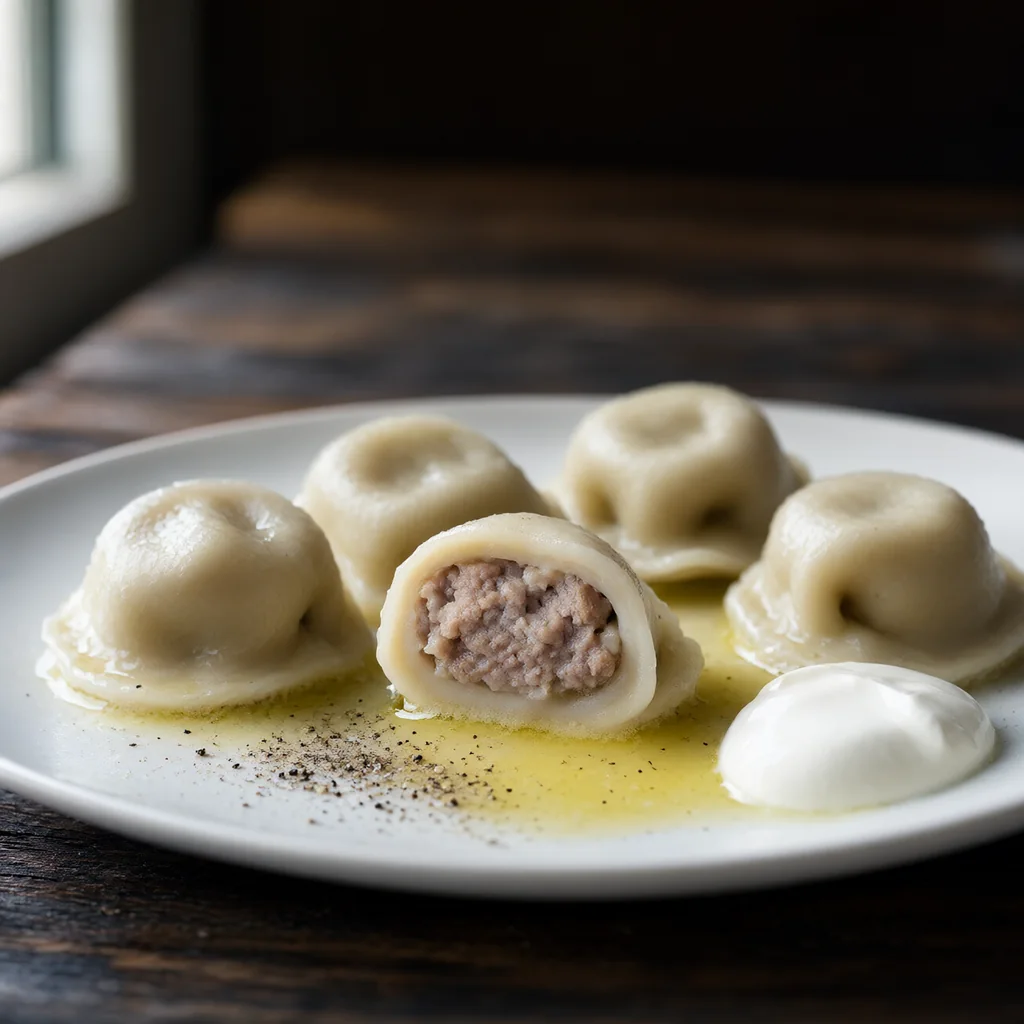
- Put 8 g of filling (a heaped teaspoon) in the middle of each circle. Fold into a half-moon and press the edge shut with no air inside.
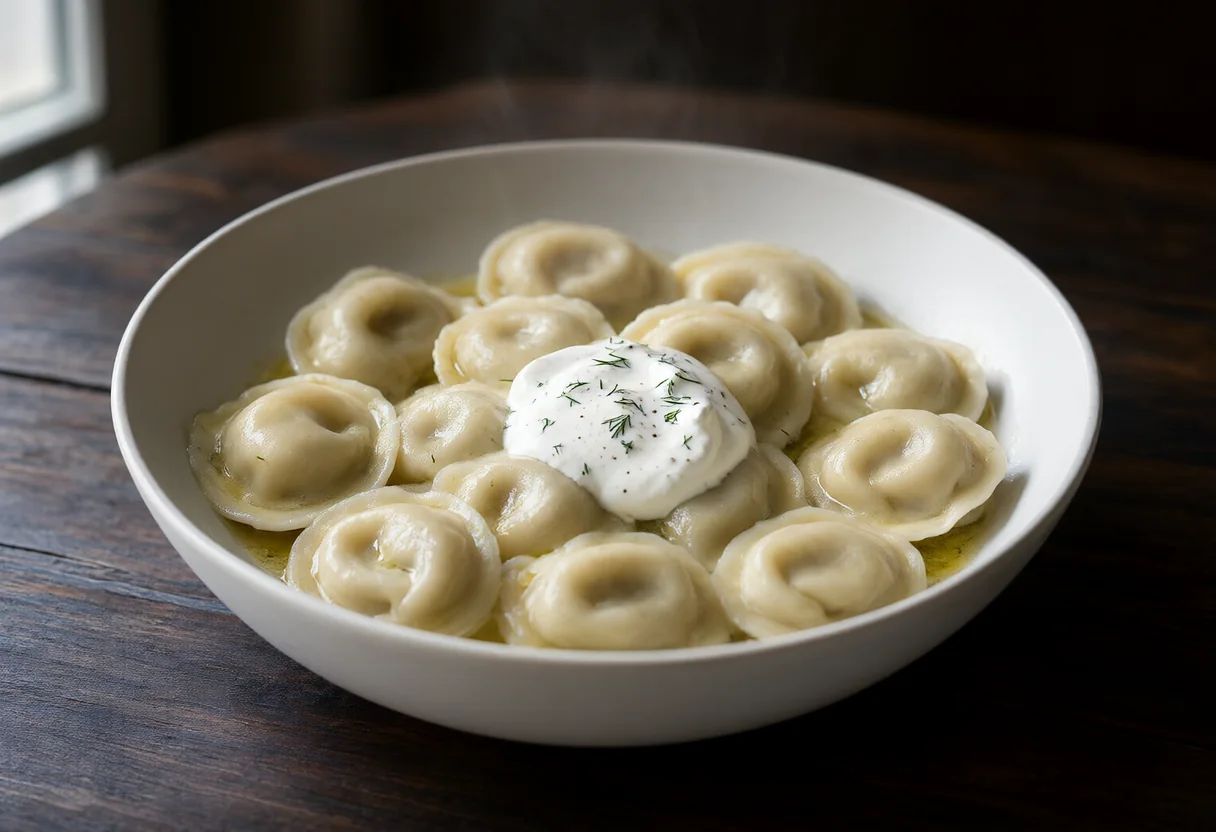
- Pull the two corners of the half-moon together over the filling and pinch them to make a ring. This makes about 72 pelmeni.
- Place the pelmeni on a floured tray in one layer, not touching. Use them now, or freeze the tray, then bag them.
- Bring 4 liters of water to a boil with 1 tbsp salt and 2 bay leaves if you have them. Lower the heat to a steady simmer.
- Add 36 pelmeni and stir once so they do not stick to the pot. When they float, simmer for 5 minutes more (7 to 8 minutes from frozen). Cut one open to check that the meat is gray, not pink.
- Lift them out with a slotted spoon and let the water drain. Keep them warm, then cook the second batch the same way.
- Divide among 4 warm bowls, 18 per bowl. Add 10 g butter to each and a spoonful of sour cream. Serve at once.
Nutrition facts
One portion is 290 g (a 4-serving recipe, 1160 g cooked). By portion, per 100 g or for any weight: calories in Pelmeni.
| Nutrient | Per portion | Per 100 g | % DV |
|---|
| Energy and macronutrients |
|---|
| Energy | 566 kcal | 195 kcal | 28% |
|---|
| Protein | 29.8 g | 10.3 g | 60% |
|---|
| Carbohydrate | 61.1 g | 21.1 g | 22% |
|---|
| of which sugars | 2 g | 0.7 g | |
|---|
| Fiber | 2.6 g | 0.9 g | 9% |
|---|
| Fat | 21.9 g | 7.5 g | 28% |
|---|
| of which saturated | 10.5 g | 3.6 g | 52% |
|---|
| of which monounsaturated | 7.4 g | 2.6 g | |
|---|
| of which polyunsaturated | 1.9 g | 0.67 g | |
|---|
| Cholesterol | 141 mg | 48.7 mg | 47% |
|---|
| Minerals |
|---|
| Sodium | 1,260 mg | 435 mg | 55% |
|---|
| Potassium | 511 mg | 176 mg | 11% |
|---|
| Calcium | 63.4 mg | 21.8 mg | 5% |
|---|
| Iron | 5.5 mg | 1.9 mg | 30% |
|---|
| Magnesium | 44.5 mg | 15.3 mg | 11% |
|---|
| Phosphorus | 332 mg | 114 mg | 27% |
|---|
| Zinc | 5.1 mg | 1.8 mg | 46% |
|---|
| Copper | 0.24 mg | 0.08 mg | 26% |
|---|
| Manganese | 0.63 mg | 0.22 mg | 28% |
|---|
| Selenium | 55.4 µg | 19.1 µg | 101% |
|---|
| Vitamins |
|---|
| Vitamin A (RAE) | 112 µg | 38.7 µg | 12% |
|---|
| Vitamin C | 2.2 mg | 0.76 mg | 2% |
|---|
| Vitamin D | 0.65 µg | 0.22 µg | 3% |
|---|
| Vitamin E | 0.68 mg | 0.23 mg | 5% |
|---|
| Vitamin K | 2.9 µg | 1 µg | 2% |
|---|
| Thiamin (B1) | 0.91 mg | 0.31 mg | 76% |
|---|
| Riboflavin (B2) | 0.73 mg | 0.25 mg | 56% |
|---|
| Niacin (B3) | 9.1 mg | 3.1 mg | 57% |
|---|
| Pantothenic acid (B5) | 1.7 mg | 0.59 mg | 34% |
|---|
| Vitamin B6 | 0.62 mg | 0.21 mg | 37% |
|---|
| Folate (DFE) | 232 µg | 80.1 µg | 58% |
|---|
| Vitamin B12 | 1.8 µg | 0.61 µg | 74% |
|---|
| Choline | 124 mg | 42.8 mg | 23% |
|---|
Calculated from the weights in the ingredient list with USDA FoodData Central (SR Legacy) values; only what is eaten counts (drained oil, rinds and similar are left out). Vitamin losses in cooking are not modelled, and “≥” marks a value that is a lower bound because the table has no figure for some ingredients. % DV uses the FDA reference values for adults. Real dishes vary with ingredients and portion size.
People who log pelmeni in Flog average about 212 kcal per 100 g, against 195 kcal per 100 g here.