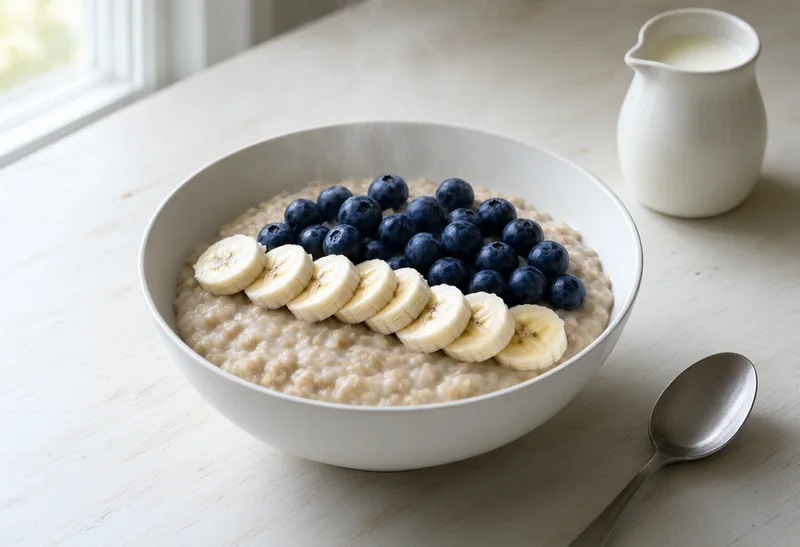
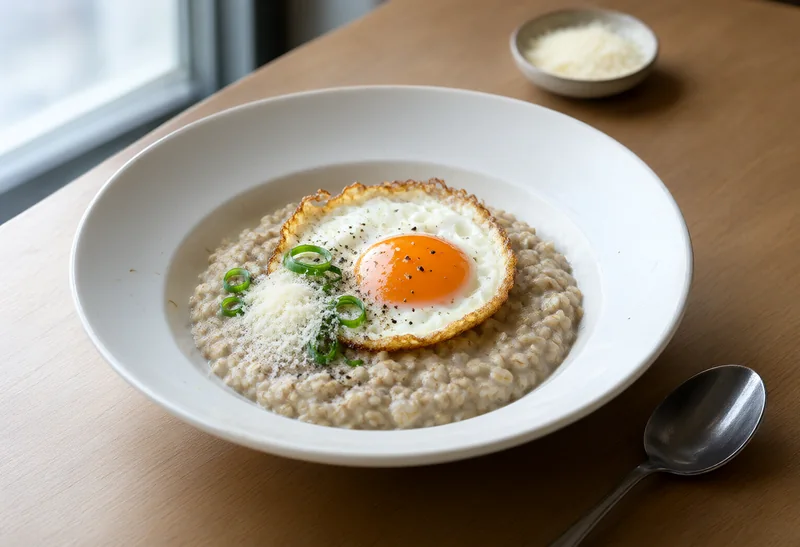
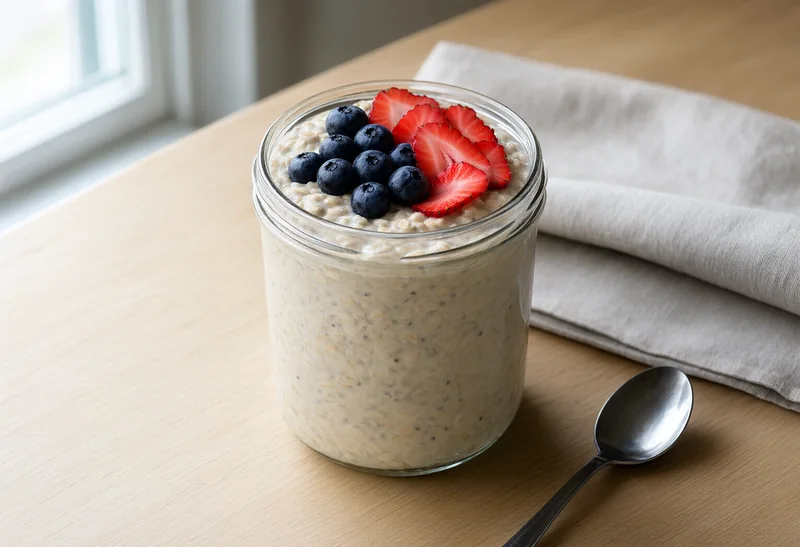
Oatmeal
The everyday stovetop oatmeal made with old-fashioned rolled oats and water, salted lightly. It is thick, creamy and soft with a little chew, and tastes mild and nutty.
- 2 servings
- 14 min in total
- International
- Vegan
- Dairy-free
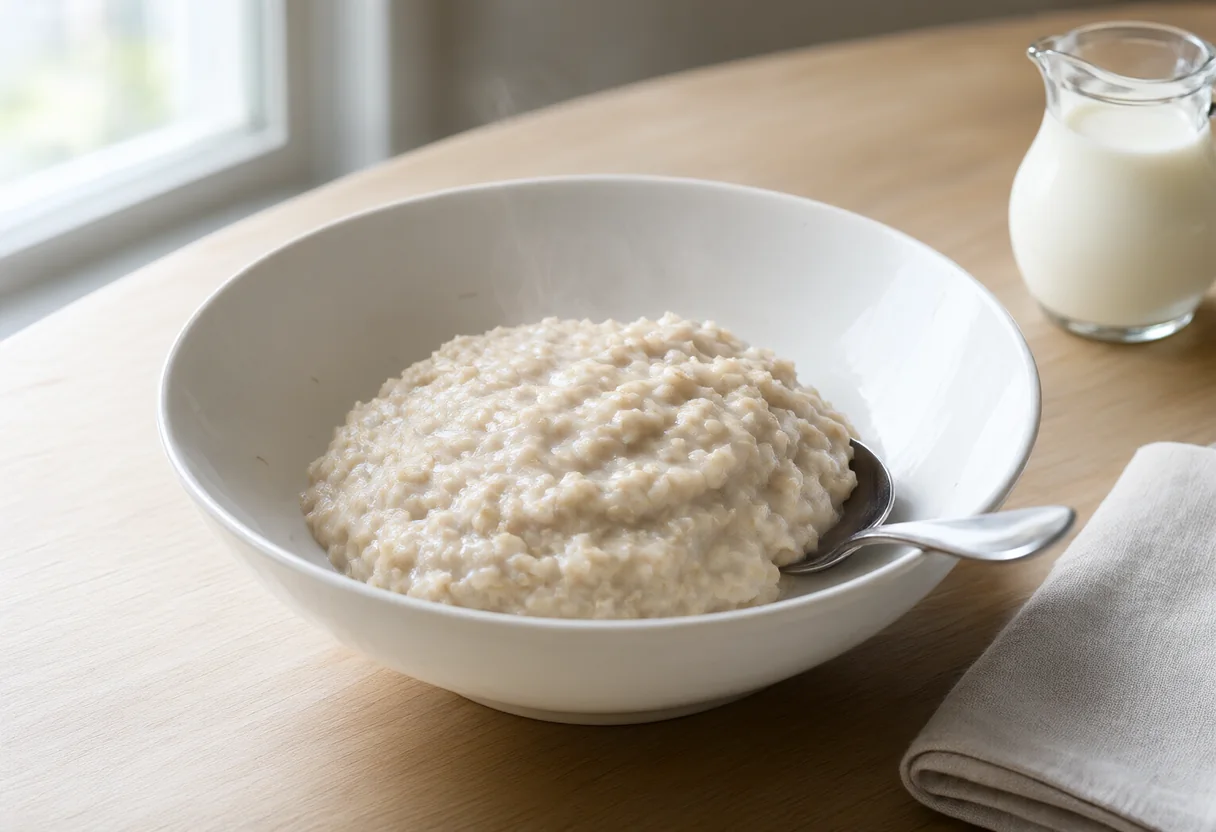
The everyday stovetop oatmeal made with old-fashioned rolled oats and water, salted lightly. It is thick, creamy and soft with a little chew, and tastes mild and nutty.
Serves 2. Prep 2 min, cook 10 min.
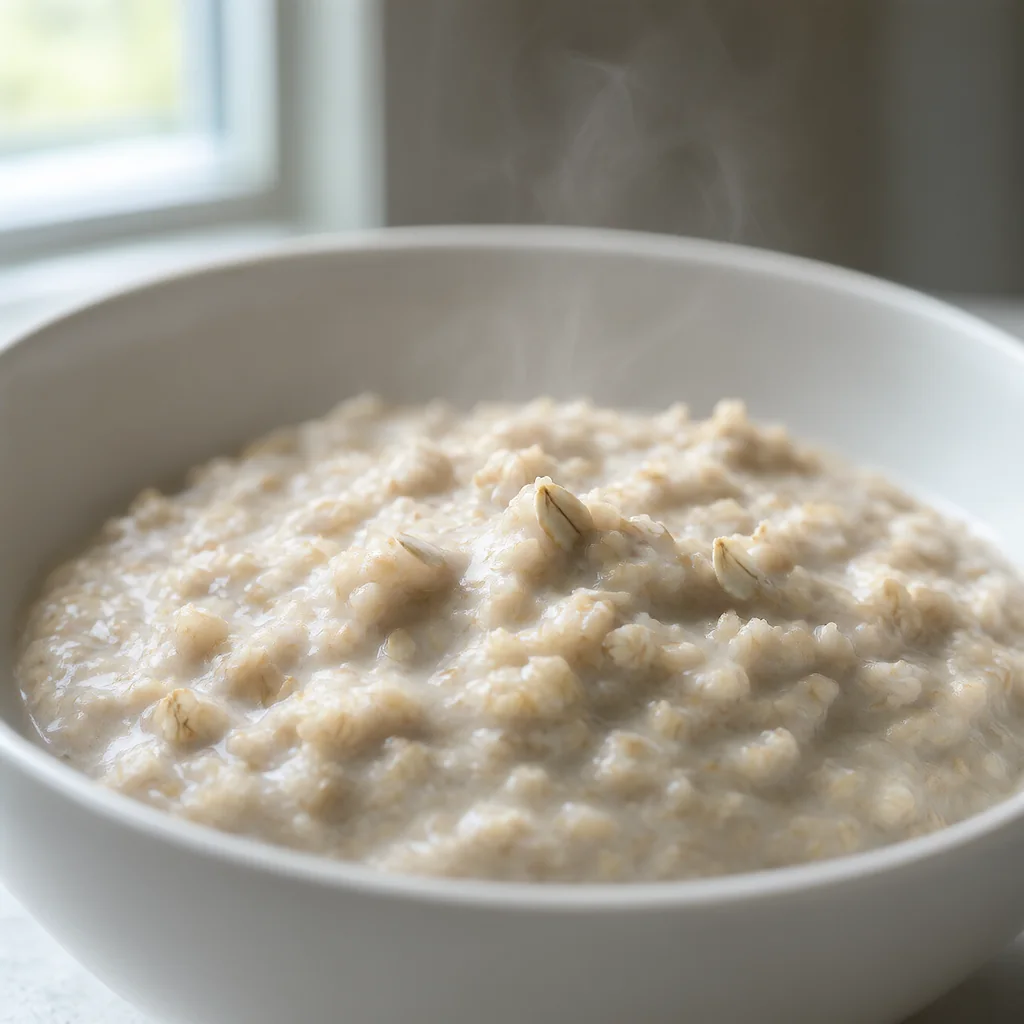
Keeps 4 days in the fridge in a covered container. Reheat in the microwave for 1 to 2 minutes with a splash of water or milk, stirring halfway.
One portion is 215 g (a 2-serving recipe, 430 g cooked). By portion, per 100 g or for any weight: calories in Oatmeal.
| Nutrient | Per portion | Per 100 g | % DV |
|---|---|---|---|
| Energy and macronutrients | |||
| Energy | 152 kcal | 70.5 kcal | 8% |
| Protein | 5.3 g | 2.5 g | 11% |
| Carbohydrate | 27.1 g | 12.6 g | 10% |
| of which sugars | 0.4 g | 0.18 g | |
| Fiber | 4 g | 1.9 g | 14% |
| Fat | 2.6 g | 1.2 g | 3% |
| of which saturated | 0.44 g | 0.21 g | 2% |
| of which monounsaturated | 0.79 g | 0.37 g | |
| of which polyunsaturated | 0.92 g | 0.43 g | |
| Cholesterol | 0 mg | 0 mg | 0% |
| Minerals | |||
| Sodium | 301 mg | 140 mg | 13% |
| Potassium | 145 mg | 67.4 mg | 3% |
| Calcium | 27 mg | 12.5 mg | 2% |
| Iron | 1.7 mg | 0.79 mg | 9% |
| Magnesium | 57.2 mg | 26.6 mg | 14% |
| Phosphorus | 164 mg | 76.3 mg | 13% |
| Zinc | 1.5 mg | 0.69 mg | 13% |
| Copper | 0.18 mg | 0.08 mg | 20% |
| Manganese | 1.4 mg | 0.68 mg | 63% |
| Selenium | 11.6 µg | 5.4 µg | 21% |
| Vitamins | |||
| Vitamin A (RAE) | 0 µg | 0 µg | 0% |
| Vitamin C | 0 mg | 0 mg | 0% |
| Vitamin D | 0 µg | 0 µg | 0% |
| Vitamin E | 0.17 mg | 0.08 mg | 1% |
| Vitamin K | 0.8 µg | 0.37 µg | 1% |
| Thiamin (B1) | 0.18 mg | 0.09 mg | 15% |
| Riboflavin (B2) | 0.06 mg | 0.03 mg | 5% |
| Niacin (B3) | 0.45 mg | 0.21 mg | 3% |
| Pantothenic acid (B5) | 0.45 mg | 0.21 mg | 9% |
| Vitamin B6 | 0.04 mg | 0.02 mg | 2% |
| Folate (DFE) | 12.8 µg | 6 µg | 3% |
| Vitamin B12 | 0 µg | 0 µg | 0% |
| Choline | 16.2 mg | 7.5 mg | 3% |
Calculated from the weights in the ingredient list with USDA FoodData Central (SR Legacy) values; only what is eaten counts (drained oil, rinds and similar are left out). Vitamin losses in cooking are not modelled, and “≥” marks a value that is a lower bound because the table has no figure for some ingredients. % DV uses the FDA reference values for adults. Real dishes vary with ingredients and portion size.
People who log oatmeal in Flog average about 71.1 kcal per 100 g, against 70.5 kcal per 100 g here.
Photograph a meal and Flog works out the nutrition for you, including the 25+ vitamins and minerals shown here. Free on iPhone, no account.