Ingredients
Serves 4. Prep 25 min, cook 80 min.
Braising liquid
- 800 ml (800 g) water
- 5 tbsp (90 g) light soy sauce
- 1 tbsp (15 g) dark soy sauce
- 40 ml (40 g) Shaoxing wine
- 2 tbsp (25 g) rock sugar (or granulated sugar)
- 4 slices (20 g) ginger, sliced
- 4 cloves (15 g) garlic, smashed
- 2 scallions (25 g), white parts, cut in half scallion whites
- 2 whole pods (4 g) star anise
- 1 stick, 7 cm (3 g) cinnamon stick
- 1/2 tsp (1 g) Sichuan peppercorns
- 2 leaves (1 g) bay leaf
Braised items
- 4 large (200 g) eggs, hard-boiled and peeled
- 160 g, cut into 2 cm pieces pork shoulder, boneless
- 160 g, cut into 2.5 cm cubes firm tofu
- 160 g, cut into 2 cm thick half-moons daikon, peeled
- 80 g (4 caps) fresh shiitake mushrooms, stems removed
Noodles and serving
- 270 g dried wheat noodles, thin
- 2 heads (160 g), halved lengthwise baby bok choy
- 220 ml (220 g) boiling water, to thin the broth
- 4 tsp (20 g) chili oil, with some of the flakes
- 2 scallions (24 g), sliced thin scallion greens
- 12 g, leaves and tender stems cilantro
Method
- Boil the eggs for 8 minutes in a pot of boiling water. Cool in cold water, then peel.
- Put the pork in a pot, cover with cold water, and bring to a boil. Boil for 2 minutes, drain and rinse under cold water. This keeps the braising liquid clear.
- In a wide 3 liter pot, combine the water, both soy sauces, wine, sugar, ginger, garlic, scallion whites, star anise, cinnamon, Sichuan peppercorns and bay leaves. Bring to a boil, add the pork, and return to a gentle simmer.
- Cover with the lid slightly open and simmer over low heat for 30 minutes, until the pork is nearly tender.
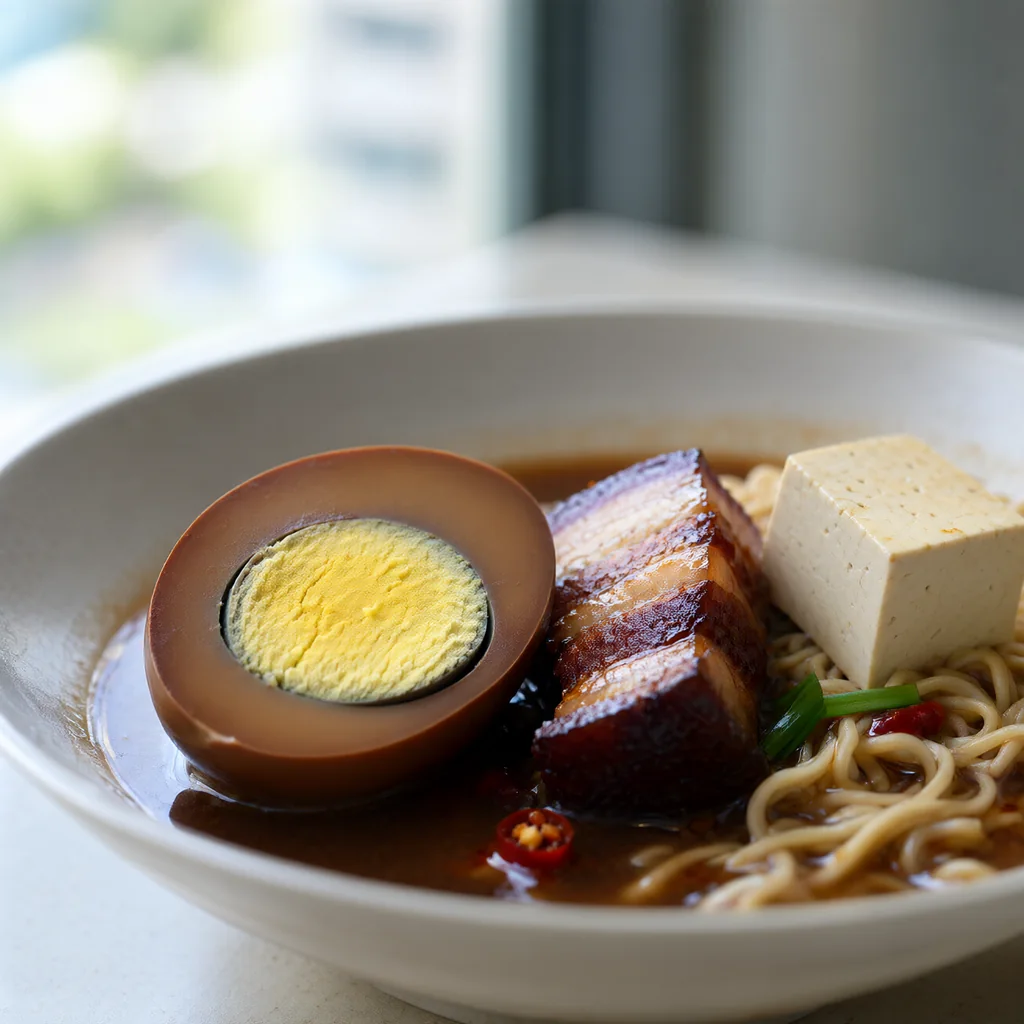
- Add the daikon, shiitake, tofu and peeled eggs. Push them down so they sit in the liquid. Simmer for 20 more minutes, turning everything over once or twice, until the daikon is tender and the eggs are deep brown. Turn off the heat and let everything sit in the liquid for 15 minutes.
- Bring a large pot of water to a boil. Cook the noodles as the package says (about 4 minutes), adding the bok choy for the last 1 minute. Drain well.
- Divide the noodles and bok choy among 4 deep bowls. In each bowl, pour 75 ml of the hot braising liquid and 55 ml of boiling water.
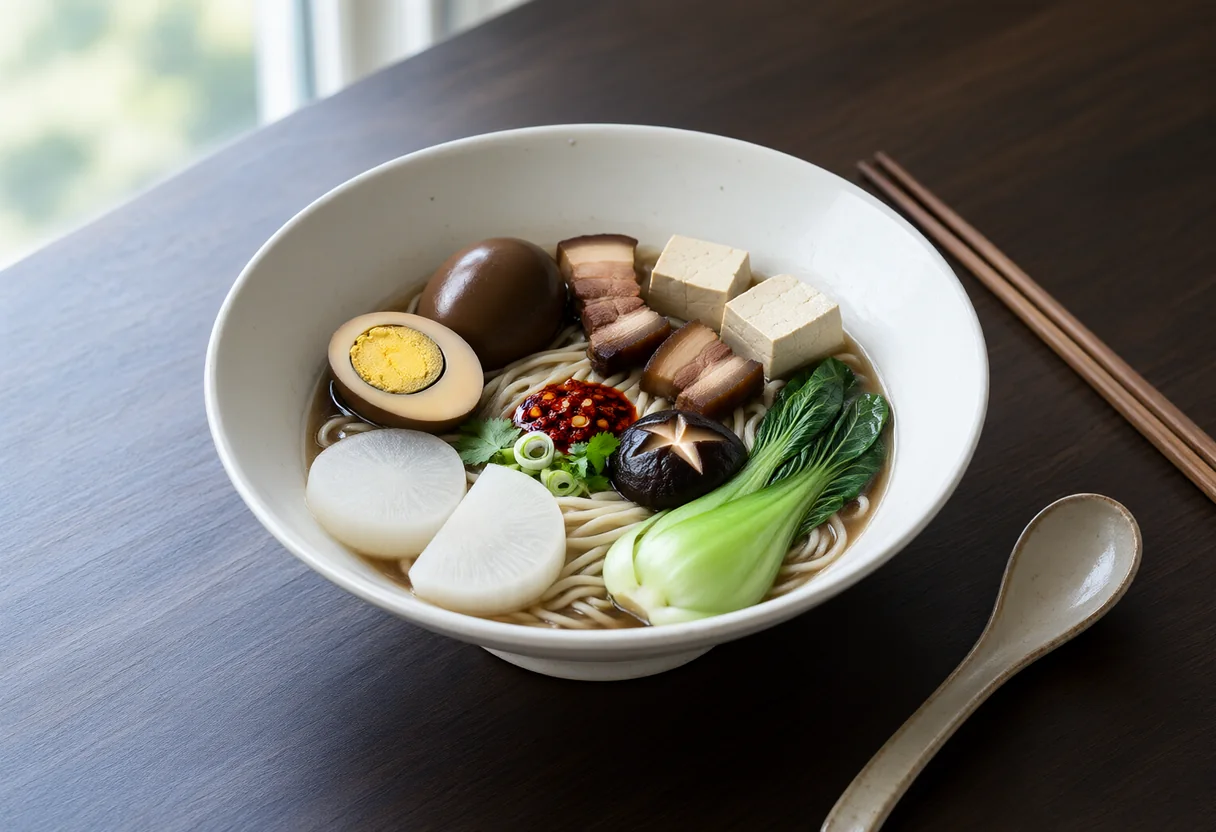
- Lift the braised items out of the pot and arrange them on the noodles: 1 egg, cut in half, a quarter of the pork, tofu, daikon and shiitake per bowl. Top each with 1 teaspoon of chili oil, scallion greens and cilantro. Strain the leftover liquid and keep it.
Nutrition facts
One portion is 510 g (a 4-serving recipe, 2040 g cooked). By portion, per 100 g or for any weight: calories in Lu Wei Noodles.
| Nutrient | Per portion | Per 100 g | % DV |
|---|
| Energy and macronutrients |
|---|
| Energy | 565 kcal | 111 kcal | 28% |
|---|
| Protein | 30.6 g | 6 g | 61% |
|---|
| Carbohydrate | 61.6 g | 12.1 g | 22% |
|---|
| of which sugars | ≥ 7.1 g | ≥ 1.4 g | |
|---|
| Fiber | 5.7 g | 1.1 g | 21% |
|---|
| Fat | 21.9 g | 4.3 g | 28% |
|---|
| of which saturated | 5.5 g | 1.1 g | 28% |
|---|
| of which monounsaturated | 7.2 g | 1.4 g | |
|---|
| of which polyunsaturated | 6.6 g | 1.3 g | |
|---|
| Cholesterol | 215 mg | 42.1 mg | 72% |
|---|
| Minerals |
|---|
| Sodium | 2,380 mg | 467 mg | 103% |
|---|
| Potassium | 756 mg | 148 mg | 16% |
|---|
| Calcium | 389 mg | 76.3 mg | 30% |
|---|
| Iron | 4 mg | 0.78 mg | 22% |
|---|
| Magnesium | 89 mg | 17.5 mg | 21% |
|---|
| Phosphorus | 369 mg | 72.3 mg | 30% |
|---|
| Zinc | 3.1 mg | 0.6 mg | 28% |
|---|
| Copper | 0.4 mg | 0.08 mg | 45% |
|---|
| Manganese | 1.1 mg | 0.22 mg | 50% |
|---|
| Selenium | 40 µg | 7.8 µg | 73% |
|---|
| Vitamins |
|---|
| Vitamin A (RAE) | 178 µg | 34.8 µg | 20% |
|---|
| Vitamin C | 29.1 mg | 5.7 mg | 32% |
|---|
| Vitamin D | 1.9 µg | 0.36 µg | 9% |
|---|
| Vitamin E | ≥ 1.1 mg | ≥ 0.22 mg | 8% |
|---|
| Vitamin K | ≥ 49.4 µg | ≥ 9.7 µg | 41% |
|---|
| Thiamin (B1) | 0.51 mg | 0.1 mg | 42% |
|---|
| Riboflavin (B2) | 0.54 mg | 0.11 mg | 42% |
|---|
| Niacin (B3) | 3.8 mg | 0.75 mg | 24% |
|---|
| Pantothenic acid (B5) | 1.8 mg | 0.36 mg | 37% |
|---|
| Vitamin B6 | 0.46 mg | 0.09 mg | 27% |
|---|
| Folate (DFE) | 93.5 µg | 18.3 µg | 23% |
|---|
| Vitamin B12 | 0.85 µg | 0.17 µg | 35% |
|---|
| Choline | ≥ 181 mg | ≥ 35.5 mg | 33% |
|---|
Calculated from the weights in the ingredient list with USDA FoodData Central (SR Legacy) values; only what is eaten counts (drained oil, rinds and similar are left out). Vitamin losses in cooking are not modelled, and “≥” marks a value that is a lower bound because the table has no figure for some ingredients. % DV uses the FDA reference values for adults. Real dishes vary with ingredients and portion size.