Ingredients
Serves 4. Prep 15 min, cook 50 min.
Curry
- 180 g (about 1 scant cup) red lentils, split
- 2 cans of 400 g, drained (about 480 g) chickpeas, canned, drained and rinsed
- 3 tbsp (41 g) sunflower or vegetable oil
- 1 tsp (3 g) cumin seeds
- 2 medium (about 220 g), finely chopped onions
- 5 cloves (15 g) garlic, minced
- a 4 cm piece (20 g) fresh ginger, grated
- 1 or 2 small (8 g) green chili, minced
- 1 tsp (3 g) ground turmeric
- 1 tbsp (6 g) ground coriander
- 1 tsp (3 g) red chili powder
- 1 can (400 g) canned crushed tomatoes
- 950 ml (950 g) water
- 2 tsp (12 g) salt
- 1 tsp (3 g) garam masala
- 4 tsp (20 g) lemon juice
- 1 small handful (15 g) fresh cilantro, chopped
Rice
- 270 g (1 1/2 cups) basmati rice
- 500 ml (500 g) water
- 1/2 tsp (3 g) salt
Method
- Rinse the lentils in a bowl of cold water, changing the water 3 or 4 times, until it runs almost clear. Drain. Rinse the rice the same way until the water is clear, and drain.
- Heat the oil in a heavy 4 liter pot over medium heat for 1 minute. Add the cumin seeds and cook for about 30 seconds, until they sizzle and darken a little.
- Add the onions and cook for 8 to 10 minutes, stirring often, until soft and golden brown.
- Add the garlic, ginger and green chili and stir for 1 minute. Add the turmeric, coriander and chili powder and stir for 30 seconds.
- Add the tomatoes and 12 g salt. Cook for 5 minutes, stirring, until the mixture is thick and the oil shows at the edges.
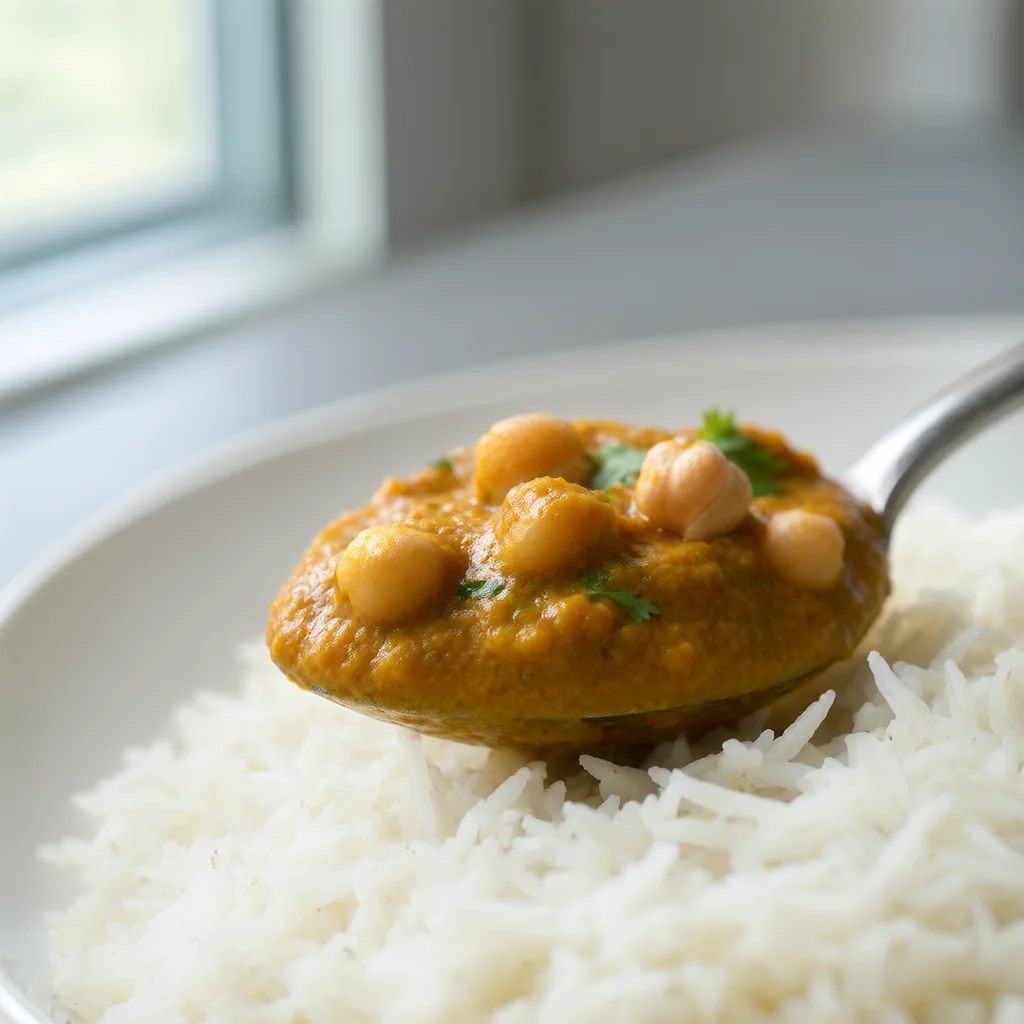
- Add the lentils, chickpeas and 950 ml water. Bring to a boil, skim off any foam, then turn the heat down to a low simmer. Cook partly covered for 30 to 35 minutes, stirring every 5 minutes and scraping the bottom, until the lentils have fallen apart and the curry is thick.
- While the curry simmers, put the rice, 500 ml water and 3 g salt in a 2 liter saucepan with a lid. Bring to a boil, stir once, cover, and cook over the lowest heat for 12 minutes. Turn off the heat and leave covered for 10 minutes. Fluff with a fork.
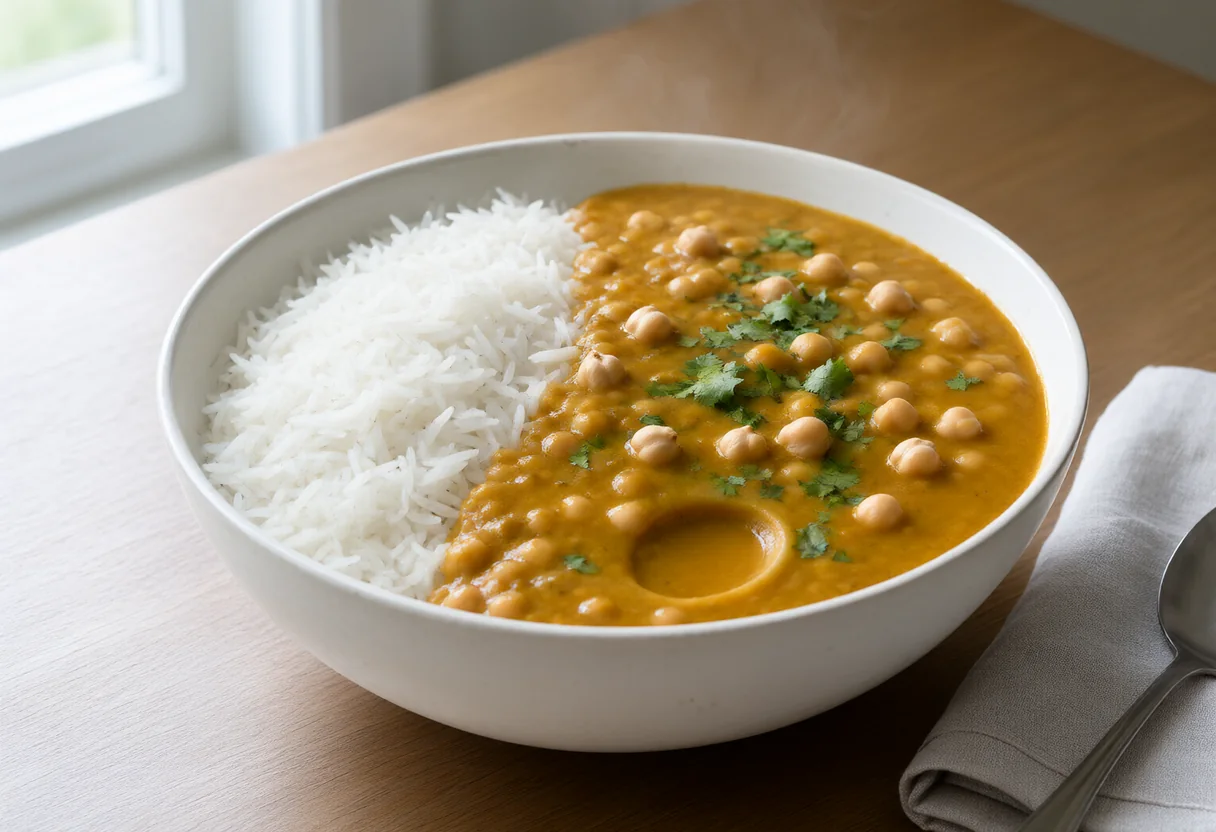
- Stir the garam masala and lemon juice into the curry and taste for salt. Serve about 190 g of rice per bowl with about 480 g of curry on top, and scatter with cilantro.
Nutrition facts
One portion is 665 g (a 4-serving recipe, 2660 g cooked). By portion, per 100 g or for any weight: calories in Dal and Chickpea Curry with Rice.
| Nutrient | Per portion | Per 100 g | % DV |
|---|
| Energy and macronutrients |
|---|
| Energy | 744 kcal | 112 kcal | 37% |
|---|
| Protein | 27.3 g | 4.1 g | 55% |
|---|
| Carbohydrate | 127 g | 19.2 g | 46% |
|---|
| of which sugars | 12.1 g | 1.8 g | |
|---|
| Fiber | 18 g | 2.7 g | 64% |
|---|
| Fat | 15.7 g | 2.4 g | 20% |
|---|
| of which saturated | 1.8 g | 0.26 g | 9% |
|---|
| of which monounsaturated | 3.4 g | 0.51 g | |
|---|
| of which polyunsaturated | 8.8 g | 1.3 g | |
|---|
| Cholesterol | 0 mg | 0 mg | 0% |
|---|
| Minerals |
|---|
| Sodium | 1,940 mg | 292 mg | 85% |
|---|
| Potassium | 1,020 mg | 154 mg | 22% |
|---|
| Calcium | 187 mg | 28.1 mg | 14% |
|---|
| Iron | 10.5 mg | 1.6 mg | 58% |
|---|
| Magnesium | 119 mg | 17.8 mg | 28% |
|---|
| Phosphorus | 382 mg | 57.4 mg | 31% |
|---|
| Zinc | 3.8 mg | 0.57 mg | 34% |
|---|
| Copper | 1.4 mg | 0.2 mg | 151% |
|---|
| Manganese | 3.1 mg | 0.47 mg | 135% |
|---|
| Selenium | 16.3 µg | 2.5 µg | 30% |
|---|
| Vitamins |
|---|
| Vitamin A (RAE) | 39 µg | 5.9 µg | 4% |
|---|
| Vitamin C | 23.8 mg | 3.6 mg | 26% |
|---|
| Vitamin D | 0 µg | 0 µg | 0% |
|---|
| Vitamin E | 6.6 mg | 0.99 mg | 44% |
|---|
| Vitamin K | 23.9 µg | 3.6 µg | 20% |
|---|
| Thiamin (B1) | 0.78 mg | 0.12 mg | 65% |
|---|
| Riboflavin (B2) | 0.2 mg | 0.03 mg | 15% |
|---|
| Niacin (B3) | 5.3 mg | 0.79 mg | 33% |
|---|
| Pantothenic acid (B5) | 1.3 mg | 0.19 mg | 25% |
|---|
| Vitamin B6 | 0.74 mg | 0.11 mg | 43% |
|---|
| Folate (DFE) | 431 µg | 64.8 µg | 108% |
|---|
| Vitamin B12 | 0 µg | 0 µg | 0% |
|---|
| Choline | ≥ 25 mg | ≥ 3.8 mg | 5% |
|---|
Calculated from the weights in the ingredient list with USDA FoodData Central (SR Legacy) values; only what is eaten counts (drained oil, rinds and similar are left out). Vitamin losses in cooking are not modelled, and “≥” marks a value that is a lower bound because the table has no figure for some ingredients. % DV uses the FDA reference values for adults. Real dishes vary with ingredients and portion size.