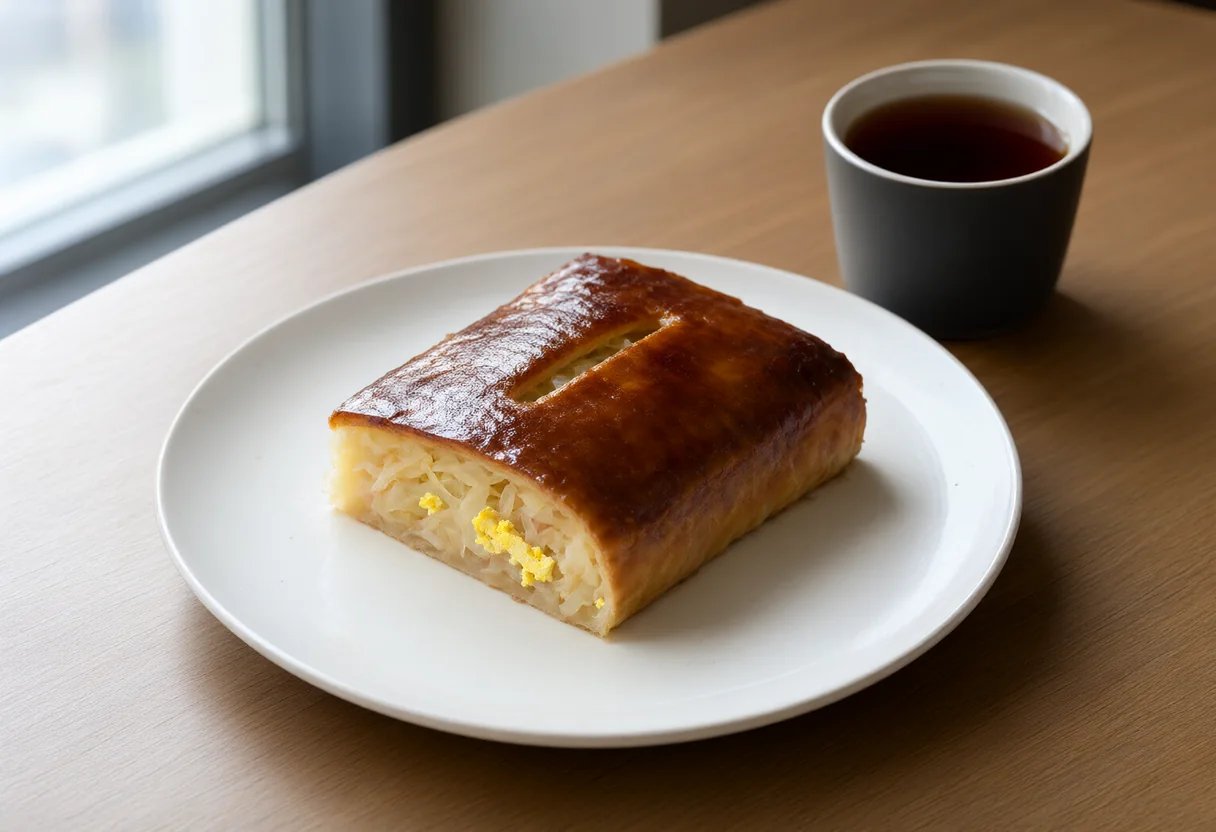
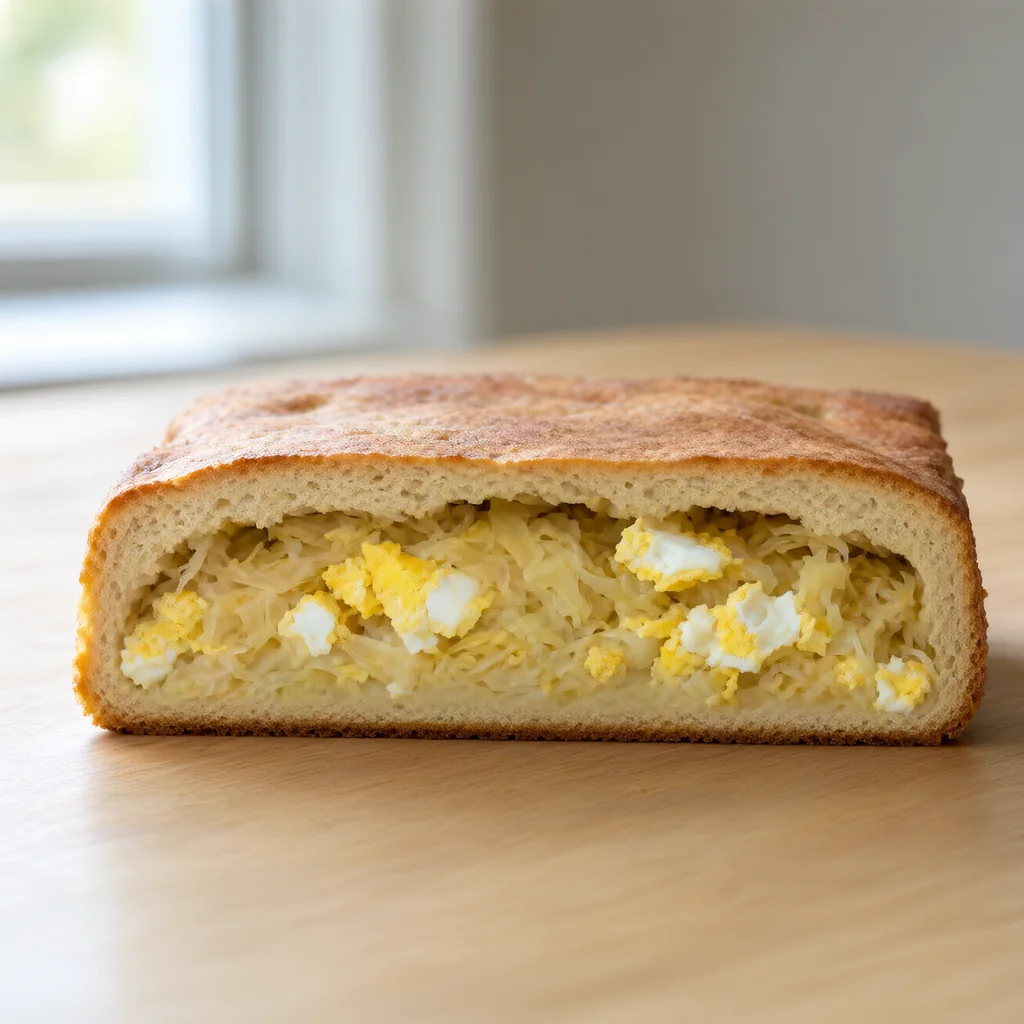
Ingredients
Serves 6. Prep 40 min, cook 65 min.
Dough
- 350 g (about 2 3/4 cups) all-purpose flour
- 170 g (a scant 3/4 cup) whole milk, warm (about 38 C)
- 1 large (about 50 g) egg
- 40 g (3 tbsp) butter, melted and cooled
- 1 tbsp (12 g) sugar
- 2/3 tsp (4 g) salt
- 2 tsp (6 g) instant dry yeast
Filling
- 550 g, shredded thin white cabbage, cored
- 1 small (about 80 g), chopped onion
- 2 tbsp (about 30 g) sunflower or vegetable oil
- 2 large (about 100 g), chopped eggs, hard-boiled and peeled
- scant 1 tsp (5 g) salt
- 1/2 tsp (1 g) black pepper, ground
Glaze
- 1 yolk (about 18 g) egg yolk
- 2 tsp (10 g) whole milk
Method
- Stir the warm milk, sugar and yeast together in a large bowl. Whisk in the egg, the melted butter and the salt. Add the flour and stir to a shaggy dough.
- Knead on a lightly floured counter for 8 to 10 minutes, until smooth, soft and just slightly tacky. Put it back in the bowl, cover with plastic wrap, and leave in a warm place for 60 minutes, until doubled.
- While the dough rises, boil the 2 filling eggs for 10 minutes, cool them in cold water and peel them. Then make the filling: heat the oil in a 30 cm skillet or wide pot over medium heat. Cook the onion for 4 minutes, until soft. Add the cabbage in two or three handfuls as it wilts, then the salt and pepper.
- Cook the cabbage over medium heat for 20 to 25 minutes, stirring now and then, until it is soft, golden at the edges, and no liquid is left in the pan. Spread it on a plate and let it cool to room temperature, about 30 minutes. Stir in the chopped eggs and taste for salt.
- Heat the oven to 190°C (375°F) with a rack in the middle. Line a 30 by 40 cm baking sheet with parchment.
- Punch down the dough and cut it into two equal pieces (about 315 g each). On a floured counter, roll one piece into a rectangle 22 by 34 cm and about 4 mm thick. Lift it onto the parchment.
- Spread the cooled filling over it, leaving a 2 cm border all round. Brush the border with water. Roll out the second piece to the same size and lay it over the filling.
- Press the edges together, then fold the border over and pinch it shut so nothing can leak. Cut 3 small slits in the top. Cover loosely and leave for 20 minutes while the oven finishes heating.
- Whisk the yolk and the 10 g of milk and brush the top of the pie with it.
- Bake for 35 to 40 minutes, until the top is deep golden and the bottom sounds hollow when tapped. Cool on the pan for 15 minutes, then cut into 6 pieces, 2 lengthwise by 3 across.
Nutrition facts
One portion is 180 g (a 6-serving recipe, 1080 g cooked). By portion, per 100 g or for any weight: calories in Cabbage Pie.
| Nutrient | Per portion | Per 100 g | % DV |
|---|
| Energy and macronutrients |
|---|
| Energy | 410 kcal | 228 kcal | 20% |
|---|
| Protein | 12.4 g | 6.9 g | 25% |
|---|
| Carbohydrate | 55.4 g | 30.8 g | 20% |
|---|
| of which sugars | 7.4 g | 4.1 g | |
|---|
| Fiber | 4.4 g | 2.5 g | 16% |
|---|
| Fat | 15.5 g | 8.6 g | 20% |
|---|
| of which saturated | 5.7 g | 3.2 g | 29% |
|---|
| of which monounsaturated | 4.1 g | 2.3 g | |
|---|
| of which polyunsaturated | 4.3 g | 2.4 g | |
|---|
| Cholesterol | 143 mg | 79.5 mg | 48% |
|---|
| Minerals |
|---|
| Sodium | 690 mg | 383 mg | 30% |
|---|
| Potassium | 327 mg | 181 mg | 7% |
|---|
| Calcium | 102 mg | 56.8 mg | 8% |
|---|
| Iron | 3.6 mg | 2 mg | 20% |
|---|
| Magnesium | 32 mg | 17.8 mg | 8% |
|---|
| Phosphorus | 181 mg | 101 mg | 14% |
|---|
| Zinc | 1.1 mg | 0.64 mg | 10% |
|---|
| Copper | 0.13 mg | 0.07 mg | 15% |
|---|
| Manganese | 0.6 mg | 0.33 mg | 26% |
|---|
| Selenium | 30.8 µg | 17.1 µg | 56% |
|---|
| Vitamins |
|---|
| Vitamin A (RAE) | 114 µg | 63.1 µg | 13% |
|---|
| Vitamin C | 34.5 mg | 19.2 mg | 38% |
|---|
| Vitamin D | 1.1 µg | 0.6 µg | 5% |
|---|
| Vitamin E | 2.7 mg | 1.5 mg | 18% |
|---|
| Vitamin K | 71.1 µg | 39.5 µg | 59% |
|---|
| Thiamin (B1) | 0.66 mg | 0.37 mg | 55% |
|---|
| Riboflavin (B2) | 0.56 mg | 0.31 mg | 43% |
|---|
| Niacin (B3) | 4.1 mg | 2.3 mg | 26% |
|---|
| Pantothenic acid (B5) | 1.2 mg | 0.65 mg | 23% |
|---|
| Vitamin B6 | 0.23 mg | 0.13 mg | 13% |
|---|
| Folate (DFE) | 252 µg | 140 µg | 63% |
|---|
| Vitamin B12 | 0.47 µg | 0.26 µg | 19% |
|---|
| Choline | 121 mg | 67 mg | 22% |
|---|
Calculated from the weights in the ingredient list with USDA FoodData Central (SR Legacy) values; only what is eaten counts (drained oil, rinds and similar are left out). Vitamin losses in cooking are not modelled, and “≥” marks a value that is a lower bound because the table has no figure for some ingredients. % DV uses the FDA reference values for adults. Real dishes vary with ingredients and portion size.
People who log cabbage pie in Flog average about 206 kcal per 100 g, against 228 kcal per 100 g here.