Ingredients
Serves 4. Prep 25 min, cook 100 min.
Broth
- 350 g, one thick cross-cut slice beef shank, bone-in
- 720 ml (720 g) water, cold
- 1 leaf bay leaf
- 1/2 tsp (1 g) black pepper, ground
- 1 1/2 tsp (8 g), used in two parts salt
Vegetables
- 1 small (about 120 g), cut into 1.5 cm cubes potato
- 120 g, shredded 5 mm thin green cabbage
Zazharka (sauteed vegetables)
- 1 medium (about 150 g peeled), coarsely grated beet, peeled
- 1 medium (about 60 g), coarsely grated carrot
- 1 small (about 80 g), diced 1 cm onion
- 1 tbsp (14 g) sunflower or vegetable oil
- 4 tsp (20 g) tomato paste
- 2 tsp (10 g) white wine vinegar or apple cider vinegar
- 1 tsp (4 g) granulated sugar
To finish
- 2 cloves (6 g), minced garlic
- a small handful (6 g), chopped fresh dill
To serve
Method
- Put the beef and the 720 ml of cold water in a 3-liter pot. Bring to a boil over high heat, then skim off the gray foam for about 5 minutes.
- Add the bay leaf, pepper and 4 g (a scant 1 tsp) of the salt. Lower the heat so the water barely bubbles, set the lid ajar and cook for 75 minutes, until the meat pulls easily from the bone. Turn the meat once if it is not fully covered.
- While the beef cooks, prepare the vegetables: grate the beet and carrot, dice the onion, cube the potato, shred the cabbage and mince the garlic.
- Lift the beef out onto a board. Cut the meat off the bone into 2 cm pieces, discard the bone, gristle and loose fat, and return the meat to the pot.
- Heat the oil in a 24 cm skillet over medium heat. Cook the onion for 4 minutes until soft, add the carrot and cook 3 minutes, then add the beet, vinegar and sugar and cook 5 minutes, stirring often. The vinegar keeps the beet red.
- Stir in the tomato paste and 3 tbsp of the broth. Cook for 2 minutes, stirring, until the paste darkens slightly.
- Bring the broth to a simmer. Add the potato and cook for 8 minutes. Add the cabbage and cook for 5 minutes.
- Scrape the sauteed vegetables into the pot. Add the remaining 4 g of salt, cover and simmer for 10 minutes, until the potato is tender and the beet is soft but not mushy.
- Stir in the garlic and half of the dill. Turn off the heat, cover and leave for 15 minutes. Taste; add a few drops of vinegar if it is flat, or a pinch of salt.
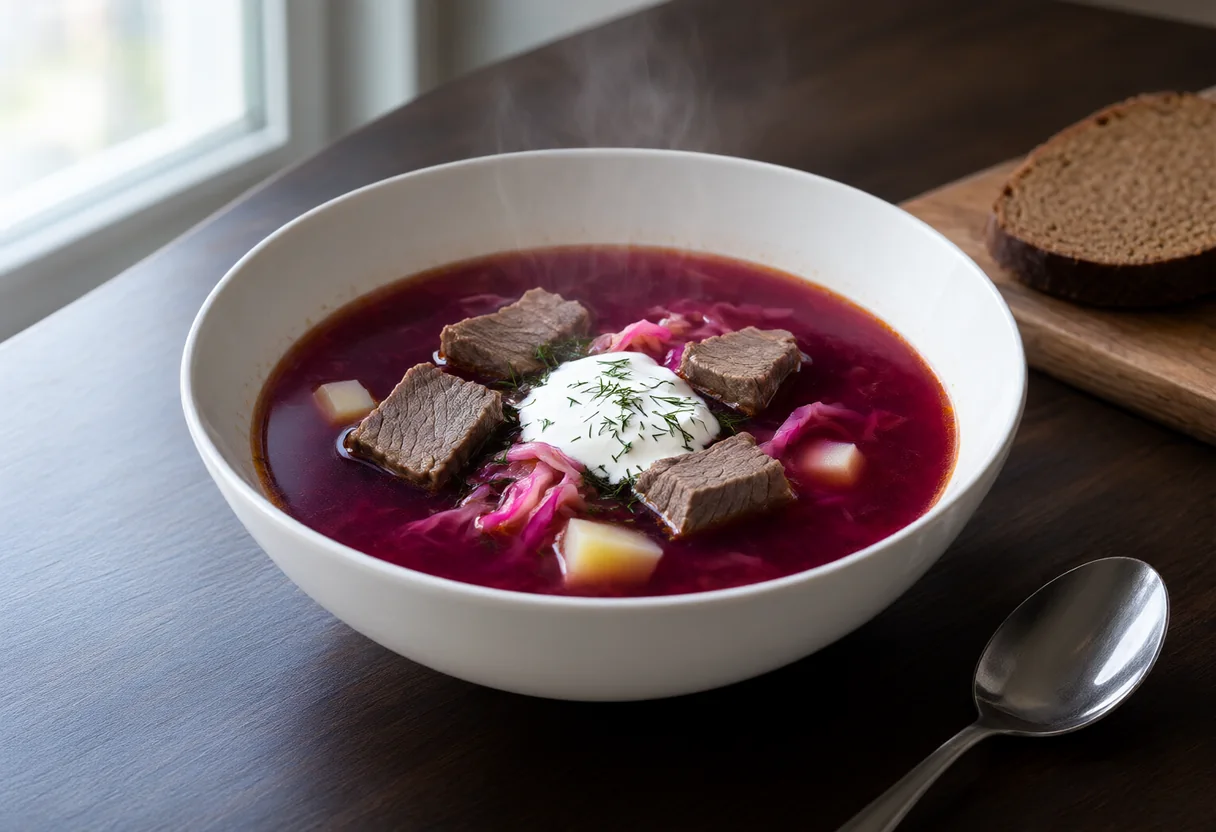
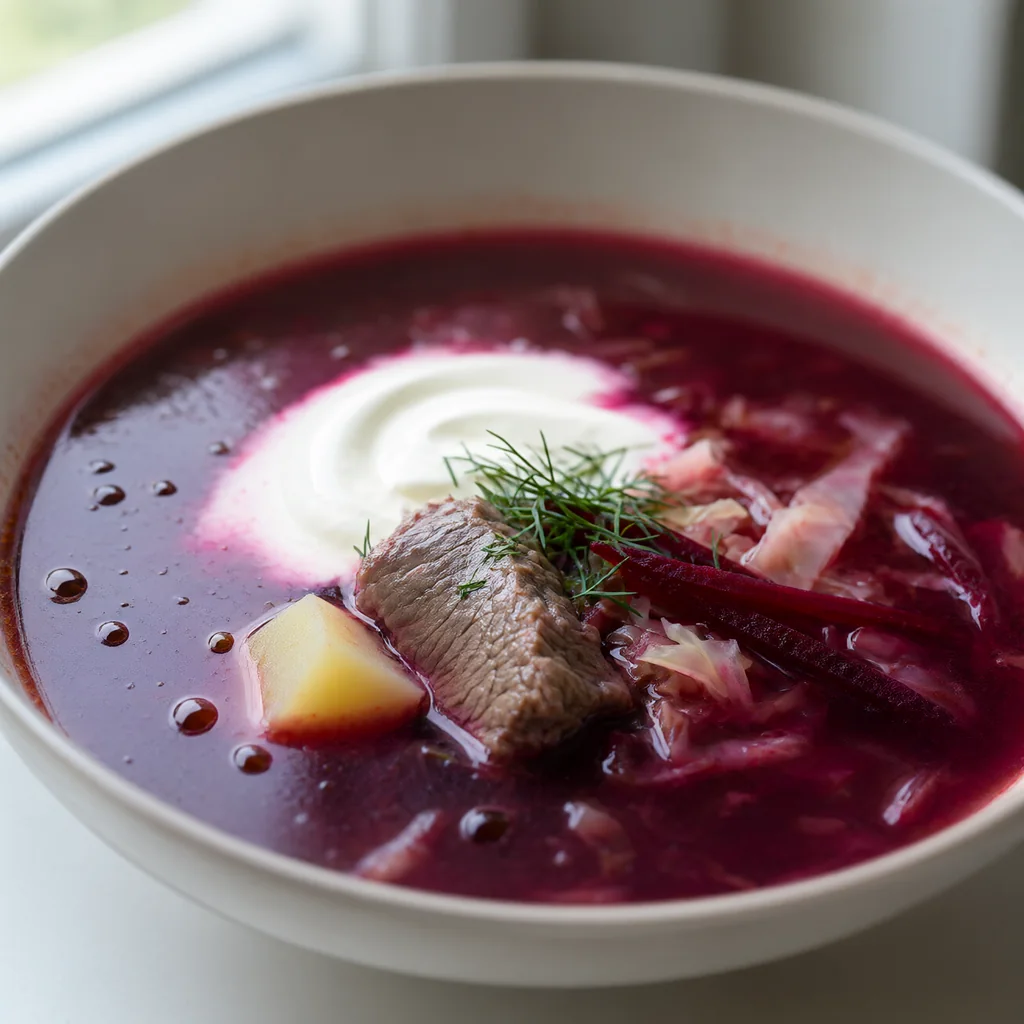
- Ladle 350 g into each bowl. Top with 1 tbsp (15 g) of sour cream and the rest of the dill.
Nutrition facts
One portion is 350 g (a 4-serving recipe, 1400 g cooked). By portion, per 100 g or for any weight: calories in Borscht.
| Nutrient | Per portion | Per 100 g | % DV |
|---|
| Energy and macronutrients |
|---|
| Energy | 213 kcal | 60.8 kcal | 11% |
|---|
| Protein | 16.5 g | 4.7 g | 33% |
|---|
| Carbohydrate | 16.8 g | 4.8 g | 6% |
|---|
| of which sugars | 7.5 g | 2.2 g | |
|---|
| Fiber | 3.6 g | 1 g | 13% |
|---|
| Fat | 9.1 g | 2.6 g | 12% |
|---|
| of which saturated | 2.8 g | 0.79 g | 14% |
|---|
| of which monounsaturated | 2.5 g | 0.72 g | |
|---|
| of which polyunsaturated | 2.6 g | 0.74 g | |
|---|
| Cholesterol | 33.7 mg | 9.6 mg | 11% |
|---|
| Minerals |
|---|
| Sodium | 882 mg | 252 mg | 38% |
|---|
| Potassium | 711 mg | 203 mg | 15% |
|---|
| Calcium | 73 mg | 20.8 mg | 6% |
|---|
| Iron | 2.5 mg | 0.71 mg | 14% |
|---|
| Magnesium | 38.4 mg | 11 mg | 9% |
|---|
| Phosphorus | 202 mg | 57.7 mg | 16% |
|---|
| Zinc | 4.9 mg | 1.4 mg | 45% |
|---|
| Copper | 0.18 mg | 0.05 mg | 20% |
|---|
| Manganese | 0.37 mg | 0.11 mg | 16% |
|---|
| Selenium | 12.9 µg | 3.7 µg | 23% |
|---|
| Vitamins |
|---|
| Vitamin A (RAE) | 156 µg | 44.5 µg | 17% |
|---|
| Vitamin C | 20.9 mg | 6 mg | 23% |
|---|
| Vitamin D | 0 µg | 0 µg | 0% |
|---|
| Vitamin E | 1.9 mg | 0.54 mg | 13% |
|---|
| Vitamin K | 26.8 µg | 7.7 µg | 22% |
|---|
| Thiamin (B1) | 0.14 mg | 0.04 mg | 12% |
|---|
| Riboflavin (B2) | 0.23 mg | 0.07 mg | 18% |
|---|
| Niacin (B3) | 4.5 mg | 1.3 mg | 28% |
|---|
| Pantothenic acid (B5) | 0.59 mg | 0.17 mg | 12% |
|---|
| Vitamin B6 | 0.51 mg | 0.14 mg | 30% |
|---|
| Folate (DFE) | 74.8 µg | 21.4 µg | 19% |
|---|
| Vitamin B12 | 2.1 µg | 0.62 µg | 90% |
|---|
| Choline | 16.5 mg | 4.7 mg | 3% |
|---|
Calculated from the weights in the ingredient list with USDA FoodData Central (SR Legacy) values; only what is eaten counts (drained oil, rinds and similar are left out). Vitamin losses in cooking are not modelled, and “≥” marks a value that is a lower bound because the table has no figure for some ingredients. % DV uses the FDA reference values for adults. Real dishes vary with ingredients and portion size.
People who log borscht in Flog average about 60.4 kcal per 100 g, against 60.8 kcal per 100 g here.