
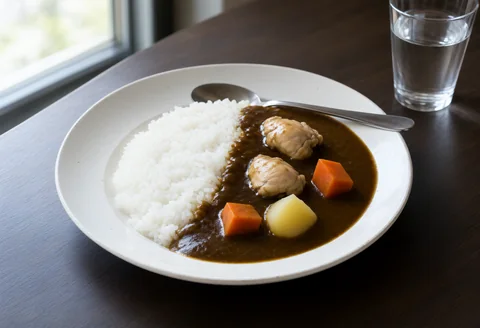
Calories in Japanese Curry Rice
Also called Kare Raisu, Curry Rice
554 kcal
in 1 plate as served · 465 g
119 kcal per 100 g
- Protein 15%
- Carbs 72%
- Fat 13%
Calculated from our Japanese Curry Rice recipe: 8 ingredients weighed, USDA values. How
By portion
| Portion | Weight | kcal | Protein | Carbs | Fat |
|---|---|---|---|---|---|
| 1 plate as served | 465 g | 554 | 20.2 | 97.5 | 8.1 |
| 100 g | 100 g | 119 | 4.3 | 21 | 1.7 |
Where the calories come from
kcal in 1 plate, by ingredient of our recipe
- Japanese short-grain rice34061%
- chicken thighs6712%
- Japanese curry roux6412%
- vegetable oil316%
- potato285%
- everything else244%
Next to other main dishes in our recipes
kcal per 100 g
- Jareesh122
- Japanese Curry Rice119
- Beef Bourguignon115
- Chicken Kebab115
- Grilled Chicken with Rice115
- Dal and Chickpea Curry with Rice112
Vitamins and minerals
1 plate as served gives 52% of the Daily Value of manganese, 41% of the Daily Value of sodium, 40% of the Daily Value of protein, 40% of the Daily Value of copper, 37% of the Daily Value of niacin, 34% of the Daily Value of Vitamin B6.
Show all 33 nutrients, per 1 plate and per 100 g
| Nutrient | Plate | 100 g | % DV |
|---|---|---|---|
| Energy and macronutrients | |||
| Energy | 554 kcal | 119 kcal | 28% |
| Protein | 20.2 g | 4.3 g | 40% |
| Carbohydrate | 97.5 g | 21 g | 35% |
| of which sugars | ≥ 3.1 g | ≥ 0.67 g | |
| Fiber | 2.6 g | 0.56 g | 9% |
| Fat | 8.1 g | 1.7 g | 10% |
| of which saturated | 1.9 g | 0.41 g | 9% |
| of which monounsaturated | 2.6 g | 0.55 g | |
| of which polyunsaturated | 2.8 g | 0.6 g | |
| Cholesterol | 52.2 mg | 11.2 mg | 17% |
| Minerals | |||
| Sodium | 935 mg | 201 mg | 41% |
| Potassium | 545 mg | 117 mg | 12% |
| Calcium | 56.3 mg | 12.1 mg | 4% |
| Iron | 1.9 mg | 0.4 mg | 10% |
| Magnesium | 57.5 mg | 12.4 mg | 14% |
| Phosphorus | 271 mg | 58.3 mg | 22% |
| Zinc | 2.4 mg | 0.51 mg | 22% |
| Copper | 0.36 mg | 0.08 mg | 40% |
| Manganese | 1.2 mg | 0.26 mg | 52% |
| Selenium | 14 µg | 3 µg | 25% |
| Vitamins | |||
| Vitamin A (RAE) | 214 µg | 46 µg | 24% |
| Vitamin C | 7.8 mg | 1.7 mg | 9% |
| Vitamin D | 0 µg | 0 µg | 0% |
| Vitamin E | ≥ 0.56 mg | ≥ 0.12 mg | 4% |
| Vitamin K | ≥ 12.1 µg | ≥ 2.6 µg | 10% |
| Thiamin (B1) | 0.21 mg | 0.04 mg | 17% |
| Riboflavin (B2) | 0.26 mg | 0.06 mg | 20% |
| Niacin (B3) | 5.9 mg | 1.3 mg | 37% |
| Pantothenic acid (B5) | 1.5 mg | 0.32 mg | 29% |
| Vitamin B6 | 0.59 mg | 0.13 mg | 34% |
| Folate (DFE) | 34 µg | 7.3 µg | 8% |
| Vitamin B12 | 0.46 µg | 0.1 µg | 19% |
| Choline | ≥ 38.2 mg | ≥ 8.2 mg | 7% |
“–” means USDA has no value for this nutrient in some ingredients. % DV is for the portion, FDA adult reference values.
Questions
How many calories are in 100 g of Japanese Curry Rice?
119 kcal, with 4.3 g of protein, 21 g of carbohydrate and 1.7 g of fat. Calculated from our recipe, 1,860 g cooked for 4 portions.
Where do the calories in Japanese Curry Rice come from?
In our recipe most of the energy comes from Japanese short-grain rice (61%), chicken thighs (12%) and Japanese curry roux (12%).
How much protein is in a portion of Japanese Curry Rice?
20.2 g in 1 plate as served, 465 g, or 4.3 g per 100 g.
Where these numbers come from
Calculated by Flog from our Japanese Curry Rice recipe: every ingredient is weighed in grams and matched to USDA FoodData Central, SR Legacy; only what is eaten counts. The recipe makes 1,860 g cooked, 4 portions of 465 g. Vitamin losses in cooking are not modelled, and “≥” marks a lower bound where USDA has no figure for some ingredients. A restaurant or packaged japanese curry rice can differ a lot: oil, portion size and recipe change the number.
Or just take a photo
Flog works out the calories, macros and 25+ vitamins and minerals of a whole plate from one picture. Free on iPhone, no account.